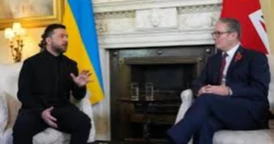
Ukrainian President Volodymyr Zelenskyy on Friday called on the United States to widen its sanctions on Russia’s oil industry — extending restrictions from two major firms to the entire sector — and appealed for long-range missiles to help counter Moscow’s attacks.
Zelenskyy traveled to London to meet with over 20 European leaders who have pledged ongoing military support to Ukraine in the event of a ceasefire, aimed at deterring future Russian aggression. The summit, hosted by British Prime Minister Keir Starmer, sought to tighten pressure on Russian President Vladimir Putin following new U.S. and European sanctions targeting Russia’s key oil and gas revenues.
Talks also focused on protecting Ukraine’s energy infrastructure from relentless Russian drone and missile strikes as winter nears, strengthening air defenses, and potentially supplying Kyiv with long-range weaponry capable of striking deep into Russian territory. Zelenskyy urged Washington to provide Tomahawk missiles — an option U.S. President Donald Trump has reportedly considered.
Zelenskyy praised Trump’s latest move to impose oil sanctions, calling it “a big step,” but stressed that pressure should extend “not only to Rosneft and Lukoil, but to all Russian oil companies.” He noted that Ukraine is also conducting drone and missile operations targeting Russia’s energy assets.
Trump, meanwhile, has delayed a planned meeting with Putin in Budapest, describing it as potentially “a waste of time.” Putin has resisted calls for peace talks, insisting Russia’s invasion was justified and exploiting loopholes in Western sanctions.
In a related development, Russian envoy Kirill Dmitriev announced he had arrived in the U.S. for talks with officials, including U.S. envoy Steve Witkoff, about investment and economic cooperation — a meeting first reported by Axios. Dmitriev has long served as a key intermediary between the Kremlin and the Trump administration on Ukraine and other issues.
Western leaders expressed growing frustration with Putin’s stance. “He’s again rejected talks and is demanding Ukrainian territory he couldn’t take by force,” Starmer said at a joint press conference with Zelenskyy. NATO Secretary-General Mark Rutte added that Putin is “running out of money, troops, and ideas.”
Leaders from Denmark, the Netherlands, and about 20 other nations joined the London talks, either in person or virtually, as part of the “Coalition of the Willing.”
Building a Reassurance Force
Ukraine’s allies are still debating their long-term commitments as the war — Europe’s largest since World War II — nears its fourth year. Key questions include funding Ukraine’s recovery, future security guarantees, and Washington’s ongoing role.
Officials discussed forming a “reassurance force” focused on air and naval support, rather than deploying Western ground troops. U.K. Defense Secretary John Healey said it would aim to “secure the skies and seas” and train Ukrainian forces.
Russia Reports Modest Gains
The war remains deadlocked. Russia’s Defense Ministry claimed its troops captured 10 Ukrainian villages in the past week as part of a slow push across Donetsk toward Dnipropetrovsk. Moscow also said it downed 111 Ukrainian drones overnight, while debris damaged civilian buildings.
Moscow Mayor Sergei Sobyanin reported three drones intercepted near the capital, disrupting flights at two airports. Meanwhile, Ukrainian officials said Russian shelling in Kherson killed two people and injured 22, while glide bomb strikes in Kharkiv wounded six. For the first time, Russia also launched glide bombs at the Odesa region — a “new and serious threat,” local officials warned.