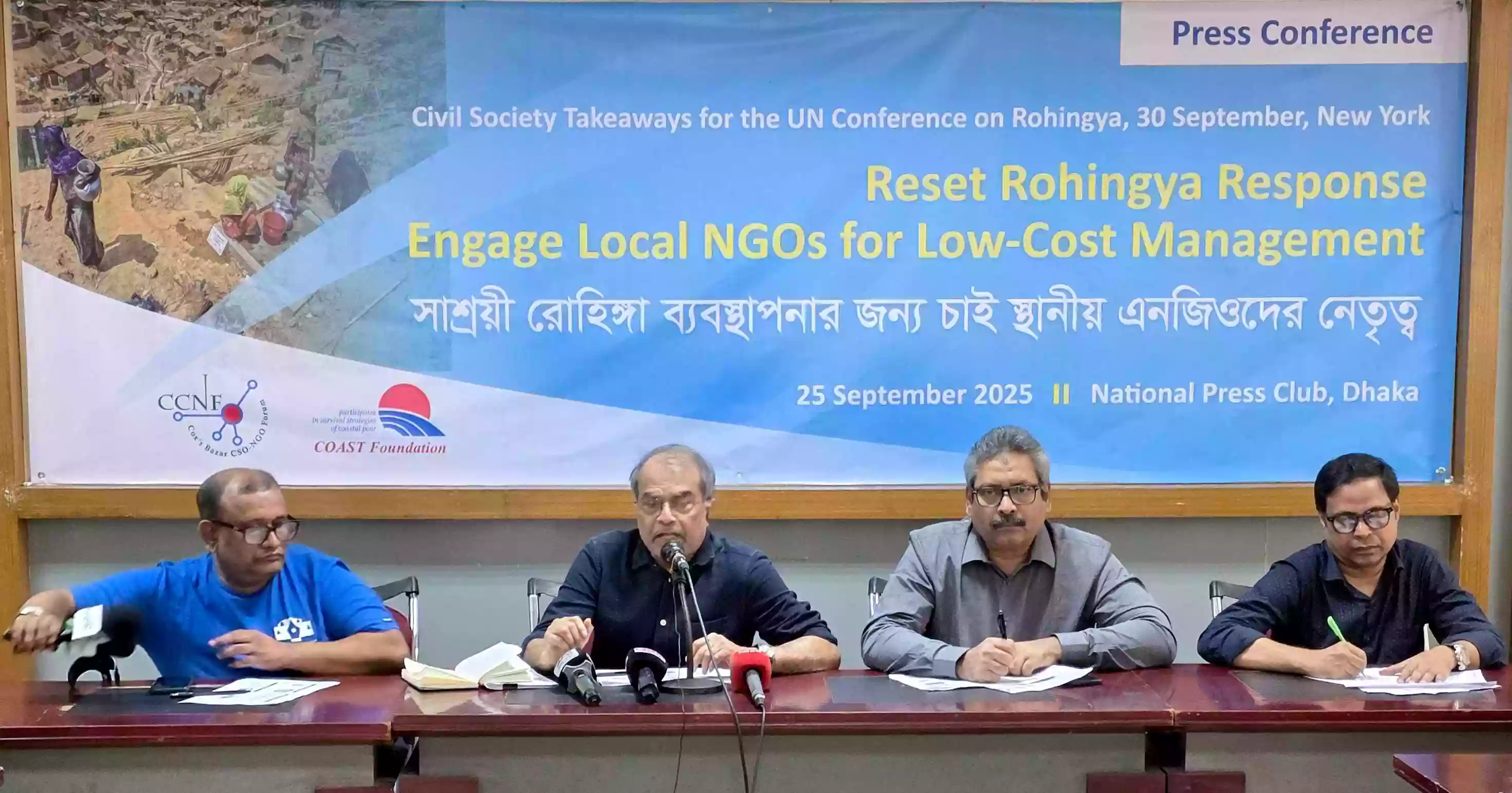
With the Rohingya crisis entering its eighth year amid a severe funding shortfall, advocacy groups on Thursday urged the international community and aid agencies to prioritise low-cost, locally-led operations in the Rohingya response.
The event, titled “Reset Rohingya Response: Engage Local NGOs for Low-Cost Management”, was organised by COAST Foundation and the Cox’s Bazar CSO-NGO Forum ahead of the UN Rohingya Conference scheduled for September 30 in New York.
Moderated by Mustafa Kamal Akanda and chaired by Rezaul Karim Chowdhury of COAST Foundation, the groups unveiled a study on the localisation of aid in the Rohingya response.
The study, presented by Shahinur Islam, highlighted a sharp disparity in funding flows and project approvals between international, national, and local NGOs, according to a press release.
According to the findings, from June to August 2025, 63 projects were approved in Rohingya camps. Of these, international NGOs secured a 44.4% approval rate, national NGOs 50.8%, while local NGOs received only 4.8%. In terms of funding, INGOs received 63.6%, national NGOs 33.9%, and local NGOs just 2.5%—despite being among the largest implementers.
The study also pointed out that management costs of UN agencies and INGOs consume around 70% of funds, leaving only 30% for actual programs, while local NGOs can deliver operations at significantly lower costs.
Speakers criticised the World Bank’s loan support to Bangladesh for Rohingya management, saying it contradicts humanitarian principles and burdens the country. Bangladesh has already increased its own funding by 263% this year compared to 2024, much of it financed by loans, the study noted.
Rezaul Karim said the aid system needs a reset, where UN agencies and INGOs play monitoring and technical support roles while local NGOs take the lead in designing and implementing low-cost operations.
Other speakers warned that the Rohingya population now outnumbers the host community in Ukhiya and Teknaf upazilas, raising tensions and security concerns. They stressed that Rohingyas should not be confined to dependency but rather engaged as human resources, with opportunities to connect to global markets and sustainable livelihoods.
The organisers urged world leaders, ahead of the UN Rohingya Conference, to ensure a shift toward locally-led, cost-effective responses that uphold humanitarian principles while easing the financial burden on Bangladesh.