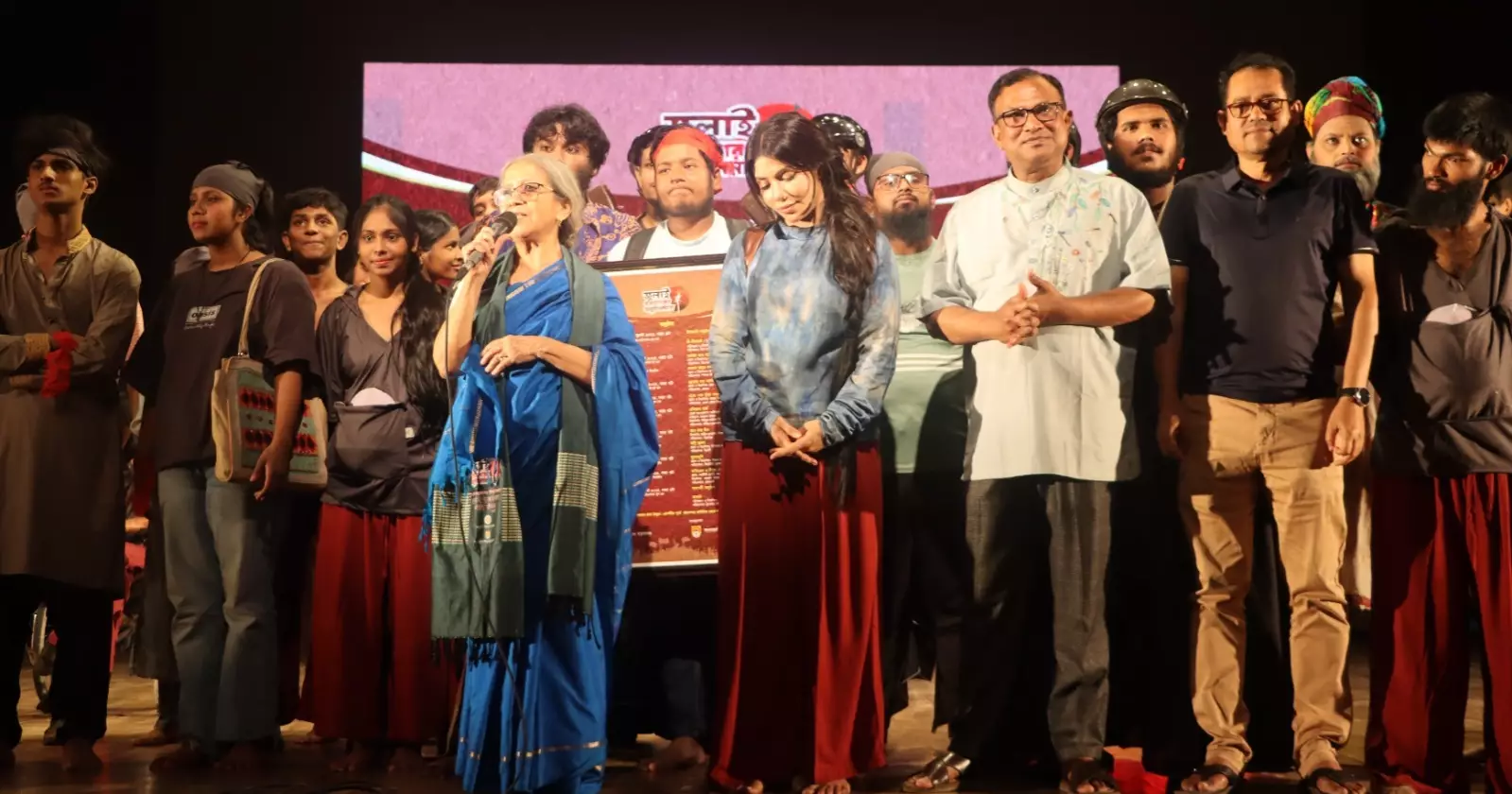
The nine-day July Renaissance Theatre Festival 2025, organised by Bangladesh Shilpakala Academy (BSA) with support from the Ministry of Cultural Affairs, concluded on Friday evening with the staging of the play ‘Aguni’ at the National Theatre Hall.
Inspired by the spirit of the 2024 Monsoon Revolution, the festival turned the theatre stage into a living document of history, blending political memory with cultural reflection.
The closing ceremony was attended by Fisheries and Livestock Ministry Adviser Farida Akhter as special guest. BSA Secretary and Acting Director General Mohammad Waress Hossain presided over the event, which was conducted by Theatre and Film Department Director Faez Zahir.
Held from July 31 to August 8, the festival featured 11 prominent theatre troupes presenting original productions rooted in the 2024 movement and contemporary social realities. More than 300 theatre practitioners participated in the event, which aimed not only to showcase theatrical creativity but also to inspire younger generations to reflect on cultural consciousness, democratic responsibilities, and ethical positions.
The festival opened with ‘Re-Revolt’ by Team Colours, directed by Naila Azad, and continued with productions including ‘Shubankar Haath Dhor-te Cheyechhilo’ (Teerondaj Repertory), ‘Deyal Jane Shob’ (Spondon Theatre Circle), ‘Droher Rokto Kodom’ (Aethera), ‘404: Naam Khunje Pawa Jai Ni’ (Fourth Wall Theatre), ‘Animal Farm’ (Rabindra Srijonkola University), ‘Ar Koto Din’ (Ontorjatra), ‘Agni Shrabon’ (Bhoirabi), ‘Mukhomukhi’ (Theatre Web), and ‘Byatikrom Ebong Niyom’ (Prachyanat).
The final production, ‘Aguni’, directed by Kazi Nowshaba Ahmed and staged by Together We Can, portrayed the journey of Nondini, a princess condemned for speaking the truth but transformed into a voice of resistance against injustice. The narrative intertwined political protest, human empathy, and a vision of a better world, supported by a large ensemble cast and an extensive creative team handling music, set design, puppetry, costumes, choreography, and production.
BSA officials said the festival positioned theatre as a language of protest, turning each scene and dialogue into a re-writing of history.