
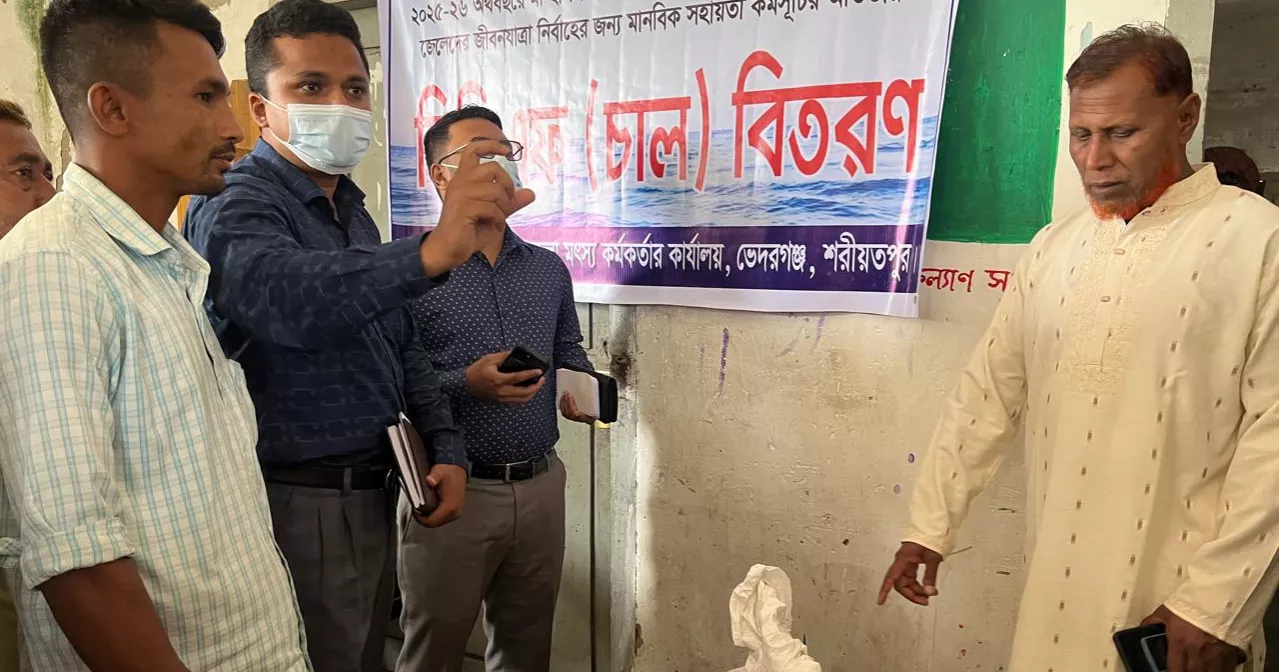
Allegations of irregularities have surfaced over the distribution of government rice to fishermen who refrained from catching mother hilsa during the fishing ban in Bhedarganj Upazila, Shariatpur.
Instead of the allotted 80 kilograms, many fishermen reportedly received 6 to 10 kilograms less, sparking concern in the locality.
The incident occurred on Tuesday at South Tarabunia Union Parishad, where accusations were raised against the local panel chairman, tag officer, secretary, and their associates for distributing less rice than allotted.
Under government directives to conserve juvenile hilsa and boost fish production, fishing—including hilsa—is prohibited from March 1 to April 30 across five protected areas. Registered fishermen are provided 80 kilograms of rice each through the VGF program of the Department of Fisheries. In Bhedarganj, 1,050 fishermen were entitled to receive the aid.
Victim fishermen reported that rice distribution began before the scheduled time and in reduced quantities. Rockib Majhi said, “I was supposed to get 80 kilograms but received only 70. When I asked, they said the rice stock was low. We are poor and cannot protest.”
Another beneficiary, Faisal Hossain, added, “I measured my portion at 72 kilograms. The chairman claimed the upazila sent less, but when journalists arrived, everyone received the full 80 kilograms.”
Upon learning of the irregularities, Bhedarganj Upazila Nirbahi Officer (UNO) Hafizul Haque sent Assistant Commissioner (Land) K.M. Rafsan Rabbi and Senior Fisheries Officer M.A. Imran to supervise distribution. They confirmed the discrepancy and ensured the remaining rice was distributed fairly.
Panel chairman Sekandar Khan denied the allegations, claiming the rice was correctly measured. UNO Hafizul Haque said a probe committee would investigate and take legal action if necessary.
Bhedarganj has a total of 15,818 registered fishermen, many of whom rely on government aid. Locals stress that irregularities not only reflect administrative failure but also injustice to vulnerable communities, and await visible action against those responsible.