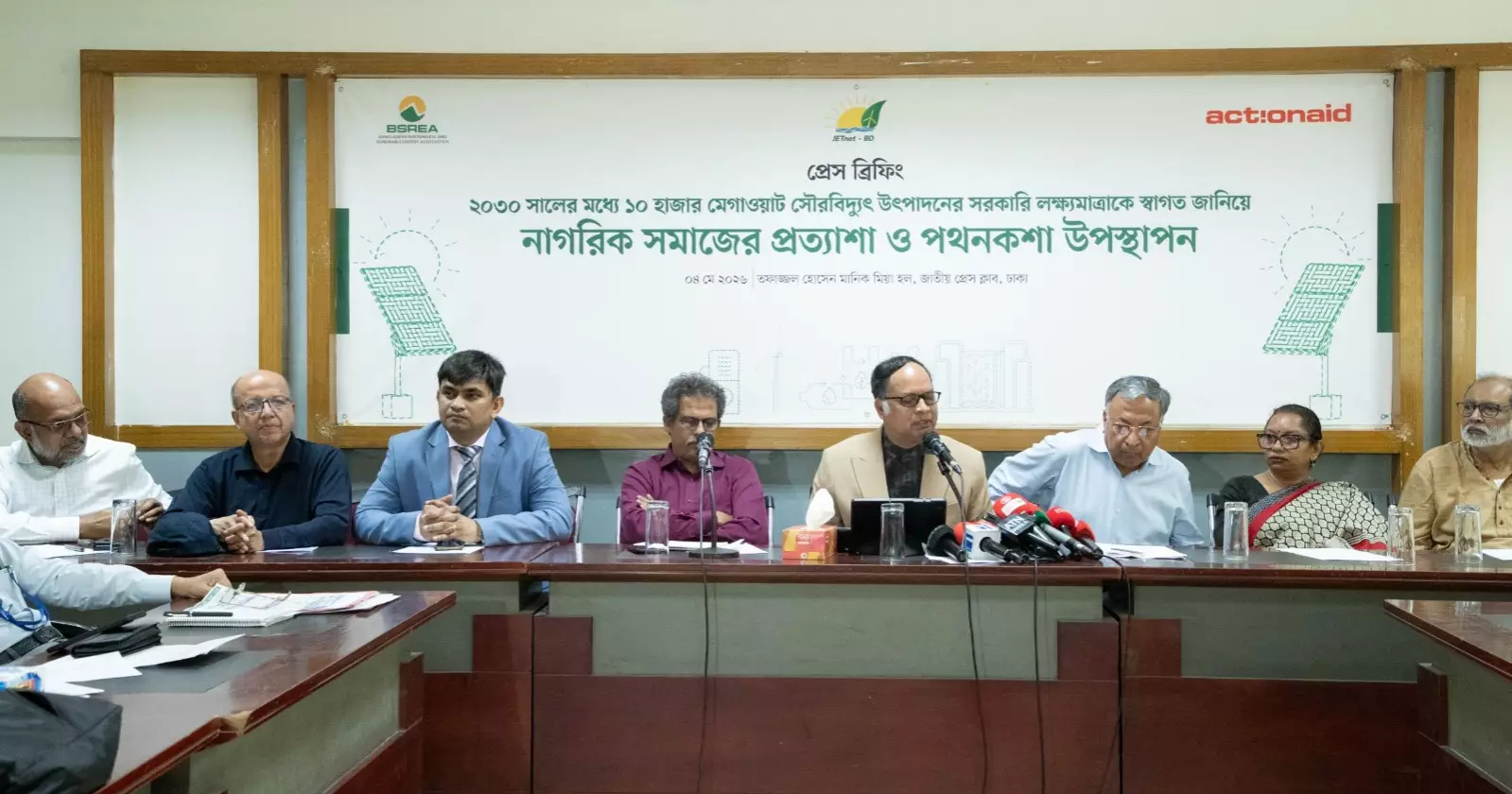
Energy experts and civil society leaders on Monday called on the government to slash import duties on solar equipment, streamline investor services and mobilise redirected fossil-fuel subsidies if Bangladesh is to achieve its target of generating 10,000 megawatts of solar power by 2030.
Speaking at a press briefing at the Jatiya Press Club, they described the target as ambitious yet achievable, warning that bureaucratic bottlenecks, high tariffs and a lack of grid modernisation remain the principal obstacles to a timely transition away from imported fossil fuels.
Solar power offers way out of energy trap: Hossain Zillur Rahman
The event was jointly organised by ActionAid Bangladesh, the Bangladesh Solar and Renewable Energy Association (BSREA) and the Just Energy Transition Network Bangladesh (JETnet-BD).
Energy expert Dr Ijaz Hossain said integrating 10,000 MW of solar capacity into the national grid could substantially reduce the country's expenditure on LNG and coal imports.
“Solar power is no longer an alternative, it is set to become the backbone of Bangladesh's energy system,” he said, stressing the need for battery storage systems to make surplus daytime generation available at night and to maintain grid stability.
Shafiqul Alam, Lead Energy Analyst at the Institute for Energy Economics and Financial Analysis, said thousands of megawatts could be unlocked simply by tapping rooftop space on garment factories and large industrial plants.
He argued that strengthening net metering policies would incentivise industrial owners to invest, reducing pressure on the public purse and cutting production costs.
Dipal Chandra Barua, Founder and Chairman of the Bright Green Energy Foundation, addressed concerns over land scarcity by highlighting the agro-voltaics model, under which shade-tolerant crops are cultivated beneath solar panels.
He also pointed to riverine char areas and floating solar projects as viable sites for large-scale generation.
Climate finance expert M Zakir Hossain Khan, Chief Executive of the Change Initiative, said reallocating even a fraction of the subsidies currently directed to fossil fuels could finance the solar push without recourse to foreign loans.
He cautioned that over-reliance on large, import-dependent projects posed a long-term risk to energy security, and said rooftop and irrigation-based solutions could deliver visible results within three to six months if there is adequate administrative will.
Mustafa Al Mahmud, President of BSREA, identified high import duties on solar panels and inverters as a leading deterrent, saying investors are further discouraged by lengthy multi-agency approval processes.
He called for a fast-track, one-stop service to facilitate renewable energy investment.
Lipi Rahman of JETnet-BD stressed that the gains from the 10,000 MW target must not accrue solely to large industrial players.
She called for the deliberate inclusion of marginalised women, smallholder farmers and micro-entrepreneurs to ensure the transition is equitable.
Experts concluded that the 2030 solar target is technically within reach but will require a coordinated, bureaucracy-free roadmap centred on grid modernisation, decentralised community-based systems and strong political commitment.