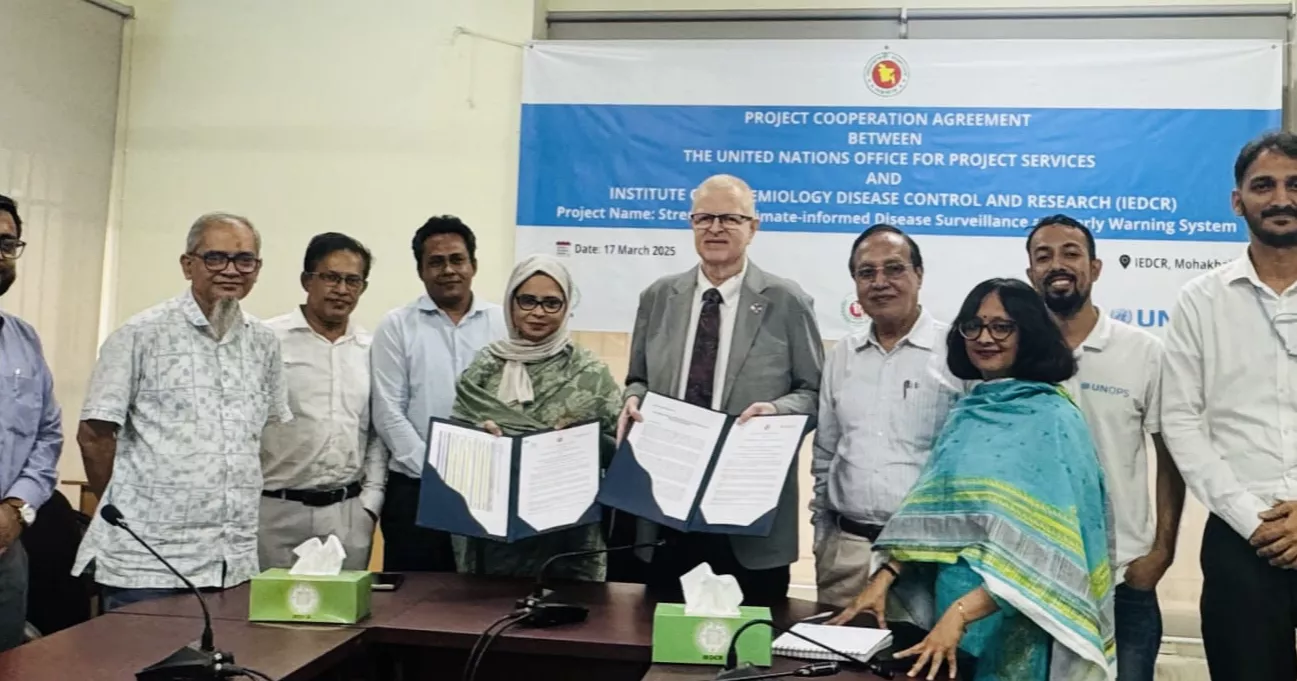
The Institute of Epidemiology Disease Control And Research (IEDCR), and the United Nations Office for Project Services (UNOPS) on Monday signed the project cooperation agreement on “Strengthen Climate-informed Disease Surveillance and Early Warning System” under the "Global Fund Climate Change & Health Fund for Bangladesh" at IEDCR.
The duration of the project will be one year with a total estimated budget of $1.6 million.
The signing ceremony was officiated by Dr Tahmina Shirin, Director of IEDCR, and Sudhir Muralidharan, Country Manager of UNOPS Bangladesh, who signed the document on behalf of their respective organisations.
IEDCR Director emphasized the importance of promoting climate resilience, health infrastructure and sustainable procurement practices on health, highlighting that this project will play a key role in achieving these goals.
"This project marks a significant step towards strengthening our healthcare infrastructure and emergency response capabilities, ensuring better preparedness and improved healthcare services for the people of Bangladesh, by IEDCR with the support from UNOPS, reinforcing Bangladesh’s commitment to global health safety and climate resilience," she said.
UNOPS Bangladesh Country Manager said, “At UNOPS, we are committed to supporting the government of Bangladesh in building sustainable and resilient health systems. This agreement with UNOPS and IEDCR, made possible by funding from the Global Fund, reflects our shared vision of improving the healthcare system and ensuring that early warning systems and disease surveillance mechanisms are strengthened."
As the primary implementation partner of this project, the National Malaria Elimination Program, Communicable Disease Control program and Directorate General of Health Services will offer strategic direction to ensure the successful delivery of intended outcomes while facilitating coordination among relevant parties.
The Global Fund Climate Change & Health Fund will focus on developing climate-resilient healthcare infrastructure, integrating climate adaptation strategies into health services, and strengthening early warning systems for climate-induced diseases.
The initiative is expected to benefit millions of people across Bangladesh, particularly those in climate-vulnerable regions.
This initiative will promote health, wellbeing & climate resilience, enhance Bangladesh’s global contributions, and align with national and international commitments, including SDG 3, 5, 13, 10, 16, and 17.
The event was attended by senior representatives from Institute of Epidemiology Disease Control and Research (IEDCR), National Malaria Elimination Program (NMEP), Communicable Disease Control Program (CDC), Directorate General of Health Services (DGHS) and representatives from UNOPS.