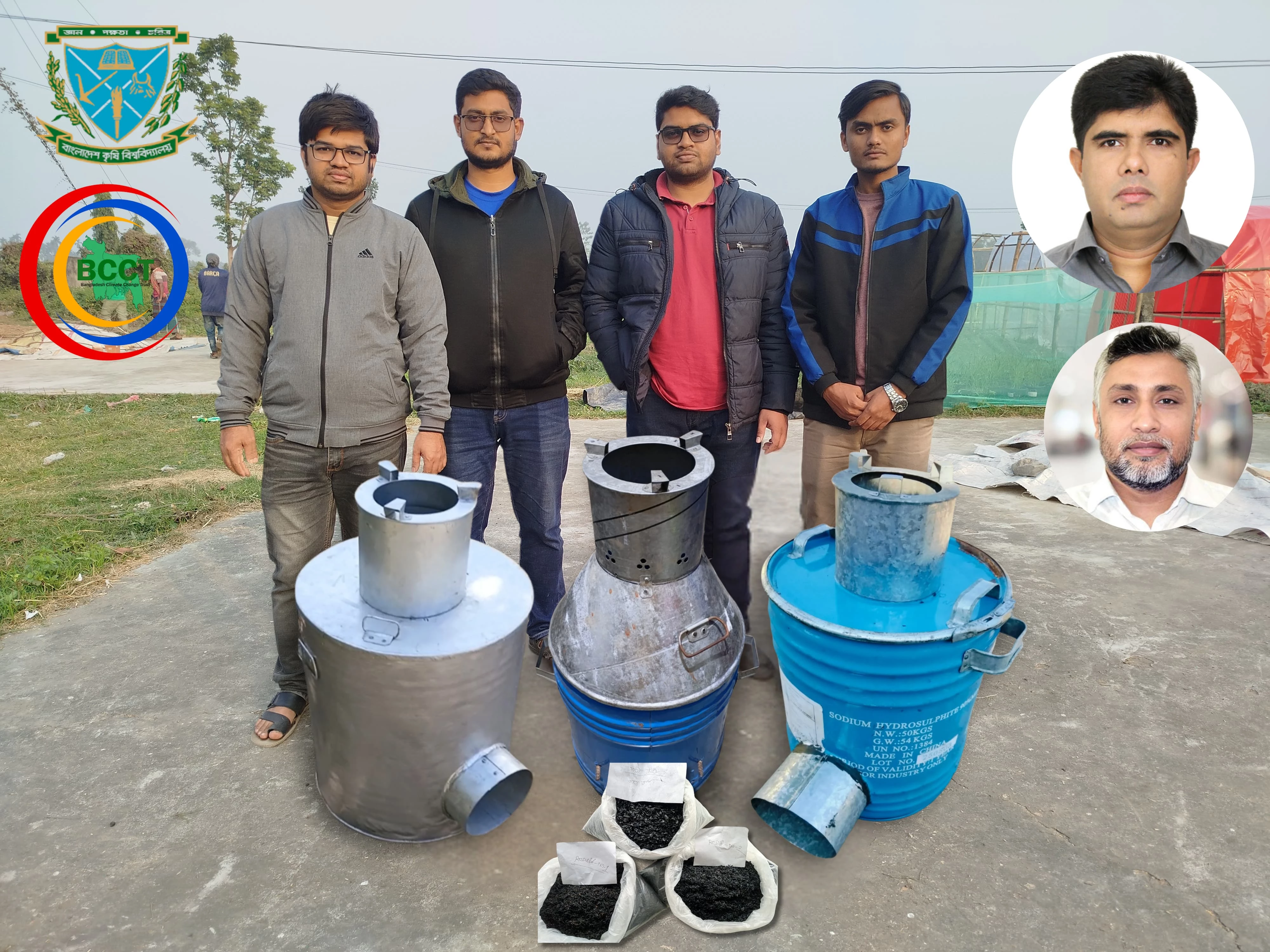
A team of researchers from Bangladesh Agricultural University (BAU) has developed a low-cost, environment-friendly stove named the “BAU Biochar Stove,” which can be used simultaneously for cooking and biochar (organic charcoal) production.
The innovation has been developed with funding from the Bangladesh Climate Change Trust (BCCT) under the leadership of Prof. Md. Shahiduzzaman of the Department of Parasitology, BAU. The research team also includes Dr. Mohammad Mofizur Rahman Jahangir of the Department of Soil Science, Faculty of Veterinary Sciences student Md. Ashikuzzaman, also UNB's campus correspondent, Mohammad Sohan, PhD student Sumon Chandro Mohanto, and Netrokona Government College student Md. Al Nur Tarak. The project is currently being implemented at the field level in Mithapukur upazila of Rangpur district.
According to the researchers, the stove allows high-temperature cooking at 300 to 600°C while simultaneously producing biochar for climate-smart crop and livestock production. It is particularly suitable for households that regularly use firewood, coal, or similar fuels for cooking. While conventional biochar production is relatively expensive, the newly developed stove enables biochar production at a very low cost and is farmer-friendly.
Explaining the scientific aspect, Project Director Dr. Md. Shahiduzzaman told UNB that biochar is a special form of charcoal produced at high temperatures in the absence of oxygen.
He said the stove was developed following scientific principles, and quality analysis of the produced biochar showed a high inorganic carbon content, making it high-quality biochar with strong carbon sequestration potential. He added that the use of this biochar would help reduce methane emissions from agricultural land, livestock, and manure, thereby contributing to climate-friendly crop and livestock production.
Dr. Jahangir said laboratory analysis revealed that the biochar produced from the stove contains high inorganic carbon along with other essential components. Farmers can use the stove for daily cooking and simultaneously produce biochar to apply to their fields along with fertilizers.
He further noted that biochar is globally recognized as an effective method for improving soil quality. Although its use has only recently begun in Bangladesh, high production costs have been a major barrier. The newly developed cost-effective stove automatically produces biochar during cooking, addressing this challenge.
Md. Ashikuzzaman said the stove was initially designed using software, its feasibility was tested, and it was developed using locally available materials at a very low cost. Observations showed that cooking with the stove requires less time and fuel compared to conventional methods. Feedback from farmers also confirmed these benefits, as they are producing quality biochar free of cost through their daily cooking.
Abdul Hamid, a trial user from Bhabakhali in Mymensingh, said the stove is particularly suitable for char areas as well as urban and rural regions due to its fuel efficiency and reduced cooking time. He expressed confidence that the stove would gain popularity across Bangladesh.
Another user, Parvin Begum from Mithapukur in Rangpur, said she cooks daily meals for a family of seven to eight members using the stove. “Now I am using this stove instead of my traditional one,” she said, adding that cooking now takes much less time and requires a significantly smaller amount of firewood than before.