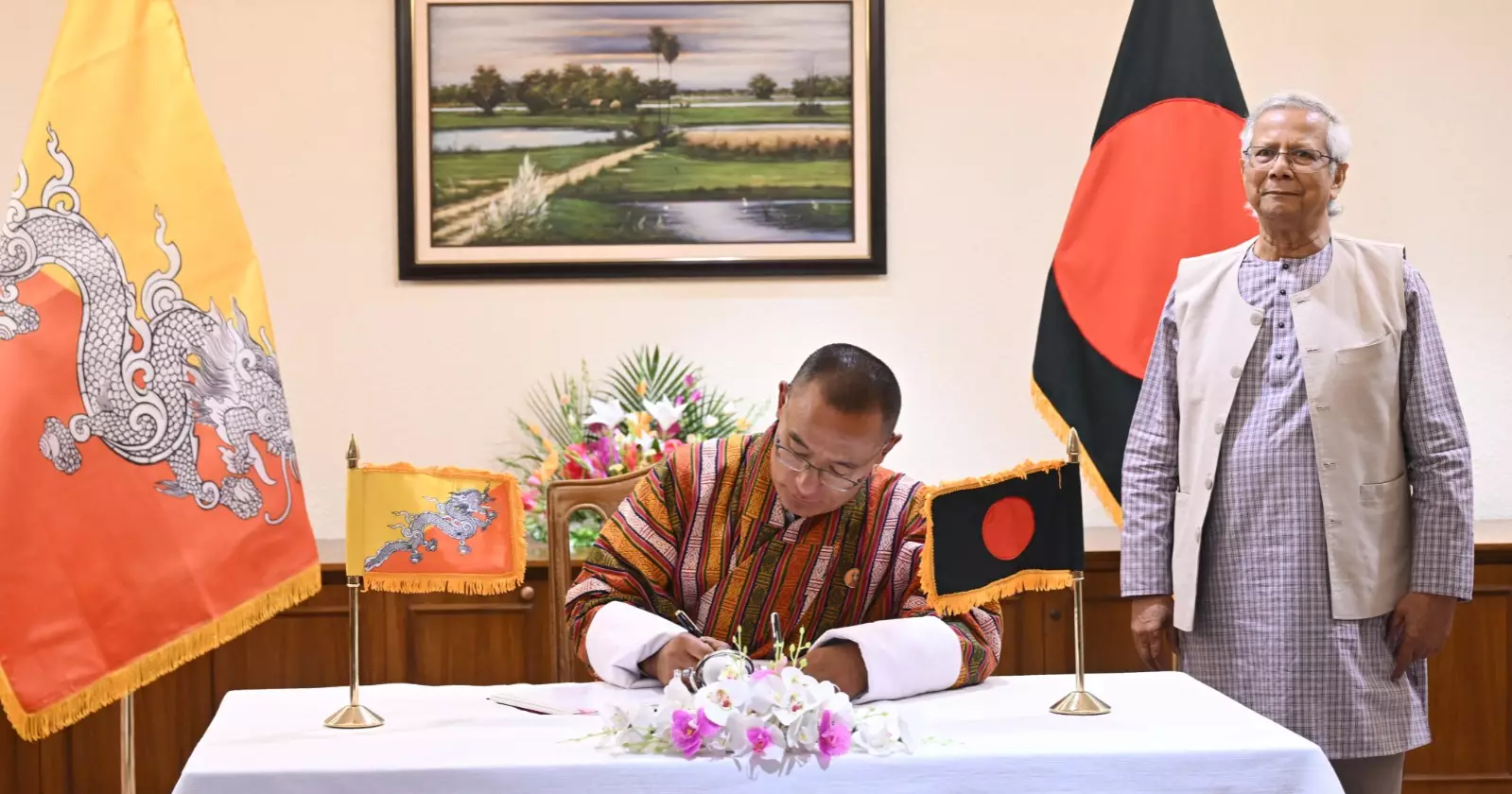
Chief Adviser Prof Muhammad Yunus on Saturday described Bhutan as a “very important friend of Bangladesh” and highlighted its important role in Dhaka’s vision for regional trade and economic cooperation.
“Our future is to build together. Geography and nature have brought us together. Our destiny is to build the future together,” the Chief Adviser said, noting the shared history between the two nations.
In response, visiting Prime Minister of Bhutan Tshering Tobgay said Bhutan and Bangladesh enjoy warm and excellent relations.
He described Bangladesh as the source of Bhutan’s “spiritual heritage," recalling that Bangladeshi monks carried Buddhism to the Himalayan region during the Middle Ages.
The two leaders held bilateral talks on Saturday at the Chief Adviser’s Office in Tejgaon, Dhaka.
They discussed a wide range of issues covering the entire spectrum of Bangladesh–Bhutan relations, including trade, energy, education, tourism, internet cooperation, transport, healthcare, environment, water resources, investment and aviation.
Prime Minister Tobgay arrived at the Chief Adviser’s Office at 3:15 pm.
The leaders first held a 30-minute tête-à-tête, followed by nearly an hour of formal bilateral discussions, Chief Adviser’s Deputy Press Secretary Abul Kalam Azad Majumder told UNB.
The visiting Prime Minister stressed the need for deeper trade and economic cooperation. “If we have to prosper, we must prosper together,” he said.
Both sides discussed a plan to formally launch discussions on a bilateral free trade agreement (FTA).
Bangladesh and Bhutan previously concluded a preferential trade agreement in 2020.
Prime Minister Tobgay said Thimphu wants to sign the FTA “as quickly as possible” and hopes Bhutan will become the first country to conclude a free trade deal with Bangladesh.
He said the FTA would boost trade and investment between the two nations.
The Chief Adviser emphasized Bangladesh’s high priority on facilitating the movement of goods to and from Bhutan and said he had instructed officials to clear Bhutanese containers as quickly as possible.
The two countries also agreed to establish a joint working group to promote two-way tourism.
Recalling the contribution of Buddhist monks from Bengal, Professor Yunus said he hopes to see more Bhutanese tourists exploring Bangladesh’s Buddhist heritage.
Prof Yunus also noted that Bangladesh is building a 1,000-bed hospital and a medical college in the northern district of Nilphamari, and invited Bhutanese nationals to avail themselves of healthcare services and medical education at the upcoming facility.
Following the formal talks, Bangladesh and Bhutan signed two memoranda of understanding — one on healthcare services and the other on the trade of international internet bandwidth. Both leaders witnessed the signing ceremony.
The Chief Adviser expressed hope that more Bangladeshi doctors and healthcare workers will now be able to work in Bhutan, particularly in the upcoming new economic city of Gelephu, now under development in the Himalayan kingdom.
Under the internet bandwidth agreement, Bhutan will import bandwidth from Bangladesh. Foreign Adviser Touhid Hossain, who attended the meeting, said Dhaka hopes the export will “strengthen Bhutan’s digital connectivity, and reduce the digital divide.”
Bangladesh also announced an increased number of seats for Bhutanese students in Bangladeshi medical colleges and earmarked seats in BUET. The Bhutanese Prime Minister shared that many of Bhutan’s top doctors are alumni of Bangladeshi medical institutions.
Prime Minister Tobgay said Bhutan is developing a major economic hub, the Gelephu Mindfulness City, and sought Bangladesh’s cooperation, including space in Narayanganj for loading and unloading Bhutanese cargo.
Bangladesh, Bhutan sign 2 MoUs on internet connectivity, health cooperation
The leaders also discussed prospects for Bangladesh to import hydropower from Bhutan, including the possibility of a trilateral agreement involving India to facilitate electricity trade.
The Chief Adviser reiterated that building a foundation for a shared, long-term future with all neighbours is a key priority of the interim government.
“Your visit will be a building block for this shared future,” Prof Yunus said, praising Prime Minister Tobgay’s efforts to make Bhutan the world’s first carbon-negative country and shared how important it is for a climate vulnerable country like Bangladesh.