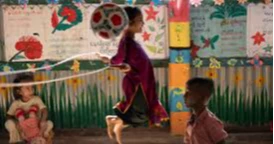
BRAC, in partnership with the LEGO Foundation, has launched a five-year initiative aimed at supporting early childhood development for Rohingya refugee children and vulnerable host communities in Cox’s Bazar.
The programme, based on BRAC’s Humanitarian Play Lab (HPL) model, seeks to reach 2,20,000 children aged between 0 and 18 years through play-based learning, mental health support and educational interventions.
The initiative was formally launched on Thursday at an event titled “Nurturing Childhoods, Preparing for Tomorrow” held at a hotel in Cox’s Bazar.
The event was organised by BRAC’s Humanitarian Crisis Management Programme (HCMP).
Sources said, Bangladesh is home to more than 30 million children under the age of 14, while more than half of the over one million Rohingya refugees living in camps in Cox’s Bazar are children. In 2024 alone, around 40,909 children were born in the camps.
The new partnership aims to promote joyful, safe and developmentally appropriate learning environments for children living in Rohingya camps and nearby host communities.
The inception event brought together government officials, humanitarian practitioners, development partners, and community representatives to align around a shared vision for whole-child development and to establish cross-sectoral collaboration across education, child protection, health and nutrition systems.
Refugee Relief and Repatriation Commissioner (RRRC) Mohammed Mizanur Rahman was present as the chief guest.
The event was facilitated by Dr. Ishaat Nabila, Programme Manager (Technical) of the Health, Nutrition and Early Childhood Development (ECD) Sector under BRAC HCMP.
When speaking, RRRC Mohammed Mizanur Rahman said, “What makes this initiative truly meaningful is how BRAC sees children as a whole. We all can be a part of this initiative, collectively.”
A special presentation on the “Programme Overview” was delivered by Dr. S M Hasanuzzaman, Programme Coordinator of Health, Nutrition & Early Childhood Development (ECD), under BRAC HCMP, and Syeda Sazia Zaman, Programme Head, BRAC Institute of Educational Development
(BIED), Brac University.
The presentation highlighted that, according to the World Health Organization (WHO) and UNICEF, 80% of a child’s brain development occurs within the first 1,000 days of life.
The two organisations have developed a globally recognised strategy known as the Nurturing Care Framework, which emphasises five key components of early childhood development: good health, adequate nutrition, responsive caregiving, safety and security, and opportunities for early learning.
The programme's target reflects this ambition: by the end of the five-year partnership, at least 70% children reached will meet age-appropriate developmental benchmarks.
It was also highlighted that BRAC began implementing the HPL model in Cox’s Bazar in 2018, building a strong evidence base over more than six years of implementation. This new partnership chapter brings greater scale and ambition, seeking not only to reach children directly but to embed play-based pedagogy within pre-primary and primary education of camp and host community.
The project will be implemented across 15 Rohingya camps as well as host communities in 8 Upazilas of Cox’s Bazar.
Key activities under the project include responsive caregiving, Humanitarian Play Lab and Play Lab, transition support into pre-primary and primary education, adolescent programming, disability inclusion and mental health and psychosocial support integrated throughout.
Organisers stated that BRAC, recognised as a pioneer in non-formal education, operated 60,000 schools between 1990 and 2000. The BRAC Play Lab model has been implemented successfully in Bangladesh, Uganda, and Tanzania.