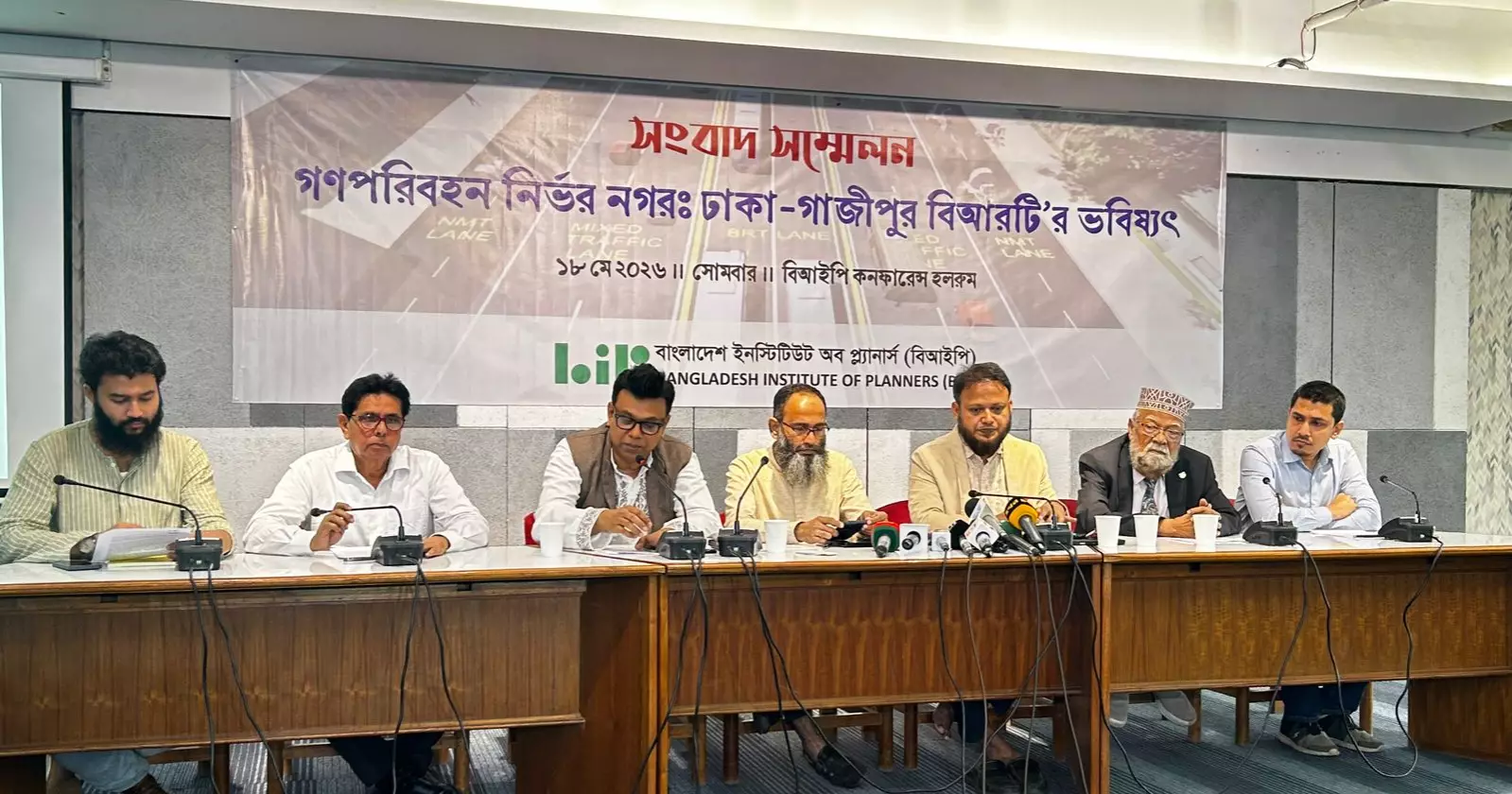
Urban planners have said the long-delayed Dhaka-Gazipur Bus Rapid Transit (BRT) service is set to introduce a ‘new dimension’ to Bangladesh’s public transport system once it becomes operational.
They said the BRT service would make commuting easier and more comfortable, similar to the metro rail system, while reducing travel time by around 30 percent on the 20-kilometre route from Dhaka Airport to Gazipur’s Shibbari area.
The observations came at a press conference organised by the Bangladesh Institute of Planners (BIP) in Dhaka on Monday.
They said the unused funds from the BRT project itself could be utilised to purchase buses and launch the new transport service in Bangladesh.
However, an additional Tk 200-300 crore would be required to procure higher-quality buses capable of providing metro rail-like comfort. Introducing state-of-the-art electric buses would require an extra Tk 1,000 crore, they added.
On the other hand, if the project is scrapped and the BRT corridor opened to all vehicles, the government would have to remove BRT stations, ramps and escalators and pay compensation to contractors, resulting in losses estimated between Tk 1,000 crore and Tk 1,200 crore.
The press conference was chaired by BIP Vice-President planner Sheikh Muhammad Mehdi Ahsan.
The keynote paper was presented by Professor Dr Md Mosleh Uddin Hasan of the Department of Urban and Regional Planning at Bangladesh University of Engineering and Technology (Buet) and General Secretary of BIP.
In his presentation, Prof Hasan said the then BNP government first prepared a Strategic Transport Plan (STP) for Dhaka in 2005, which proposed two BRT lines, including the Gazipur-Dhaka-Keraniganj corridor.
Later revisions retained the recommendation for BRT implementation.
Subsequently, the Keraniganj section was dropped and work on the 20-km Gazipur-Airport BRT project began in 2012, with completion originally scheduled for 2016.
Despite numerous delays and setbacks, around 97 percent of the project work has now been completed.
“At this stage, converting the BRT corridor into a regular road would deprive people of BRT facilities,” he said.
Prof Hasan said concerns have been raised over issues such as increased congestion on other lanes and difficulties for pedestrians crossing roads after BRT operations begin.
However, he argued that efficient traffic management could minimise congestion, particularly since traffic jams are mainly caused by buses stopping at intersections and elevated ramps to pick up passengers.
He also said safety risks for pedestrians could be addressed through proper management of the five new foot overbridges and 13 grade-separated crossings built under the project.
Citing research by Buet’s Urban and Regional Planning Department, the planners said BRT services should have already been introduced not only in Dhaka but also in Chattogram.
They added that six more cities — Rajshahi, Bogura, Tangail, Mymensingh, Cumilla and Noakhali — currently require BRT services, while another 13 cities may need such services in the near future.
The urban planners observed that although Bangladesh has spent a large amount on the BRT project, construction costs for BRT systems are roughly one-tenth of metro rail costs.
According to the planners, since its introduction in the Brazilian city of Curitiba in 1974, BRT services are now operating in 191 cities worldwide. Although BRT systems carry roughly half the number of passengers per hour compared to metro rail, they remain globally popular due to lower costs, faster implementation and efficient mobility.
Prof Hasan also alleged that a “propaganda campaign” is being spread against BRT in Bangladesh.
“Paracetamol works worldwide to reduce fever. If it does not work here, it is easy to say our paracetamol is adulterated,” he said.
“Similarly, BRT systems are not only operating successfully across the world — except in one or two cities — but are revitalising entire urban areas. Yet here we call BRT a ‘thorn in the throat’. We should instead ask whose throat it is stuck in, and who tried to swallow it.”