
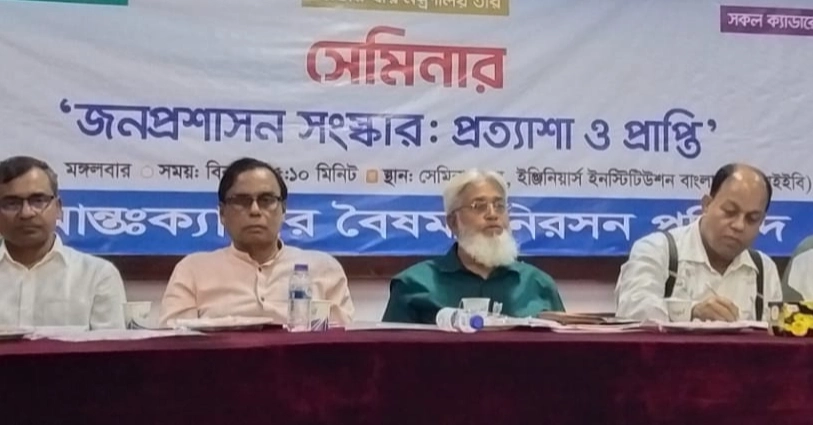
Experts and professionals from various sectors on Tuesday expressed concern that the ongoing public administration reform initiative would fail to bring effective change if the demands and recommendations of 25 civil service cadres – all except the administration cadre -continue to be ignored.
Speaking at a seminar titled “Public Administration Reform: Expectations and Reality” organised by the Inter- Cadre Discrimination Elimination Council at the Institution of Engineers, Bangladesh (IEB) , they warned that the current reform proposals risk reinforcing the administration cadre’s monopoly rather than fostering a more accountable and efficient bureaucracy.
Presenting the keynote paper, Dr. Muhammad Mofizur Rahman, Coordinator of the Inter- Cadre Discrimination Elimination Council, said that in the 53 years since Bangladesh’s independence, 26 commissions or committees have been formed to reform public administration. “The current commission was expected to be different, but its structure once again reflects bias and is likely to fall short of building the desired civil service,” he said.
Dr. Rahman noted that despite written recommendations submitted in advance by the Council to avoid repeating the failures of past commissions, the latest one again lacks inclusivity and balance. “Though the reform commission was meant to promote a people-centric, accountable, efficient, and impartial civil service, in reality, it appears to be a mere formality, much like its predecessors,” he said.
He pointed out that the report ignores public demand for professionalism in civil service and instead seems aimed at further consolidating the dominance of a particular group. “If implemented as-is, this report will derail genuine reform efforts and strengthen administrative fascism,” he warned.
Army reaffirms keeping law and order in garment industrial areas
Speakers also criticized the commission’s recommendations for allegedly creating complications around the education, health, family planning, statistics, postal, audit, and accounts cadres. They highlighted proposals that undermine judicial independence and elected representation by recommending the abolition of district councils and increasing the powers of the administration cadre—moves they believe are detrimental to a welfare-oriented state.
Among the Council’s proposals presented at the seminar were:
* Establishing cadre-specific ministries
* Abolishing the quota system in deputy secretary promotions in favor of merit-based recruitment
* Ensuring equality among all cadres
* Keeping all cadres under the same public service commission
* Retaining family planning and statistics cadres within the service
* Rejecting the proposal to allow only administration cadre officers to return to their previous posts after joining Superior Executive Service
* Opposing the proposal to assign the role of District Magistrate exclusively to Deputy Commissioners
* Renaming the ‘Administrative Service’ to ‘Land Service’ or ‘Land Management Service’
* Renaming the Ministry of Public Administration to either the ‘Ministry of Human Resource Management’ or ‘Ministry of Government Employee Management’
Speakers at the seminar included Prof. Dr. Mohammad Golam Rabbani of Jahangirnagar University, senior journalist and columnist M. A. Aziz, former DAE Director Ahmed Iqbal Chowdhury, columnist Firoz Ahmed, retired senior district judge Dr. Shahjahan Saju, former Director of the Department of Livestock Services Dr. Md. Mahbubur Rahman, Rashed Khan of Gano Adhikar Parishad, Faisal Mahmud Shanto of the National Citizen Party (NCP), and IEB Vice President Engineer Khan Manjur Morshed, among others.
They emphasized the urgent need to assign skilled professionals from relevant cadres to the leadership of their respective ministries to ensure efficient service delivery. They warned that a single cadre’s control over all sectors has undermined professionalism and created bureaucratic inefficiency.
“Without equality in promotion, a fair civil service is impossible,” said several speakers, adding that allowing one cadre to be promoted despite the absence of positions while others with eligible posts are denied promotions is unjust and reflective of a colonial mindset.
The seminar was presided over by Md. Jamilur Rahman, coordinator of the Council and convener of the seminar organizing committee.