
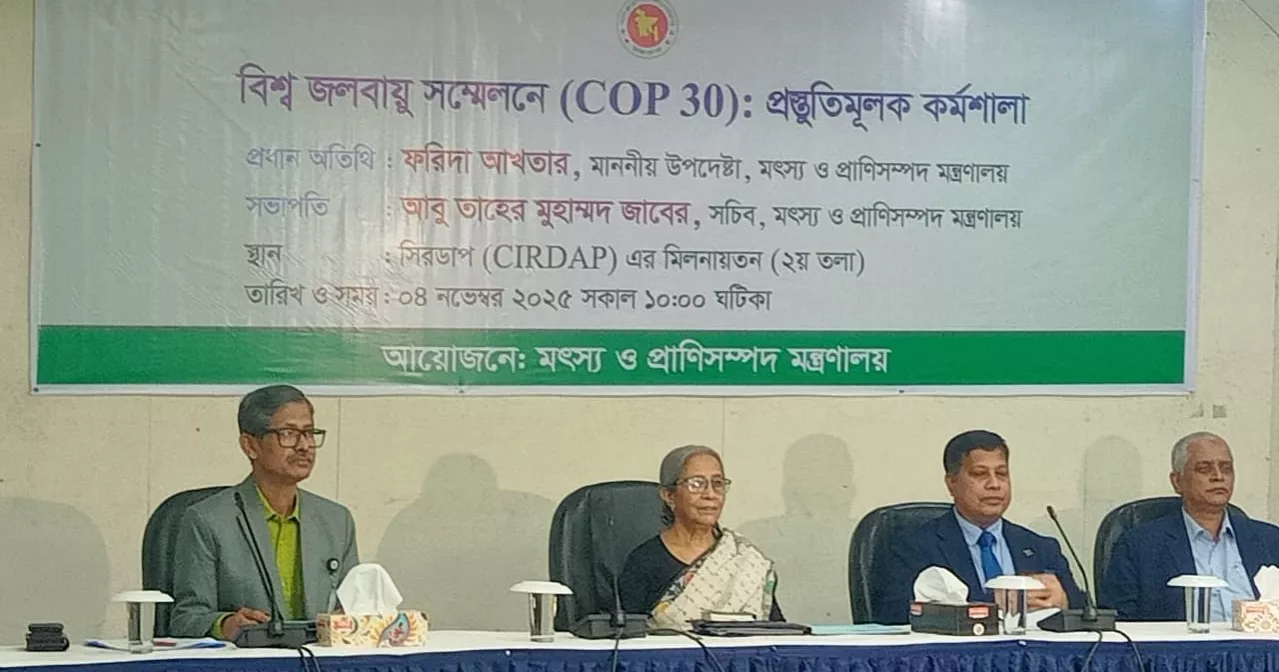
Preparations for the upcoming COP-30 climate summit in Brazil on Tuesday revealed significant coordination gaps among Bangladesh’s ministries and stakeholders, even as the Ministry of Fisheries and Livestock prepares to participate in the global conference for the first time.
“For the first time, the ministry will attend alongside the Ministry of Environment, Forest and Climate Change. However, the absence of inter-ministerial coordination could weaken Bangladesh’s ability to present a unified position on climate impacts,” said Fisheries and Livestock Adviser Farida Akhter.
Speaking at a preparatory workshop titled ‘World Climate Conference COP-30: Preparatory Workshop’, she said, “Everyone assumes COP is only the responsibility of the Environment Ministry. But ministries like Fisheries, Education, Agriculture, Disaster Management, and Women and Children Affairs are also intrinsically linked. One ministry alone cannot ensure proper representation at COP.”
This year, at the initiative of the Food and Agriculture Organization (FAO), the Ministry of Fisheries and Livestock will attend the COP summit for the first time. “We will highlight how the climate crisis is adversely affecting the country’s fisheries and livestock sectors,” Farida Akhter said.
Govt committed to stable electricity prices, says Farida Akhter
Pointing to the lack of coordination not only among ministries but also between government and non-government entities, Farida Akhter said, “At this COP, we must forget who represents the government and who represents NGOs — we all represent Bangladesh.”
Environmentalists and NGO representatives at the event alleged that unlike Bhutan or Indonesia, Bangladesh has made little effort in creatively presenting its pavilion at past COP summits.
“This year, Bangladesh’s pavilion will feature exhibits and visuals on local species such as Hilsa and Black Bengal Goat to showcase how climate change is impacting fisheries and livestock resources,” the adviser said.
She emphasised the need for closer coordination between government delegates and civil society representatives at this year’s summit.
Bangladesh wastes 21 million tonnes of food annually: Adviser Farida
Expressing concern, the adviser said as Bangladesh approaches graduation from the LDC category, the country’s access to the Loss and Damage Fund remains uncertain. “We can no longer play the victim. We must demand compensation as our rightful claim.”
Highlighting the regional gap, she observed that Asian countries, especially those in South Asia, still lack collective coordination at COP compared to African nations, which present united positions on climate issues.
Due to climate impacts, Bangladesh’s capture fisheries sector has suffered significant losses, she said, adding, “While 60 percent of fish demand once came from capture fisheries, that share has now dropped by more than 20 percent.”
“Major countries still think they are immune to the effects of climate change. But even the U.S. is now facing floods — this is the consequence of the climate crisis. Everyone must act to confront it,” she said.
Fisheries and Livestock Secretary Abu Taher Muhammad Jaber presided over the session.