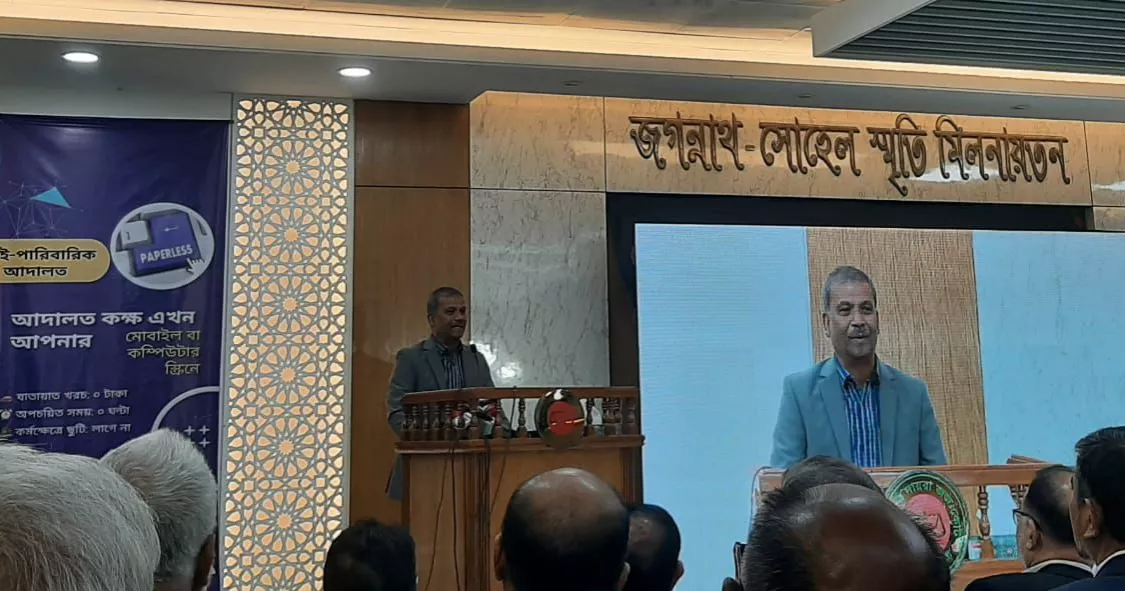
The introduction of e-family courts across Bangladesh will not only ease public suffering but also help curb corruption, Law Adviser Asif Nazrul said on Monday.
“The litigants will no longer have to run from place to place as before due to the e-family court system,” he said while speaking at the inauguration of the e-family court at the Dhaka Metropolitan Sessions Judge Court.
Daffodil International University assisted in the development of the e-family court platform.
Highlighting the government’s ongoing legal reforms, Asif Nazrul said the Ministry of Law has already implemented 21 reforms.
He, however, stressed that these initiatives will only be sustainable if all stakeholders, including lawyers, remain engaged and ensure continuity.
The adviser also announced upcoming initiatives, including the e-judiciary and e-registration projects. He expressed hope that all political parties would support these efforts “out of love for the country.”
Under the reforms, the legal aid office will now have a panel of three judges instead of one—an important change expected to bring positive results once fully practiced.
The programme has already started in 20 districts, with a goal of expanding to all 64 districts, he added.
Asif Nazrul mentioned that once the system is implemented nationwide, one-quarter to one-third of all cases in Bangladesh could be resolved through the legal aid office, potentially reducing the country’s case backlog by at least 50 percent within five years
Citing global examples, he noted that Singapore’s reforms under former Prime Minister Lee Kuan Yew took a decade, emphasising that meaningful reform cannot be achieved overnight.
He also referenced the experiences of Maldives and Tunisia, saying additional reforms must not weaken state institutions.
“Reforms must be carried out with realistic thinking, and the people must be prepared to accept them,” he said.
He said technology does not necessarily reduce the number of cases, but can instead enable lawyers to provide more efficient services.
Environment Adviser Syeda Rizwana Hasan, Special Assistant to the Chief Adviser for the Posts, Telecommunications and IT Ministry Faiz Ahmed Taiyeb, Law and Justice Secretary Liaquat Ali Mollah, Registrar General of the Supreme Court Muhammad Habibur Rahman Siddiqui and others also spoke at the event.