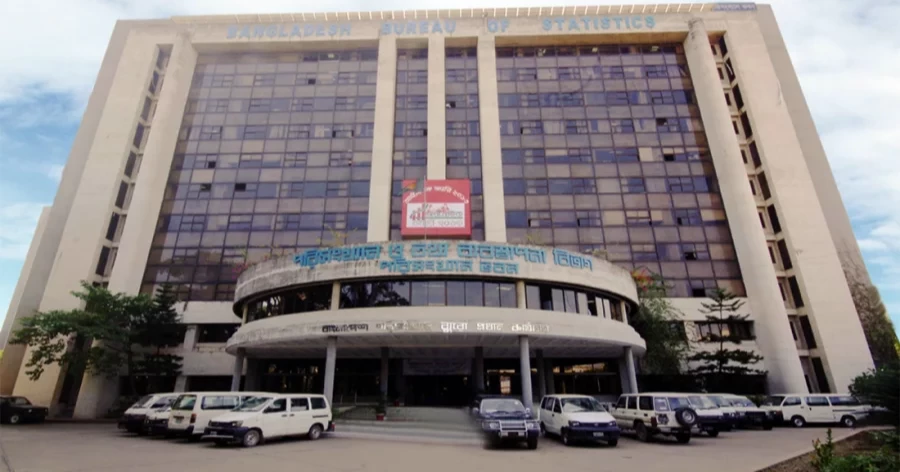
The Bangladesh Bureau of Statistics (BBS) on Tuesday released the national report of the Economic Census 2024, showing a sharp expansion in economic activities with the total number of economic units rising by nearly 50 percent over a decade.
According to the report, the number of economic units increased to 1,17,02,792 in 2024 from 78,18,565 in 2013, marking a 49.68 percent growth between the two census periods.
The census, conducted nationwide from December 10 to 26, 2024 under the ‘Economic Census-2023’ project, collected data from all economic units using Computer Assisted Personal Interviewing (CAPI) technology. A preliminary report was released in January 2025, followed by detailed analysis leading to publication of the national report.
State Minister for Finance and Planning Zonayed Abdur Rahim Saki, speaking as chief guest at the report unveiling, said the findings present a comprehensive and dynamic picture of Bangladesh’s economy and will support data-driven planning and people-centric economic policies.
The report shows that economic activities expanded in both rural and urban areas, with 73,85,828 units located in rural regions and 43,16,964 in urban areas in 2024.
Permanent establishments dominate the economic landscape, accounting for 53.57 percent of total units, while micro and cottage industries together represent the overwhelming majority 56.67 percent and 38.74 percent respectively highlighting the strong presence of small entrepreneurs.
Sector-wise, about 90.02 percent of economic units belong to the service sector, while 9.98 percent fall under industry. Wholesale and retail trade, along with repair of motor vehicles and motorcycles, emerged as the largest segment with 41.82 percent share, followed by transportation and storage at 22.22 percent and manufacturing at 9.57 percent.
The census also recorded an increase in total persons engaged in economic units to 3,06,32,661 in 2024 from 2,45,00,850 in 2013, reflecting a 25.03 percent rise in employment.
Officials said the updated database and findings would help policymakers, researchers and businesses in formulating evidence-based development strategies and identifying sectoral and regional investment opportunities.