
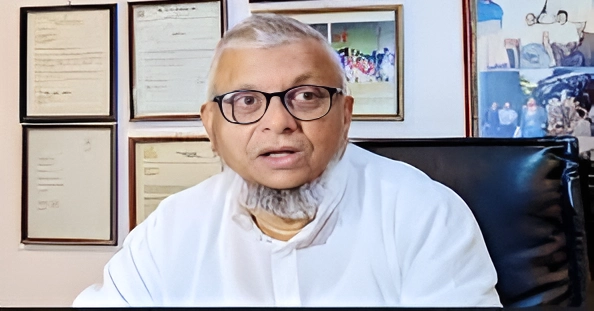
Labour and Employment Minister Ariful Haque Choudhury on Tuesday said strengthening workplace safety and protecting workers’ rights in Bangladesh require trained, well-equipped and secure factory inspectors capable of conducting effective field monitoring.
Speaking at a seminar on Occupational Safety and Health (OSH) in the capital, he stressed the need for enhanced training, logistical support and security for factory inspectors alongside proper and timely reporting from the field.
The seminar, titled “Enhancing Occupational Safety and Health Practices in Bangladesh,” was jointly organised by the Department of Inspection for Factories and Establishments and the Ministry of Labour and Employment marking National Occupational Safety and Health Day 2026.
Prime Minister’s Adviser on Politics and Agriculture Nazrul Islam Khan attended the programme as the chief guest, while PM’s Adviser on Education, Primary and Mass Education, Expatriate Welfare and Overseas Employment, and Labour and Employment ministries Mahdi Amin was present as a special guest.
Ariful said inspectors need adequate institutional support and security to perform their responsibilities effectively, adding that ensuring their safety during field inspections is the government’s responsibility.
He said inspectors must remain active in the field, collect accurate information and submit timely reports to ensure proper enforcement of labour standards and workplace safety measures.
Referring to his experience as a former city mayor, the minister said he had personally visited various industrial establishments and witnessed the harsh living and working conditions faced by many workers.
According to him, the actual condition of workers cannot be fully understood without direct field visits and close observation of their living environment.
Ariful also stressed the importance of greater awareness among employers and labour leaders to build a more worker-friendly environment in the country.
He said ensuring necessary facilities and protections for workers is essential for sustainable industrial growth and improving labour conditions.
Highlighting institutional challenges, he said many positions under the ministry suffer from inadequate logistical support, which weakens implementation of policies and field-level operations.
He also referred to the difficulties faced by labour attachés posted abroad, saying many struggle to perform their duties effectively due to lack of transport and operational facilities.
Calling for coordinated efforts from the government, employers and workers, Ariful said improving labour conditions requires practical implementation of recommendations rather than limiting efforts to seminars and discussions.
He expressed optimism that even partial implementation of the recommendations discussed at the seminar could significantly improve workplace safety and labour conditions across the country.
Prime Minister’s Office spokesperson Dr Mahdi Amin said the government is working to build a labour-friendly Bangladesh by ensuring workers’ safety, rights, skills development and decent working conditions through a coordinated and holistic policy framework.
He said the current government came to power through a “free, fair and acceptable national election” with public support and is committed to implementing people-oriented policies.
Referring to the ruling party’s election pledges, he said the Prime Minister repeatedly stressed the importance of building a labour-friendly Bangladesh where workers’ protection and workplace safety would remain a key priority of governance.
He said the country’s labour sector, particularly the readymade garment industry, has historically received policy support from previous BNP governments, including initiatives taken during the tenure of late President Ziaur Rahman and former Prime Minister Begum Khaleda Zia.
The adviser said the government now aims to formulate modern labour-friendly policies to address workers’ problems and improve their living standards.
“Our priority is to create employment opportunities, enhance workers’ skills and ensure the highest possible standards of workplace safety and security,” he said.
He said the government is strengthening institutional structures and ensuring industries and factories comply with labour laws and regulations to improve workplace safety.
At the same time, efforts are underway to gradually bring informal sector workers under an institutional framework through appropriate policy measures, he added.
Describing workers as the backbone of the country’s economy, the adviser said ensuring workers’ safety is not only about protecting individuals but also about safeguarding families and the broader national economy.
“If Bangladesh wants to move forward, we must protect the workers who are driving the country’s economic progress,” he said.
He stressed the need to extend support beyond export-oriented industries and focus on informal and domestic sector workers as well.
The adviser said workers need not only institutional support but also healthcare, education opportunities for their children, nutrition support and other social protections to improve their quality of life.
He said the government is implementing grassroots-level initiatives, including family card programmes for women’s empowerment and farmer card initiatives to improve the lives of working people.
“By workers, we mean all those people whose labour, sacrifice and hard work are helping Bangladesh move forward,” he said.
The adviser said the government wants to build a “holistic ecosystem” through coordinated efforts involving workers, employers and the state so that all stakeholders can contribute opinions and participate in decision-making.