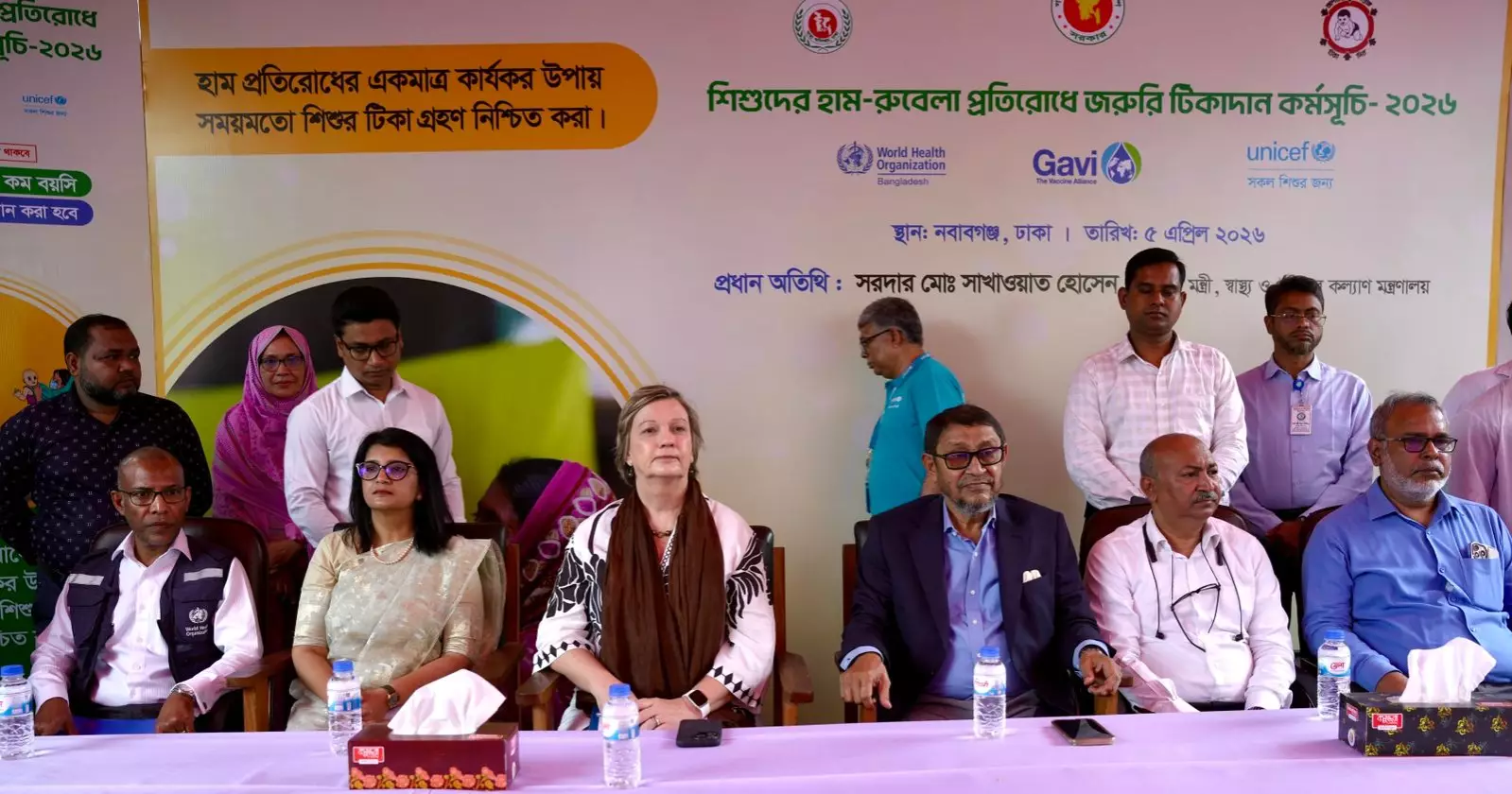
The government of Bangladesh, with support from UNICEF, WHO and Gavi, the Vaccine Alliance, on Sunday launched an emergency measles-rubella vaccination campaign to protect more than 1.2 million children aged 6 months to 5 years across 30 upazilas in 18 high-risk districts.
There will be a phased expansion and gradual scaling up to additional districts and City Corporation areas nationwide.
The emergency campaign will expand to four City Corporations from April 12, and go nationwide from May 3, according to UNICEF.
The World Health Organization (WHO) urged all parents and caregivers to bring their children to the nearest vaccination centre and remains committed to supporting the government and partners to safeguard the health of every child across Bangladesh.
UNICEF and WHO, together with partners, continue to call for sustained investment in immunization and child health services to ensure that all children in Bangladesh are protected, today and in the future.
“Due to the current outbreak of measles in the country, the Ministry of Health and Family Welfare has taken swift and effective measures, said Health and Family Welfare Minister Sardar Md. Sakhawat Husain.
He expressed his sincere thanks to UNICEF Representative Rana Flowers for providing the necessary technical support and ensuring the rapid supply of vaccines for the successful implementation of this large-scale campaign.
"On behalf of the Ministry of Health and Family Welfare, I also extend my heartfelt gratitude to Gavi and the World Health Organization,” said the Health Minister.
The campaign is prioritizing children who have missed routine immunization and are most vulnerable to severe illness and complications.
In Dhaka and Cox’s Bazar, efforts will be intensified to ensure high coverage in densely populated and high-risk settings.
Without a rapid scale-up of vaccination and response measures, transmission is likely to continue expanding, placing further strain on health services and increasing the risk of severe health outcomes among children.
The campaign complements ongoing routine immunization efforts and forms part of a broader strategy to restore immunization coverage, strengthen health systems, and build resilience against future resurgences.
“Vaccines are foundational to child survival. UNICEF is deeply concerned about the sharp rise in measles cases across Bangladesh, putting thousands of children, especially the youngest and most vulnerable, at serious risk,” said Rana Flowers, UNICEF Representative in Bangladesh.
This resurgence highlights critical immunity gaps, particularly among zero-dose and under-vaccinated children, while infections among infants under nine months, who are not yet eligible for routine vaccination, are especially alarming, said Flowers.
“We extend our deepest condolences to families who have lost loved ones and offer our support to the Government of Bangladesh for renewed efforts building on this emergency campaign. With coordinated action, this resurgence can be contained. UNICEF is working closely with the Government and partners to reach every child, close immunity gaps, and protect Bangladesh’s children from this preventable disease.”
Thanks to donors, especially Gavi, UNICEF is supporting vaccine procurement and delivery, strengthening cold chain systems, and leading risk communication and community engagement to ensure caregivers are informed and motivated to vaccinate their children.
UNICEF is also working closely with frontline health workers and partners to reach children in remote, underserved, and high-burden areas.
“WHO commends the Government of Bangladesh for its decisive and timely action,” said Dr Ahmed Jamsheed Mohamed, WHO Representative to Bangladesh.
“By targeting children aged 6 to 59 months in high-risk areas, followed by nation-wide scale-up, this campaign will help prevent further tragic loss of young lives and close the immunity gaps driving the outbreak. The measles–rubella vaccine is safe, effective and has protected billions of children worldwide – it is our strongest defence against this fast-spreading disease.
"The loss of children’s lives in this outbreak is a tragic reminder that measles can quickly turn deadly when immunity gaps persist. Together with the Ministry of Health & Family Welfare, WHO and UNICEF, Gavi is supporting Bangladesh to roll out measles rubella vaccines already in the country. It is urgent that we work together as effectively as possible to bring the current situation under control," said Dirk Gehl, Gavi, the Vaccine Alliance Senior Country Manager for Bangladesh.
Bangladesh has a strong history of high immunization coverage, but even small disruptions can lead to the gradual accumulation of immunity gaps over time. Resurgences like the current one are typically the result of these accumulated gaps rather than a single factor.
As the lead agency for vaccine procurement, UNICEF is working closely with the Government to ensure timely access to quality-assured vaccines and to expedite supply in response to increased demand.
Health facilities in high-burden areas are already facing overcrowding, limited isolation capacity, and gaps in referral and treatment, increasing the risk of transmission and complications among children.
In Cox’s Bazar, these challenges are further compounded by high population density and mobility, making rapid vaccination even more critical.
Since 2007, Gavi has invested more than US$2.2 billion (including US$1.1 billion in the last five years alone) to support measles and measles-rubella immunization through routine programmes, preventive campaigns and outbreak response across 57 lower income countries, reaching over 1.3 billion children.
In 2024, Gavi backed one of the largest pushes against measles, supporting 24 countries to roll out catch-up and follow-up campaigns reaching more than 62 million children, alongside outbreak response in five countries, vaccinating up to 6.8 million children.
Under the Gavi Leap reform agenda, the Alliance will from 2026 to 2030 sharpen its focus on securing vaccine supply, providing predictable funding for outbreak response, and supporting country led efforts to close immunity gaps at scale.
Gavi, the Vaccine Alliance is a public-private partnership that helps vaccinate more than half the world’s children against some of the world’s deadliest diseases.
The Vaccine Alliance brings together developing country and donor governments, the World Health Organization, UNICEF, the World Bank, the vaccine industry, technical agencies, civil society, the Gates Foundation and other private sector partners.