
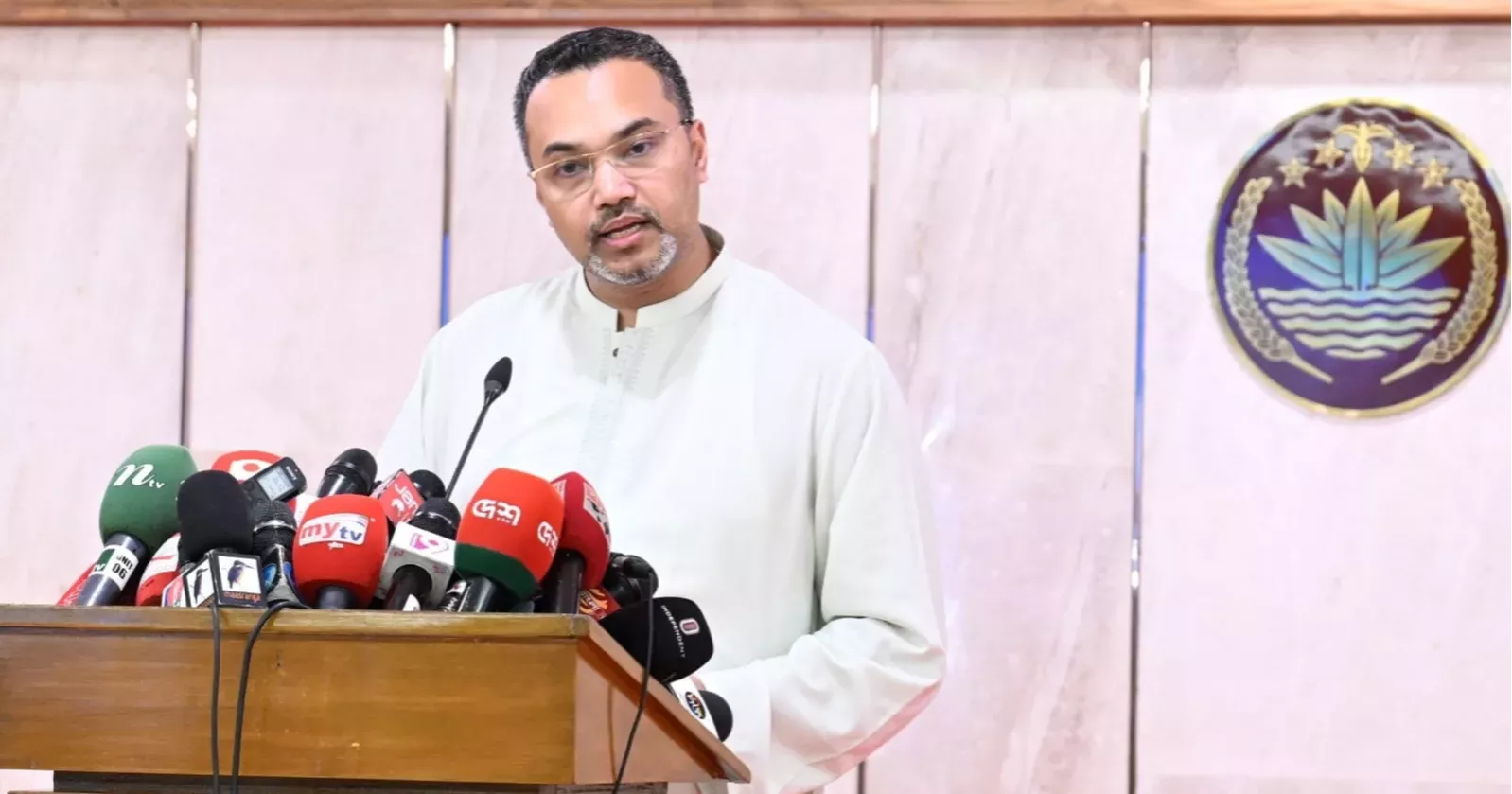
Ensuring food security remains a central priority for the government, Prime Minister’s Office spokesperson Dr Mahdi Amin said on Saturday.
“We have the Family Card, the initial goal of which was to provide financial support. At some point, we want to introduce products through it, if we can achieve agricultural self-reliance,” he said at a roundtable titled “From the Unveiling of DNA Design to the Future of Bangladesh's Bioeconomy” at Eskaton Garden in the capital.
“In that case, we need to explore whether we can increase the production of essential food items such as edible oil and sugar,” he added.
Govt undertakes various development initiatives, but opposition's role uncooperative: Mahdi Amin
“We can assess how to increase the production of crops like beetroot or mustard, which could help us achieve self-reliance in essential food products,” he said.
Mahdi Amin said biotechnology has practical applications that align with government priorities and public interest.
“One of our major goals is to work on vaccination, both for humans and livestock. This is directly linked to biotechnology. We must consider how to become more self-reliant in vaccine production, which is now a key issue,” he said.
He added that greater discussion is needed on investing in cancer and other life-related research, as well as on the policies required to support such efforts.
Referring to the government’s broader vision, Mahdi Amin said expert input is essential to turn plans into practical outcomes. He pointed out that productivity remains low in many agricultural sectors.
“We need to increase productivity, possibly through crop diversification. Overall, if we look at the ratio of production to land, Bangladesh is still inefficient. Modern technology must be introduced to improve efficiency,” he said.
He also mentioned the government’s commitment to introducing midday meals in primary schools. Around 20 million students are expected to benefit from a phased rollout of tiffin distribution.
“At present, a major challenge is that these foods are perishable, such as butter beans or bananas. We need research and development to produce non-perishable, nutritious and cost-effective food items for children,” he said.
He observed that although these are practical and longstanding challenges, solutions have not been found over the past 16 to 18 years. Climate resilience is another key goal, along with promoting waste-based energy solutions.
On employment, he stressed the need to create more job opportunities at home and abroad by using the country’s demographic dividend.
“If we can equip our young people with the right skills and technical capacity, we can strengthen industry-academia collaboration. At present, our education system focuses on degrees, but lacks practical relevance,” he said.
He called for curriculum reforms to include transferable, interpersonal and technical skills, as well as subject-specific knowledge.
Describing brain drain as a major challenge, Mahdi Amin said efforts should be made to turn it into “brain circulation” by connecting skilled Bangladeshis abroad with the country.
“We want our academics and professionals abroad to engage with Bangladesh through initiatives such as summer schools, short courses and joint research. This will strengthen our research ecosystem,” he said.
He emphasised that research should focus on solving real-world problems. While fundamental research is important, application-based research is more urgent for a country like Bangladesh.
He also highlighted the weak link between industry and academia despite the presence of high-tech parks, software parks and economic zones.
“This gap must be addressed. We have already taken steps to identify unused spaces in industrial clusters and link them with universities, offering workspaces and opportunities for incubation and commercialisation,” he said.
Students, he added, should be encouraged to turn their ideas into startups with the help of funding, grants and supportive policies.
“Our main objective is to empower people and make them self-reliant, especially youth and women. We must focus on training, upskilling, curriculum reform and technical and vocational education,” he said.
He noted that significant job opportunities exist in fields such as biotechnology, but these remain underutilised.
Mahdi Amin said achieving these goals will require joint efforts from the government, private sector and academia, with strong public-private partnerships.
“We will consult widely with the Ministry of Education and experts, and apply global best practices suited to Bangladesh. If there is political will, along with the guidance of the Prime Minister, we can bring sustainable change and improve people’s lives InshaAllah,” he added.