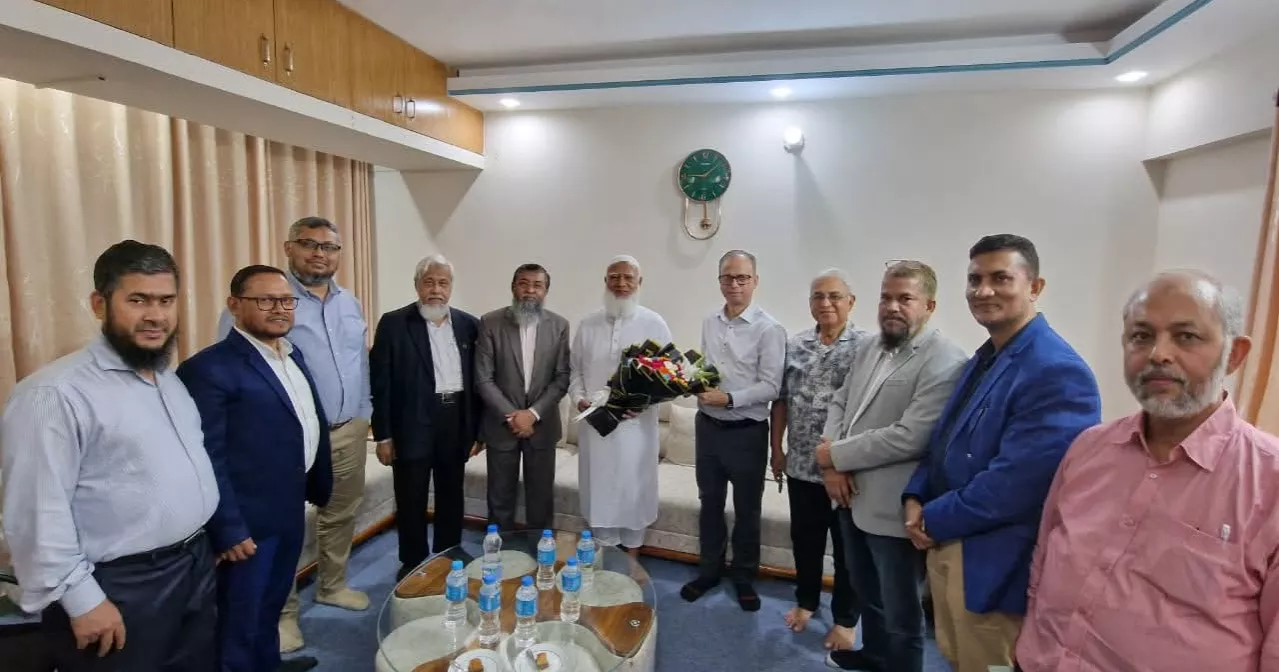
A delegation comprising the garment sector entrepreneurs has met with the Amir of Bangladesh Jamaat-e-Islami Shafiqur Rahman at his residence in the capital's Bashundhara residential area.
Jamaat-e-Islami and the business leaders confirmed that the meeting was held on Sunday evening.
The business delegation included Tapan Chowdhury, a former adviser to the caretaker government and chairman of Square Textiles, Mahmud Hasan Khan, president of the Bangladesh Garment Manufacturers and Exporters Association (BGMEA), Mohammad Hatem, president of the Bangladesh Knitwear Manufacturers and Exporters Association (BKMEA), and Fazle Shamim Ehsan, president of the Bangladesh Employers Federation.
Jamaat-e-Islami representatives at the meeting included Shahidul Islam, president of the party’s Industry and Commerce Wing, Anwarul Azim, secretary of the wings, and Jamaat leader Khaliduzzaman, according to a press release by Jamaat-e-Islami.
BGMEA president Mahmud told UNB that the meeting was part of an ongoing series of discussions with political parties regarding business issues.
"We previously met with a BNP delegation. The Jamaat Amir had invited us earlier, but we couldn't go then, so we went this time," he said.
The BGMEA president said that the discussion covered LDC graduation, US countervailing duties, and labour issues.
Regarding the meeting, Mohammad Hatem said, "We informed the Jamaat-e-Islami Amir about various issues. We explained the problems that would arise if the labour law is forced through, and we also informed him about the challenges we will face if the LDC graduation is not deferred."
He said that the labour environment in factories is often disrupted. Business leaders sought cooperation from politicians to protect the interests of both workers and the industry.
“The Jamaat-e-Islami Amir listened to us attentively and agreed with us on many points,” Hatem added.
According to the Jamaat-e-Islami, the meeting's agenda included discussions on Bangladesh’s industrial and commercial potential, new investments and the investment climate, and contemporary challenges, particularly the ‘Labor Law 2025’.
They urged all political parties to help maintain stability in the country's factories and provide overall support. In response, the Jamaat Amir emphasised the importance of improving worker-owner relations to protect the industry and keep the economy stable.