
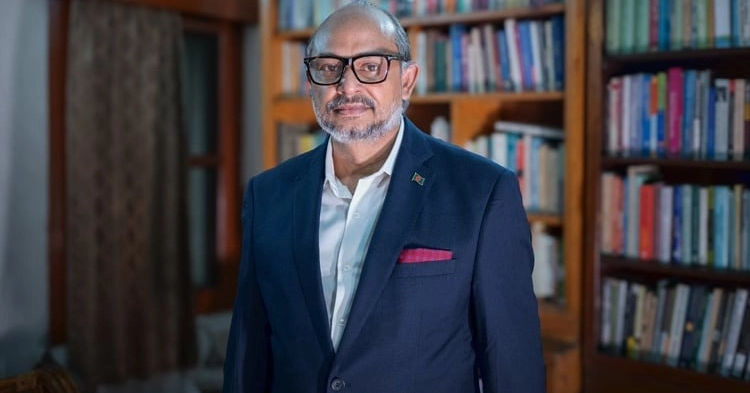
The government is moving toward a sustainable, investment-driven economic model by encouraging entrepreneurs to raise capital from the stock market rather than relying solely on bank loans, said Rashed Al Mahmud Titumir, Advisor to the Ministry of Finance and Planning.
Speaking as the chief guest at a seminar titled "Challenges and Actions for the New Government in the Capital Market," organized by the Capital Market Journalists' Forum (CMJF) at a city hotel on Sunday, the Advisor noted that the upcoming national budget will include specific steps for economic reform and transformation.
Titumir emphasized that the previous "consumption-led" economic model was unsustainable.
"We want to move from a debt-dependent economy to an ownership-based industrialization model. In the future, bank loans will not be available to everyone; we must decide who gets loans and who goes to the capital market," he stated.
The Advisor revealed an ambitious goal to reach a $1 trillion economy by 2034, highlighting the need to upgrade the Bangladesh stock market from a "Frontier Market" to an "Emerging Market." Currently, the market capitalization-to-GDP ratio stands at only 12 percent, significantly lower than neighboring countries.
Khondoker Rashed Maqsood, Chairman of the Bangladesh Securities and Exchange Commission (BSEC), reported that the commission has conducted 126 investigations, resulting in fines totaling Tk 1,488 crore. However, only Tk 5.23 crore has been realized so far due to legal challenges and the nine-month payment window.
He also noted that 16 money laundering cases have been referred to the Anti-Corruption Commission (ACC) for the first time. To prevent the embezzlement of investor funds through fake bank statements, "Back Office Software" is being installed across 280 brokerage houses.
National Board of Revenue (NBR) Chairman Abdur Rahman Khan stressed that tax incentives alone do not guarantee a healthy market.
He pointed out that the current 7.5 percent tax gap between listed and non-listed companies is sufficient.
"We must ensure that companies providing false information or those unable to pay dividends are not allowed to go public," he added.
In the keynote paper, DBA Senior Vice President Moniruzzaman highlighted a major structural flaw: Bangladesh’s banks are currently providing both short-term and long-term financing, creating a risky asset-liability mismatch. He argued that a deep capital market is essential to relieve this pressure on the banking sector.
The seminar, chaired by CMJF President Monir Hossain and moderated by General Secretary Ahsan Habib, was also attended by DSE Chairman Mominul Islam, CSE Chairman AKM Habibur Rahman, and other top financial stakeholders.