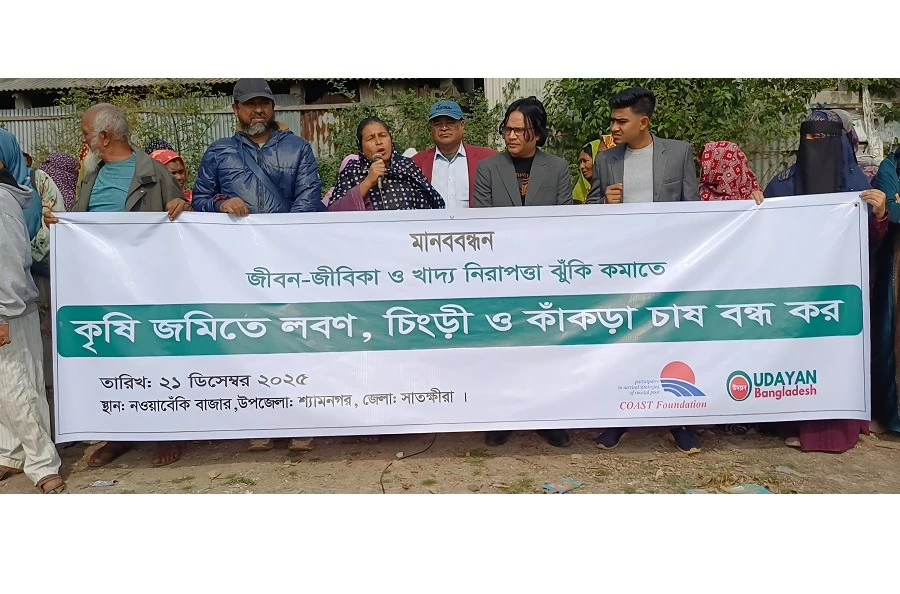
Speakers at a human chain on Sunday demanded strict enforcement of existing laws to stop salt, shrimp and crab farming on agricultural land and called for alternative livelihoods and rehabilitation for affected farmers to ensure food security and sustainable livelihoods.
They said the practice of introducing saline water into cropland is destroying fertile agricultural land, reducing soil productivity, threatening biodiversity and creating long-term livelihood risks for agriculture-dependent communities. As a result, local food production is declining and salinity is making vast areas uncultivable for years, they added.
The demands were raised at a human chain held at Nawabenki Bazar in Shyamnagar upazila of Satkhira district, jointly organised by COAST Foundation and Udayan Bangladesh.
The programme was presided over by Sheikh Asad, Executive Director of Udayan Bangladesh, while M A Hasan, Head of Climate Change of COAST Foundation, moderated the event, says a press release.
Speaking at the programme, M A Hasan said that besides climate change-induced natural disasters, shrimp and crab enclosures are artificially increasing salinity in the area and intensifying environmental risks.
He noted that although saline shrimp and crab farming may be profitable for a few, it is destroying land, food systems and livelihoods of many people, pushing their future into uncertainty.
He referred to the Agricultural Land Preservation Act (ALPA) 2000, which requires approval from the Land ministry for converting agricultural land to non-agricultural use, and called for strict implementation of the law.
Sheikh Asad said shrimp and crab farming in Shyamnagar in Satkhira is posing serious threats to agriculture due to salinity intrusion, forcing many farmers to abandon farming and migrate elsewhere in search of livelihoods.
He stressed the need for monthly allowances, short-term loans and support for alternative income-generating activities for affected farmers.
Shyamnagar Press Club President Samiul Islam Monir said illegally granted canal leases must be cancelled and illegal sand extraction stopped, as river erosion is worsening.
He emphasised the need to return to agriculture, transform single-crop land into triple-crop land and increase rice and vegetable production to achieve food self-sufficiency.
Ganachetna Foundation Executive Director Shibu Prasad Vaidya said the coastal region is already facing a severe drinking water crisis, which is more acute in areas dominated by shrimp and crab farming.
He warned that without strict regulation, the environment, nature and economy of the southwestern region would face further disruption.
Jharna Khatun, a representative of affected women, said women are facing increasing health risks due to salinity and food insecurity.
She also said that declining agricultural production has increased dependence on markets, leading to malnutrition among women and children amid poverty and rising prices. She urged the government to take effective and sustainable measures.
Development activist Imran Parvez said the government must take urgent initiatives to address the drinking water crisis, promote climate-adapted agricultural management, train farmers and increase incentives to protect agriculture and livelihoods in the coastal region.