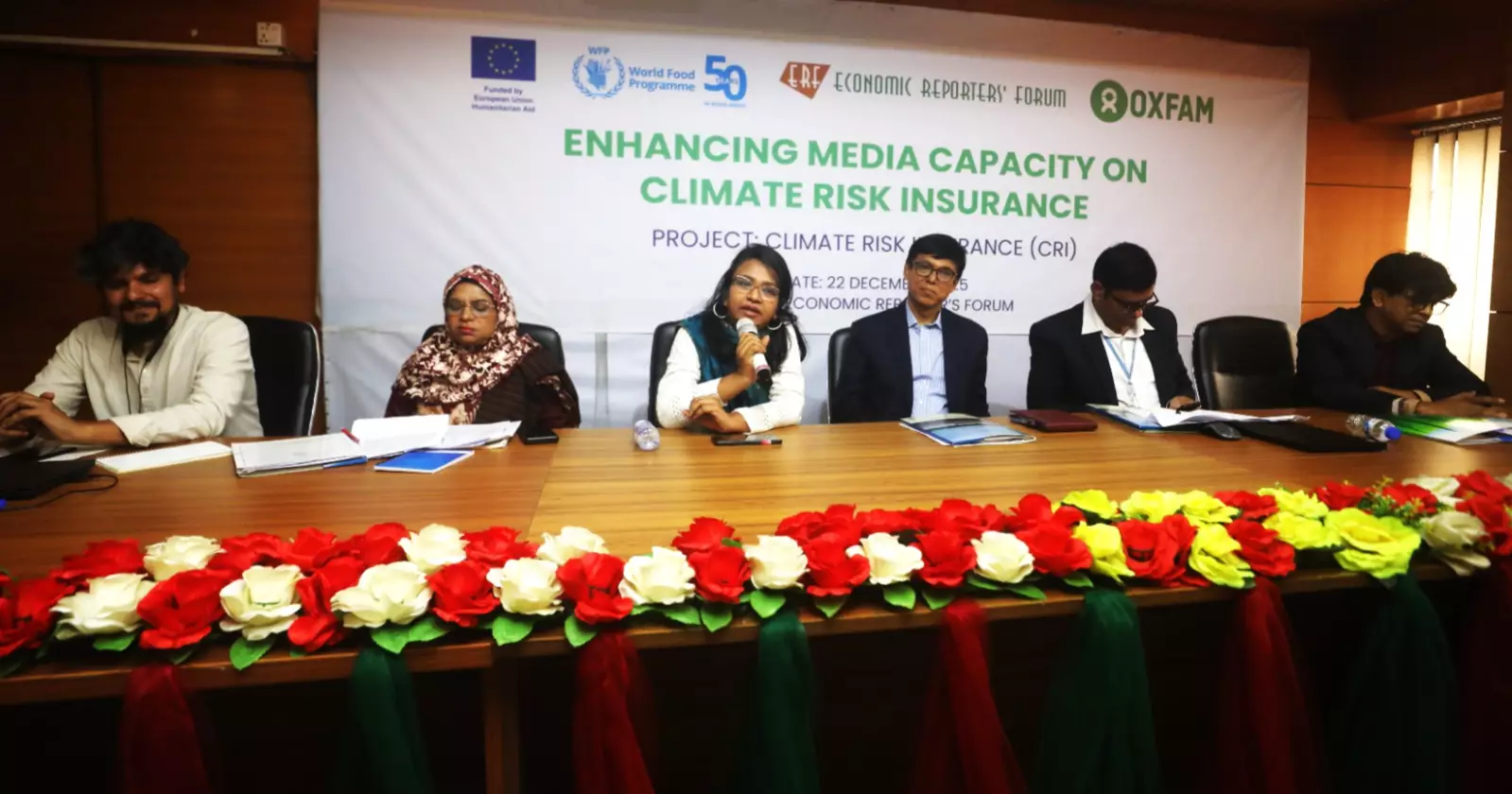
Climate risk insurance is becoming increasingly crucial for Bangladesh, one of the world’s most climate-vulnerable countries, but structural, technical, and policy challenges have so far hindered its large-scale implementation, said Insurance Development and Regulatory Authority (IDRA) Chairman Dr M Aslam Alam on Monday.
“Climate change is no longer a future threat. It is already affecting our lives, food security, and health,” Dr Alam said while speaking at a workshop on Enhancing Media Capacity on Climate Risk Insurance, held at the Economic Reporters’ Forum (ERF) auditorium.
The workshop was jointly organised by ERF and Oxfam.
He said rising temperatures, shrinking winters, and intensifying floods and cyclones are severely impacting agriculture, livelihoods, and public health, creating complex risks for millions.
He noted that climate risk insurance could be a vital tool to protect vulnerable communities if key barriers are addressed.
The IDRA chairman identified insurability, affordability and moral hazard as major obstacles.
He explained that repeated losses make some households uninsurable while insurance premiums remain unaffordable for the poorest segments.
Exaggerated or false claims also pose a risk to event-based climate insurance.
To mitigate these challenges, Dr Alam advocated for parametric or weather-index insurance which triggers payouts based on pre-defined parameters such as river water levels or cyclone wind speeds.
However, he noted legal recognition, nationwide data infrastructure, and coordination among multiple agencies remain critical challenges for scaling up the scheme.
Executive Director of Bangladesh Bank Hosne Ara Shikha emphasised the role of the insurance sector in strengthening climate resilience alongside green and sustainable finance.
She highlighted that Bangladesh Bank has introduced green finance products and pilot insurance-linked financial products for climate-affected communities, stressing the importance of integrating insurance with credit and guarantee schemes.
Shikha further noted that 20 percent of bankable funds have been directed toward green initiatives, with special focus on women entrepreneurs, and urged coordinated efforts among regulators, banks, development partners, academia, and civil society to scale up climate-resilient finance.
Moderated by Md Sariful Islam, Head of Influencing, Communications, Advocacy and Media, Oxfam in Bangladesh, journalists at the workshop received technical understanding on CRI models, data sources, and policy trends.
Participants were encouraged to focus not only on post-disaster payouts but also on proactive solutions, fiscal protection, and justice-based narratives.
Nurul Amin, Programme Policy Officer at WFP Bangladesh, stressed the importance of fast, reliable instruments. “Climate-vulnerable families should not have to wait for aid or rely on uncertain humanitarian responses,” he said.
Dr Mohammad Emran Hasan, Head of Climate Justice and Natural Resource Rights at Oxfam in Bangladesh, said, “Bangladeshis living in climate hotspots did not create the climate crisis—but they pay the highest price. We must ensure it reaches the poorest, and media can drive that transformation.”
ERF President Doulot Akter Mala and General Secretary Abul Kashem also spoke at the programme.