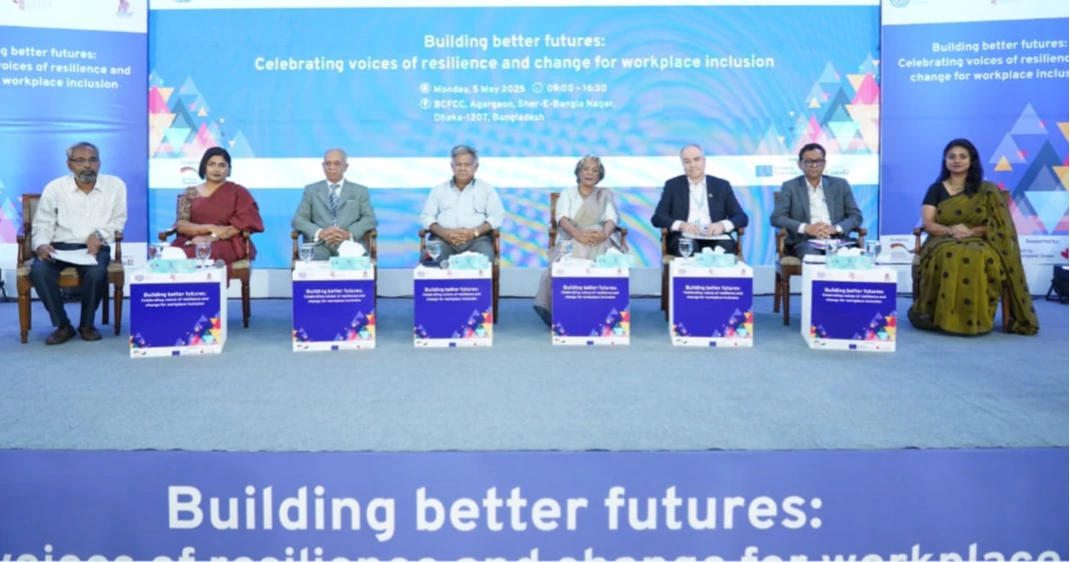
An effective national policy on equality is required to promote inclusion through fair recruitment practices and anti-discrimination measures, to ensure that no one willing to work is excluded from the job market, according to participants of a national dialogue on creating better futures.
The dialogue, organized by ILO, the Bangladesh Business and Disability Network and Bonhishikha to commemorate Labour Day, highlighted the importance of inclusion in the labour market and celebrated voices of resilience and change in the workplace.
Md Rubel Islam, a student at UCEP Bangladesh lamented the lack of practical skills asking for more opportunities to connect with employers. “Is there any communication between the education system and industry to keep youth up to date on employment requirements?” He called for initiatives that would ensure the skills youth are acquiring can be used in the labour market.
Lily Prue Marma from Chittagong Hill tracts highlighted challenges indigenous peoples face including lack of training and job opportunities, geographical and language barriers, calling for affirmative action and accountability to ensure their inclusion.
“We gather to recognise the resilience, ambition, and rights of all workers, especially those whose voices have too often gone unheard. The importance of equal opportunities for all women and men cannot be overstated as Bangladesh charts a new future for its people,” said ILO’s Country Director Tuomo Poutiainen.
The event heard from inspiring women and men from marginalized groups who are making it big in business and breaking through workplace barriers to make their contribution to society and the economy.
Speakers acknowledged that discrimination persists, structurally and unconsciously, calling for clear policies and a change in culture and mindsets.
“Effective inclusion can only be achieved on the basis of labour rights; this must be the foundation of inclusion and equality,” said Badal Khan, workers’ representative and Chairman of the National Coordination Committee for Workers’ Education (NCCWE).
The Bangladesh Employers’ Federation’s Vice-President Tahmid Ahmed emphasized: “Inclusion must go beyond policy; It must be part of the workplace culture that affords dignity and protection to all workers. The stories we have heard today inspire us to do more to build inclusive workplaces.”
“Inclusive labour markets are not just a development goal, but a question of dignity and equity as well as economic and social justice for everyone. Inclusion not only benefits individuals, but it also strengthens entire communities and economies,” said AHM Shafiuzzaman, the Secretary, Ministry of Labour and Employment.
Sharmeen S Murshid, Advisor, Ministry of Women and Children Affairs and Ministry of Social Welfare highlighted the issue of women’s safety at home, during commutes to and from work, and at work as a key factor for inclusion of women in the workforce.
“There is a big gap in public transportation and at the workplace where sexual harassment is rampant, which requires policy reforms to guarantee the safety of women in the world of work,” said Sharmeen S Murshid. "We are reviewing how to make stronger policies and ensure their implementation in every institution and organization.”
Labour Adviser Brigadier General (R.) Dr. M Sakhawat Hussain closed the dialogue emphasizing enforcement of the law, especially in the issue of sexual violence and harassment of women, saying the consequences for such actions would be dire.