
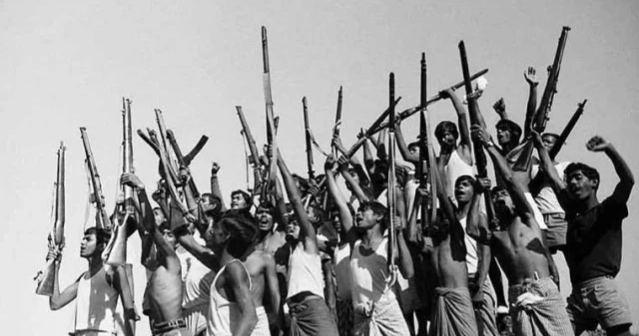
The Jatiya Muktijoddha Council (Amendment) Bill, 2026 was passed in Parliament on Thursday to modernise existing laws and expand the state’s recognition of those who contributed to the 1971 Liberation War.
The bill placed and moved by Liberation War Affairs Minister Ahmed Azam Khan emphasises the preservation of the ideals of the Liberation War and the realisation of its core goals: equality, human dignity, and social justice.
A significant highlight of the amendment is the formal distinction between those who fought on the front lines and those who provided critical support from within the country or abroad.
According to the draft, ‘Bir Muktijoddha’ remains the designation for those who actively engaged in combat or military training against the Pakistani occupation forces and their local collaborators between March 26 and December 16, 1971.
This category specifically includes women who were repressed by the occupation forces (Biranganas) as well as medical staff who served in field hospitals.
According to the bill, "Bir Muktijoddha" means those who have undergone war preparation and internal training in villages and towns within the country from 26th March to 16th December 1971 and those who crossed the borders of Bangladesh and enrolled in various training camps in India with the aim of participating in the Liberation War and have actively participated in the Liberation War against the invading and occupying Pakistani armed forces and their domestic allies Razakars, Al-Badr, Al-Shamu, then Muslim League, Jamaat-e-Islami, Nezam-e-Islam and Peace Committee by engaging in war against Pakistan in order to achieve the great independence of Bangladesh.”
“ All such civilians who are within the minimum age specified by the government at that time and who are members of the armed forces, East Pakistan Rifles (EPR), police forces, Mukti Bahini, the Bangladesh Government in exile and other forces recognised by that government, naval commandos, Kilo Force, Ansar members and the following citizens of Bangladesh shall also be included as valiant freedom fighters, Namely:-
(a) All women (heroes) who were tortured by the invading and occupying Pakistani forces and their collaborators; and
(b) All doctors, nurses and medical assistants of the field hospitals who provided medical care to the wounded freedom fighters during the Liberation War;
The new category, "Associates of the Liberation War" (Muktijuddher Shohojogi), will now officially include individuals who played organizational roles, built international public opinion, or provided diplomatic and psychological support.
This group encompasses professionals living abroad who campaigned for Bangladesh, officials and employees of the Mujibnagar Government, members of the National and Provincial Assemblies (MNA and MPA), artists and technicians of the Shadhin Bangla Betar Kendra, pro-liberation journalists, and the members of the Shadhin Bangla Football Team.
As per the Bill, "Associates of the Liberation War" means those who, from 26 March to 16 December 1971, were present in the country or abroad, to inspire the brave freedom fighters and to accelerate the liberation war and the achievement of Bangladesh's independence, to play the role of organizers, to form world public opinion, to obtain diplomatic support and to gain psychological strength, in the context of the following Bangladeshi citizens who directly participated and cooperated, namely:-
(a) Bangladeshi professionals who made special contributions to the liberation war while staying abroad during the liberation war and who played an active role in forming world public opinion;
(b) Those who were officers or employees or envoys under the Bangladesh Government in Exile formed during the liberation war and who served as doctors, nurses or other assistants appointed by that government;
(c) All MNAs (Member of National Assembly) or MPAs (Member of Provincial Assembly) associated with the Bangladesh Government in Exile of the People's Republic of Bangladesh formed during the Liberation War who were later considered as Members of the Constituent Assembly;
(d) All artists and craftsmen of the Swadhin Bangla Radio Station and all Bangladeshi journalists who served in support of the Liberation War in the country and abroad; and
(e) Swadhin Bangla Football Team;
The amendment also proposes structural changes to the Jatiya Muktijoddha Council (JAMUKA).
Financial management of the Council is also addressed in the bill. It provides for the establishment of a dedicated "JAMUKA Fund" which will be maintained through government grants, private donations, and international aid. The fund will be managed via a Personal Ledger account under the government’s public account system, with provisions for the Council to take out loans with prior government approval for necessary expenditures.
The bill also grants JAMUKA the authority to appoint administrators or form 11-member ad-hoc committees for organisations related to freedom fighters if their executive committees are canceled or dissolved.
The statement of the bill notes that while previous laws in 2002 and 2022 focused on listing and welfare, this 2026 amendment is necessary to ensure the "ideals of the Liberation War remain upheld in national life" and to provide distinct recognition to those who accelerated the victory through non-combat support roles.
This bill follows the Jatiya Muktijoddha Council (Amendment) Ordinance of 2025, which is set to be repealed and replaced by this comprehensive Act upon passing.
Paying tribute to freedom fighters Jamaat-e-Islami leader and Leader of the Opposition Md Shafiqur Rahman prayed for the souls of those who led the bloody war of independence.
He stated that while the country became independent with hopes of humanity and justice, the reality after liberation was the opposite.
He argued that the Liberation War became inevitable because the mandate of the people was denied, yet the post-independence rulers quickly forgot this.
Shafiqur Rahman noted that multi-party democracy was eventually replaced by a one-party BAKSAL system.
He highlighted that in 1975, Parliament abolished multi-party democracy after only seven minutes of debate, banning all political parties.
He commented that multi-party democracy only returned to Bangladesh after 1975 under President Ziaur Rahman, whom he described as a leader loved by people.
Regarding the JAMUKA Act, the opposition leader claimed the current definitions were not introduced by post-independence governments or during the tenures of Ziaur Rahman and Khaleda Zia.
Instead, he attributed the specific inclusion of certain definitions to the previous Awami League administration which he labeled as fascist.
He specifically questioned the inclusion of three political parties—the then Muslim League, Jamaat-e-Islami, and Nezam-e-Islam Party—alongside the Pakistani army in the bill.
He remarked that only Allah is the complete witness to the roles played during the extreme times of 1971.
Referring to the 1979 Political Party Ordinance, Rahman expressed gratitude for the restoration of political rights, which allowed parties like the Awami League to be reborn.
He concluded by calling for national unity and a political culture rooted in responsibility and compassion rather than division.
Later, Speaker Hafiz Uddin Ahmed said that the NCP has no objection to the Jamuka Bill and requested the Parliament to bring it to the attention of the Parliament.
Then, he put the bill to a vote. At that time, when the Minister for Liberation War Affairs wanted to speak, the Speaker said that the opposition leader did not raise any objection.
Still, he said, if you want to say something, you can say it.
The Minister for Liberation War Affairs said, "Honorable Speaker, I request you to bring up the bill in the form it was raised." Later, the Speaker gave permission.