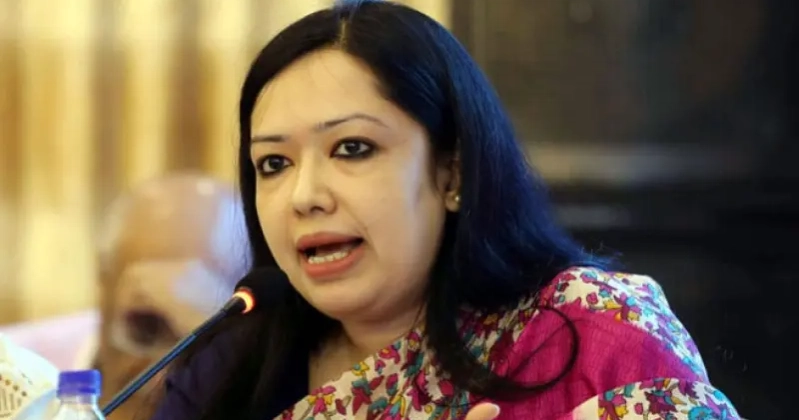
Independent MP Rumeen Farhana on Tuesday told Parliament that the July 2024 mass uprising was not merely about a change in government, but about building a new, inclusive Bangladesh.
Taking part in the general discussion on the thanksgiving motion on the President’s speech, she said the movement was driven by ordinary citizens who envisioned a transformed political culture.
“Those whose sacrifices brought us here today – some as ministers, some as MPs, some in government and some in opposition – will never hold such positions. They were ordinary, hardworking people with extraordinary dreams,” she said.
Rumeen Farhana said the aspirations of those who took part in the uprising were clear and grounded in the vision of a fairer and more accountable state.
Highlighting the role of women in the movement, she noted that women were at the forefront during the protests but remain largely absent from political representation afterwards. “Women led from the front. Yet within a year, their presence has faded. There are only seven women in this Parliament – I leave that question to you,” she said.
The independent MP also lamented the societal treatment of women, saying they are often used as shields during movements but later subjected to ridicule.
“Women stand at the frontlines as shields in the face of tear gas and baton charges. But once stability returns, they become targets of trolling – judged for their clothing, appearance, speech and even their smiles,” she said, adding that excluding 52% of the population from the vision of a new Bangladesh is simply not possible.
Rumeen Farhana also highlighted economic challenges, including employment generation, inflation, remittance, forex reserves and money laundering.
She particularly emphasised the issue of illicit financial outflows, noting that a huge amount of money had been siphoned out of the country over the past 15 years.
“According to central bank estimates, $234 billion has been laundered out of the country in the last 15 years. Unless this money is brought back, or the defaulted loans in the banking sector – amounting to around Tk 6 lakh crore – are reduced, no economic recovery plan will succeed,” the MP said.
She pointed out that 75% of the laundered money was transferred through over- and under-invoicing, adding that $68 billion had been siphoned off in the last decade through such practices. “As long as false invoicing continues, money laundering cannot be stopped,” she warned.
Rumeen Farhana stressed the importance of reducing bureaucratic complexities, ensuring uninterrupted electricity and gas supply, curbing corruption, and introducing an effective one-stop service system to improve investment climate.