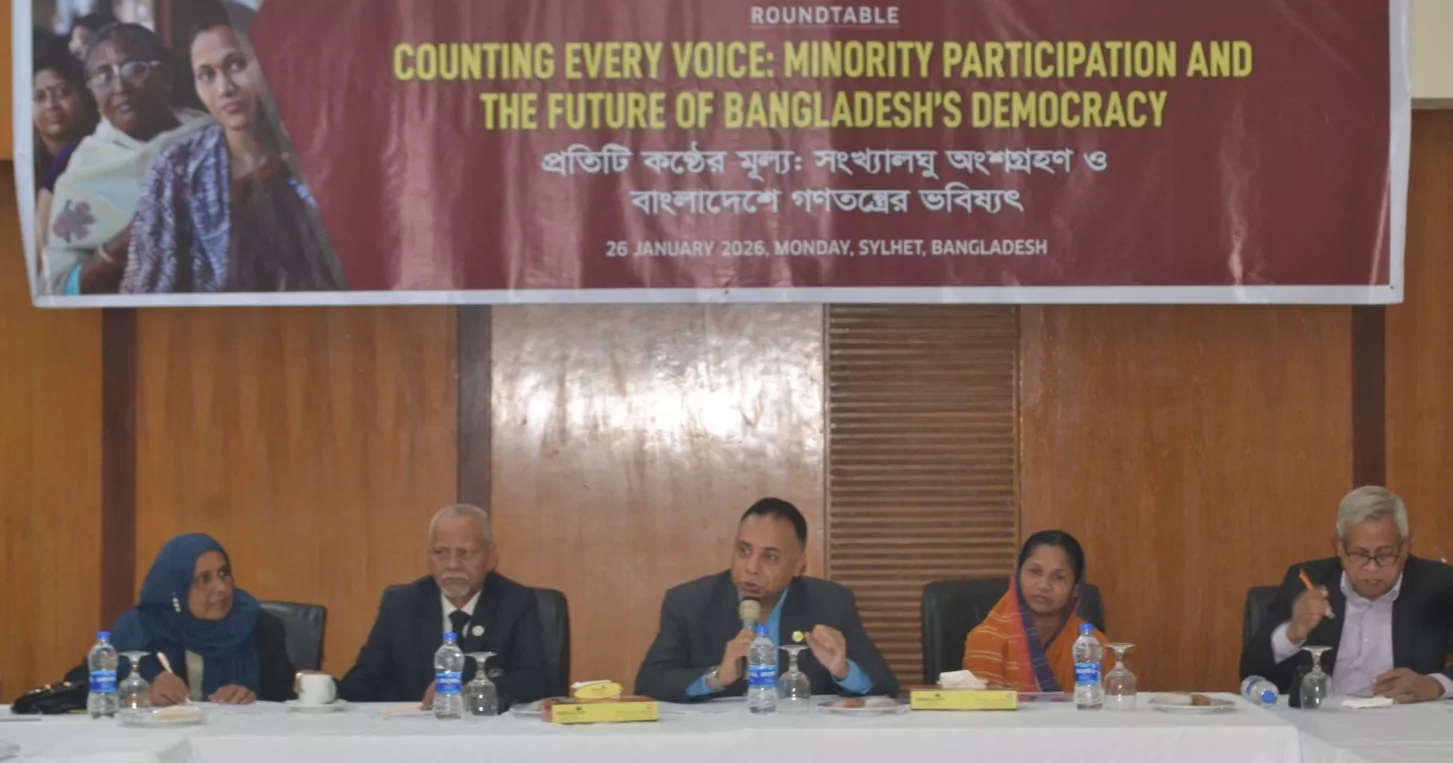
Speakers at a discussion on Monday highlighted the importance of equal rights and opinions of all citizens in an accountable and participatory democratic system, particularly emphasising the necessity of ensuring meaningful participation of minority communities in the context of the upcoming National Parliamentary Election 2026.
The speakers also highlighted the need to bring the voices of marginalized communities into the mainstream and ensure their active and fearless participation in the electoral process to strengthen transparency and accountability in state governance.
If the right to vote cannot be ensured in a fear-free environment, inclusive democracy will remain only a matter of words, the discussants said.
In elections, minorities must not be treated as mere vote banks; their rights and dignity must be guaranteed, they said.
Chevron's CSR: Rotaplast completed 54 life-changing surgeries in Sylhet
The Centre for Governance Studies (CGS) organised the roundtable discussion titled “Counting Every Voice: Minority Participation and The Future of Bangladesh’s Democracy.”
The event was moderated by Zillur Rahman, President of the Centre for Governance Studies (CGS) held at Nirvana Inn, Mirzajangal Road, Sylhet.
Representatives from civil society, lawyers, teachers, journalists, minority communities, and marginalized groups took part in the event.
Among the discussants were Advocate Mrityunjoy Dhor (President, Bangladesh Hindu Buddhist Christian Unity Council, Sylhet Metropolitan), Advocate Moloy Purkayastha (Acting President, Puja Udjapan Parishad, Sylhet Metropolitan), Advocate Bijoy Krishna Bishwas (President, Bangladesh Hindu Buddhist Christian Unity Council, Sylhet District), Mintu Deshowara (Sylhet Correspondent, The Daily Star), Iqbal Siddiqui (Bureau Chief, Financial Express), Aniljoy Dikar (Secretary, Khasi Social Council), Hilda Mukim (Khasi Women’s Representative), Samar Bijoy C. Shekhar (President, Sylhet District Tax Lawyers’ Association), Ronen Sarkar Rony (Lawyer), Gouranga Patra (President, Patra Community Welfare Council), Lokkhi Kanta Singh (Chief Executive Officer, Ethnic Community Development Organization), Hari Sabor (Tea Worker Leader), Shely Das (Tea Worker Leader), Professor Zahirlul Haque Shakil (Vice-Chancellor, Metropolitan University), Abdul Karim Kim (Coordinator, Aggrieved Citizens’ Movement, Sylhet), Pronob Kanti Deb (Head of Department, English Department, Sylhet International University), Advocate Emadullah Shahidul Islam Shaheen (Former President, Sylhet District Bar Association), Milon Orao (Representative, Orao Community), Professor Nazia Chowdhury (Department of Physics, SUST), Advocate Syeda Shirin Haque (President, Conscious Citizens Committee, Sylhet), Deacon Nijhum Sangma (Chairman, Presbyterian Church), Rajib Kumar Dey (Member Secretary, Hindu Buddhist Christian Welfare Front), Ms. Sukta (President, Hijra Youth Welfare Organization, Sylhet), Mukti (Treasurer, Hijra Youth Welfare Organization, Sylhet), Milon Robidas (President, Bangladesh Dalit Parishad, Sylhet Division), Utpol Barua (Founding President, Bangladesh Buddhist Youth Council, Sylhet Region), Chandra Shekhar Barua (President, Buddhist Association, Sylhet), Piyush Kanti Purkayastha (entrepreneur), along with CGS President Zillur Rahman, among others.
Salinity in Khulna’s water may reach near-ocean levels in 50 years: Ainun Nishat
At the beginning of the event, Zillur Rahman said that as Bangladesh moves toward the upcoming national parliamentary election, the participation of minority communities must be viewed as a core measure of democracy, not as a side issue.
Although minority communities comprise approximately 9.6 percent of the country’s population, many feel that political parties do not give due importance to their issues in electoral pledges and programs.
While many parties consider minorities as vote banks during elections, visible and responsible initiatives to ensure their security, rights, and dignity are often limited.