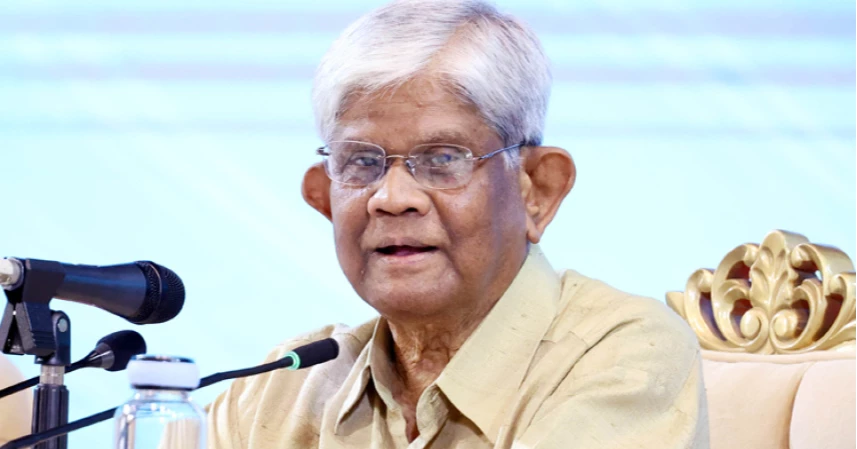
Finance Adviser Dr Salehuddin Ahmed on Tuesday said the government has made substantial progress in identifying individuals and destinations involved in money laundering, though recovering the funds remains a complex and lengthy process.
“Identifying money laundering is difficult, but you are aware that we have streamlined the processes,” he said while speaking to reporters after a meeting of the Advisers Committee on Government Purchase.
The adviser acknowledged that detecting illicit financial flows is inherently difficult but stressed that institutional mechanisms had been strengthened during his tenure.
Upon assuming office, Dr Salehuddin said, he convened a meeting on money laundering that had not been held for five years. “The first meeting on money laundering after five years was held after I took charge. Previously, such a meeting had not taken place.”
A sub-committee was subsequently formed to collect primary information and initiate action, he said, adding, “We have to take action from our side first. When we make requests abroad, they ask what steps we have taken domestically. Without demonstrating our own actions, it becomes difficult to seek cooperation.”
The finance adviser highlighted that mutual legal assistance procedures with foreign jurisdictions are highly complicated. “Mutual legal assistance is not simple. It involves numerous formalities and documentation. In some countries, such as Japan, documents must be translated into their language. You cannot simply send papers in English and expect results.”
He said those who launder money often employ highly skilled professionals and complex methods. “Those who have laundered funds have done so using very competent people. There is layering, multiple documentation and intricate financial arrangements. To detect this, we also need equally skilled professionals.”
Despite the challenges, Dr Salehuddin claimed that a significant amount of information has already been gathered. “Identification has been made. We know who has done it and in which countries. Many individuals hold passports in multiple countries. We are aware of where they are.”
He, however, declined to disclose the exact amount of money identified as laundered. “I am not stating the exact figure at this moment.”
The adviser clarified that not all overseas funds held by Bangladeshis are illicit. “Not everyone has transferred money illegally. Some funds abroad may be legal, with proper permission from Bangladesh Bank. For instance, export proceeds or retained earnings may lawfully remain outside the country.”
According to him, authorities have identified around 11 or 12 major cases, while information on others is also available. The National Board of Revenue (NBR), Bangladesh Bank and the Ministry of Finance possess relevant data, he added.
“The base has been created. The information is there with the NBR, Bangladesh Bank and the Ministry of Finance. If the next government is serious, they can take this forward,” said Dr Ahmed, urging the incoming administration to consolidate the progress made so far rather than restarting investigations from scratch.
“My strongest suggestion to the next government is: please try to consolidate what has been done. Many discoveries have already been made. There is no need to rediscover the same things,” he said.
Revitalising trade, job creation top challenges for next govt: Dr Salehuddin
He emphasised the need for stronger coordination among government agencies, pointing to existing gaps in inter-agency cooperation. “There is a lack of coordination among government departments and agencies. This needs to improve.”
Referring to asset declarations, the finance adviser said he had submitted his own statement of assets two years ago and that the matter had been forwarded to the Cabinet Division for necessary action in accordance with procedure. “Our accountability is to the Cabinet Division. We have submitted what was required. The relevant divisions will take action as per their mandate.”
Dr Salehuddin said that although recovering laundered funds is difficult and takes time, the necessary institutional foundation is now in place for future action.