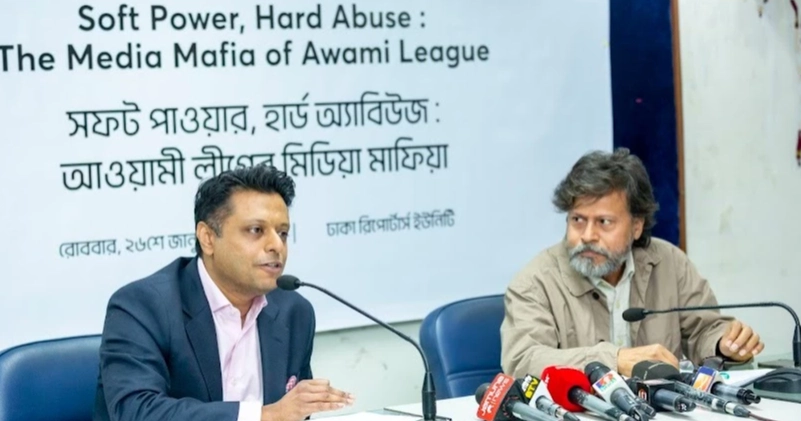
Speakers at a press conference have alleged the strategic use of "soft power" by the recently ousted Awami League government to legitimise an authoritarian regime through domestic and international platforms.
The press conference titled “Soft Power, Hard Abuse: The Media Mafia of Awami League”, organised by The Future Forum, was held at Dhaka Reporters Unity (DRU) in the capital on Sunday.
They alleged that during its tenure, the Awami League employed substantial financial resources to control local media, enforce the Digital Security Act of 2018 (later renamed the Cyber Security Act), and propagate favorable narratives internationally.
Electoral reforms must be done by Oct for polls in Dec
Dhaka Lit Fest founder Ahsan Akbar accused the previous government of funneling significant resources into controlling local media and promoting a global narrative to its advantage.
Highlighting the 2018 Digital Security Act as a key tool for stifling dissent, Akbar alleged that the Awami League invested heavily in international lobbying and propaganda efforts.
“For example, international political lobbyists were hired, questionable members of the U.S. Congress were paid, and biased opinions were propagated," Akbar said.
He also said that the Center for Research and Information (CRI), which operated under the leadership of Sheikh Hasina’s nephew, played a role in dominating platforms like PEN Bangladesh.
Dhaka Lit Fest was also misused for government propaganda, he alleged.
Akbar further noted that this agenda often involved promoting narratives described as anti-Muslim, Hindutva-aligned, and pro-Israel, with efforts intensifying since 2015.
Ahsan Akbar also raised concerns over alleged financial misconduct, claiming millions of dollars were distributed to individuals and organizations abroad without approval from the Bangladesh Bank—a violation of the country’s money-laundering laws.
Journalist and political analyst Ashraf Kaiser cited a report by The Sunday Times (UK), which revealed that former Prime Minister Sheikh Hasina had hired a British lawyer to take legal action against journalists critical of her administration. Kaiser said that the CRI influenced local and global platforms, manipulated Dhaka Lit Fest panels, and even took over PEN Bangladesh without democratic elections.
During his address, Akbar said that both he and his family faced threats and intimidation from the Rapid Action Battalion (RAB).
He also referenced a controversial statement by Kazi Anis Ahmed, director of Gemcon Group, during the July Revolution. Akbar alleged that students opposing members of the Gemcon Group board of trustees, who reportedly supported the fascist government, were called “terrorists.”