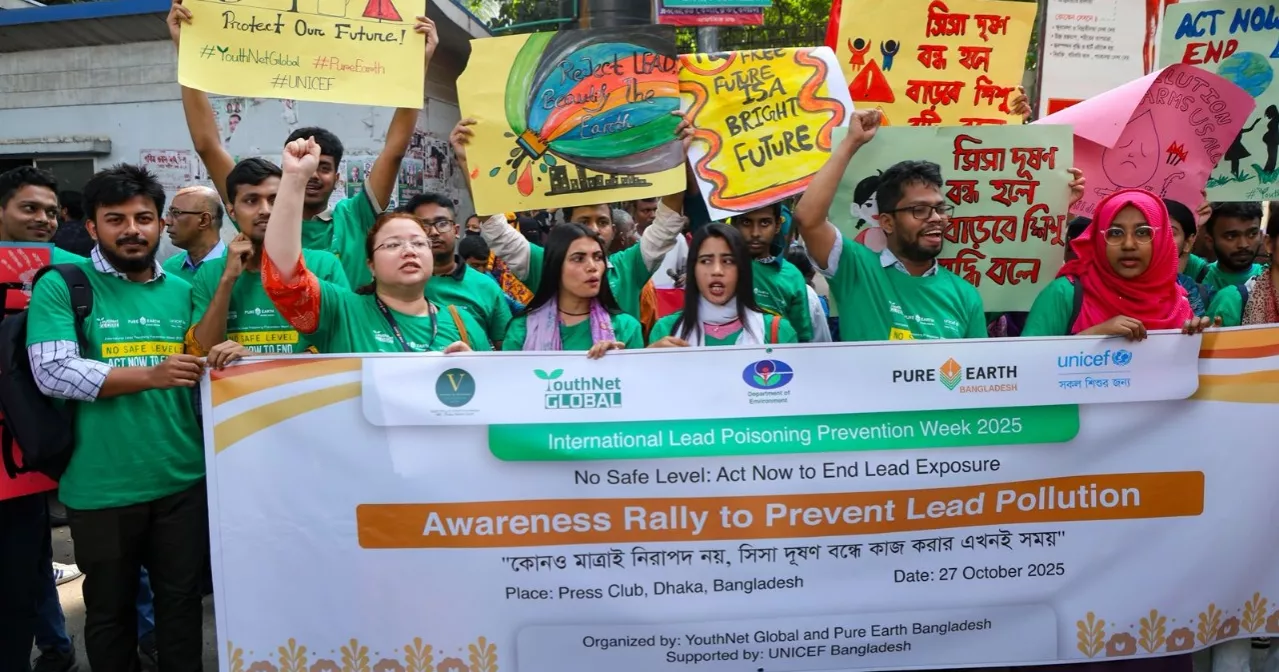
Speakers at a rally in Dhaka on Monday urged the government to take immediate action against lead pollution, calling illegal lead-acid battery recycling a “silent public health crisis” that threatens millions of children and the nation’s future.
They stressed the need for environmentally sound management (ESM) and strict regulation of unauthorised recycling of used lead-acid batteries (ULAB) to prevent health risks and environmental damage.
The rally, organised by YouthNet Global and Pure Earth Bangladesh in coordination with the Department of Environment and with support from UNICEF, was held at the Dhaka Press Club to mark International Lead Poisoning Prevention Week 2025 under the global theme “No Safe Level: Act Now to End Lead Exposure.”
The organisers reaffirmed their commitment to building a lead-free Bangladesh, echoing WHO’s call that “there is no safe level of lead exposure” and urging immediate action.
During the human chain, speakers issued a 10-point demand, calling on the government to classify lead as a toxic chemical, conduct a nationwide blood lead survey, enforce strict product standards, shut down unsafe lead-acid battery recycling factories, remediate contaminated sites, strengthen laboratory and research capacity, provide training for officials and youth, develop a national strategy, increase public awareness, and ensure stricter monitoring of consumer products.
The event formed part of a month-long nationwide campaign across all 64 districts, engaging 18 partner organisations to strengthen collective action against lead pollution.
Over 150 participants, including volunteers, youth organisations, environmental activists, government officials, students, and media representatives, joined the rally.
Sohanur Rahman, Executive Coordinator of YouthNet Global, highlighted the role of young people in combating lead pollution. “Lead pollution is devastating for children, but it is entirely preventable,” he said.
Mitali Das, Country Director of Pure Earth Bangladesh, warned that lead contamination has spread through soil, water, and air, entering the food chain. “This toxic metal is harming children, families, and workers across Bangladesh,” she said.
Md. Maruf Mohaimen, Research Officer (Waste and Chemical Management) and Focal Person for Lead at the Department of Environment, said, “Preventing lead pollution is a national priority. We are working closely with communities, NGOs, and industries to enforce laws, promote safe practices, and raise awareness so that every citizen can live in a lead-free, healthy Bangladesh.”