The year 2028 will mark the bicentenary of Henrik Ibsen’s birth, an occasion that will be commemorated worldwide. As part of the lead-up to the global celebration, the 198 th birth anniversary of this Norwegian playwright will be observed on 20 March this year.
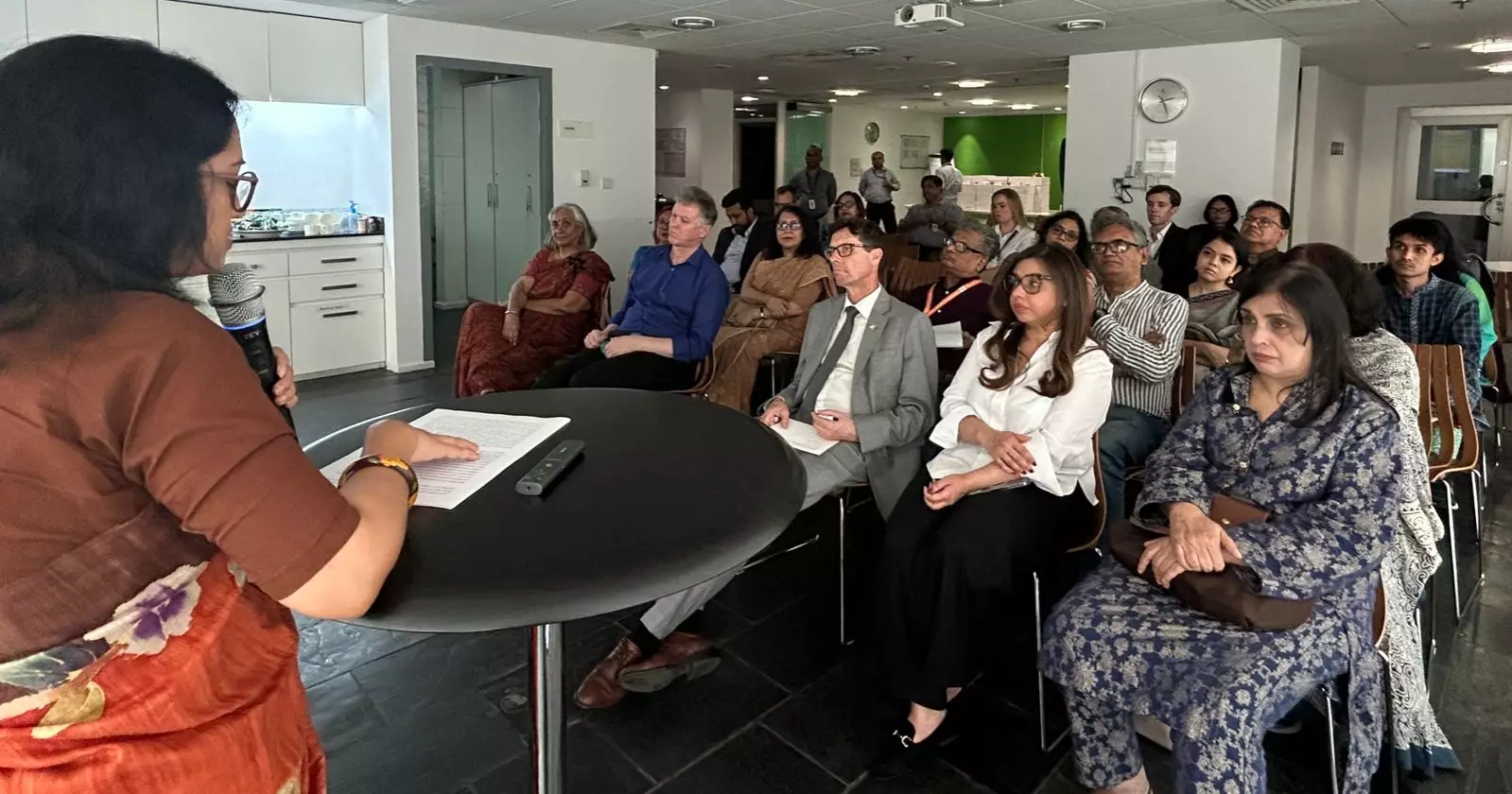
To mark this occasion, the Royal Norwegian Embassy in Dhaka hosted a special talk titled ‘Ibsen as an Environmental Artist’ on Sunday.
UN mobile photography contest held in city
The Norwegian dramatist Henrik Ibsen (1828-1906) is recognised for his social plays that prioritise the representation of middle-class urban domesticity and its inherent ideological tensions. The idea of Professor Sabiha Huq’s monograph Ibsen’s Green and Blue Cartography germinates from the
history of Ibsen’s growth as a dramatist with greater connections with his surroundings than is often
brought out in common discussions.
The book is envisaged as a study of Henrik Ibsen’s work vis-à-vis the abundance or lack of nature (of
which forests and mountains are conceptualised by ‘green’ in the title of the book and the sea by
‘blue’), and its effect on human mind.
Professor Huq describes the main intent of the book as highlighting the fact that there is an undercurrent of longing for a closer bonding with nature even in
the social plays of Ibsen that give us “a sense of parched wastelands devoid of happiness and where
the human mind is essentially fettered”.
Ibsen’s characters are immersed in complicated philosophical and existential questions, and one of the major reasons, this book hypothesises, is their
lack of connection with nature. On the other hand, the natural environment plays a crucial role in
some of his plays.
Due to the existence of even more crucial human interactions in the plays,
however, these natural backgrounds have historically been obfuscated from readers’ and audiences’
attention. In her book, Dr Huq will discuss Ibsen’s dramatic texts and look at some select productions
from the angle of environmental humanities. She will look at Ibsen’s vocabulary to trace the
existence of the natural world in them.
During the event, Dr Sabiha Huq, Professor at the Department of English and Humanities, BRAC
University and a member of the International Ibsen Committee, engaged in a dynamic discussion
with academics, members of the cultural community, diplomats and development partners,
responding to questions and comments on her research and its broader implications.