Additional Secretary (World Health Wing) of the Health Services Division Sheikh Momena Moni said on Tuesday that although the government earns around BDT 400 billion annually in revenue from the tobacco sector, losses in this sector exceed BDT 870 billion due to healthcare costs, reduced productivity, and premature deaths.
"To prevent this enormous financial loss and loss of life, the interim government approved the Tobacco Control Ordinance, clearly demonstrating its strong commitment to protecting public health. If the next elected government continues this position, there should be no obstacle to passing the law in Parliament. Therefore, political parties participating in the elections must also take a stance in favour of this law," she said
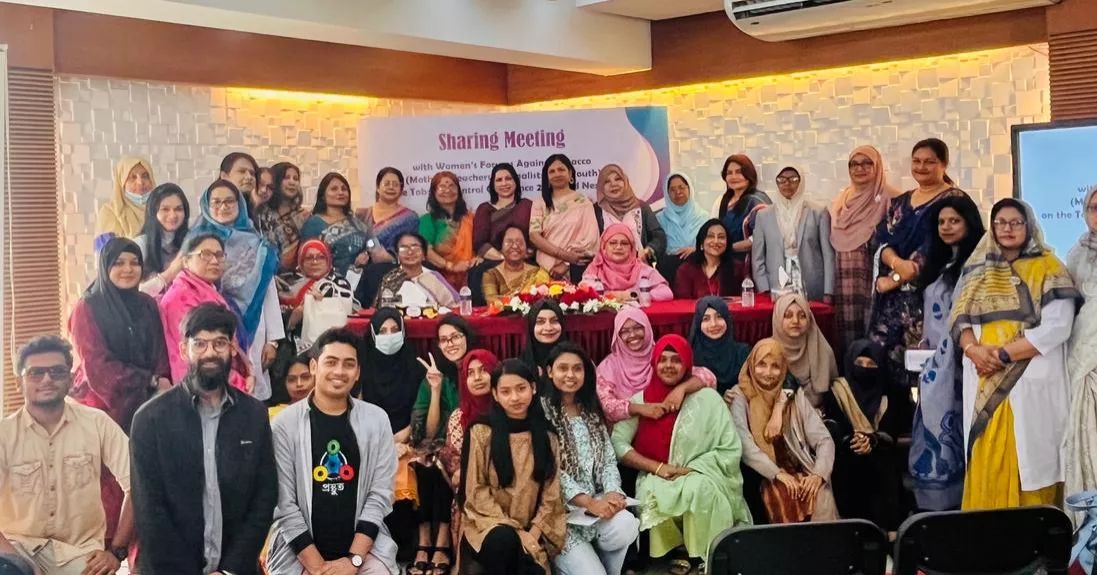
She said this while addressing a sharing meeting titled “Tobacco Control Ordinance 2025 and next steps” with women’s forums, organized by Nari Maitree at the Bishwo Shahitto Kendro in the capital, as the chief guest. The meeting was chaired by Shaheen Akhtar Dolly, Executive Director of Nari Maitree while Special guests included Md. Mostafizur Rahman, former Chairman of BCIC and Lead Policy Advisor of CTFK-Bangladesh.
Women professionals from various fields have demanded that it be passed in Parliament and enacted into law during the first session of the upcoming Parliament.
At the meeting, participants shared that according to the World Health Organization’s Tobacco Atlas 2025, more than 21.3 million adults (aged 15 years and above) in Bangladesh use tobacco. Among them, nearly 200,000 people die every year from tobacco-related diseases—more than 545 deaths per day. On the other hand, tobacco use causes an annual economic loss of approximately BDT 392 billion.
In this context, at the latest meeting of the Advisory Council (24 December 2025), the Smoking and Use of Tobacco Products (Control) (Amendment) Ordinance, 2025, proposed by the Health Services Division of the Ministry of Health and Family Welfare, was approved.
Under the approved ordinance, the use, production, and marketing of emerging tobacco products have been banned; nicotine pouches have been included under the definition of “tobacco products”; the use of all forms of tobacco products—alongside smoking—has been prohibited in public places and public transport. At the same time, provisions for designated smoking areas have been made subject to government directives; the definitions and scope of “public place” and “public transport” have been expanded; all forms of advertising, promotion, and display of tobacco products— including at points of sale and through the internet or any other media—have been banned; and the requirement for health warnings on tobacco product packaging has been increased from 50 percent to 75 percent of the surface area.
Shaheen Akhtar Dolly in her welcome speech said that the harms of tobacco are not limited to individual health risks; they have severe negative impacts on families, society, and the national economy. Citing data from Tobacco Atlas 2025, she noted that more than 11 percent of women in Bangladesh die from tobacco-related diseases.
Md. Mostafizur Rahman said that after the upcoming parliamentary elections, the ordinance must be passed and enacted into law in the very first session of Parliament. To achieve this, widespread public support must be mobilized so that it becomes a public demand. Once it becomes a public demand, the government will not be able to ignore it.
Speakers at the meeting also included Abdus Salam Mia, Program Manager of Campaign for Tobacco-Free Kids (CTFK) Bangladesh; Shibani Bhattacharya, Convener of Nari Maitree Mothers’ Forum; Dr. Khaleda Islam, Convener of the Teachers’ Forum; and youth advocates Raisul Islam and Shahreen Ferdous.