
Despite ongoing efforts by multiple agencies, preventing human trafficking in the Rohingya camps remains a significant challenge, experts said at a workshop organised by BRAC.
Participants mentioned that trafficking survivors often face barriers in accessing justice.
Key challenges include weak evidence management, the high vulnerability of displaced Rohingya communities, heavy workloads on police, frequent transfers of law enforcement personnel, difficulties in registering cases, and the informal settlement of serious crimes.
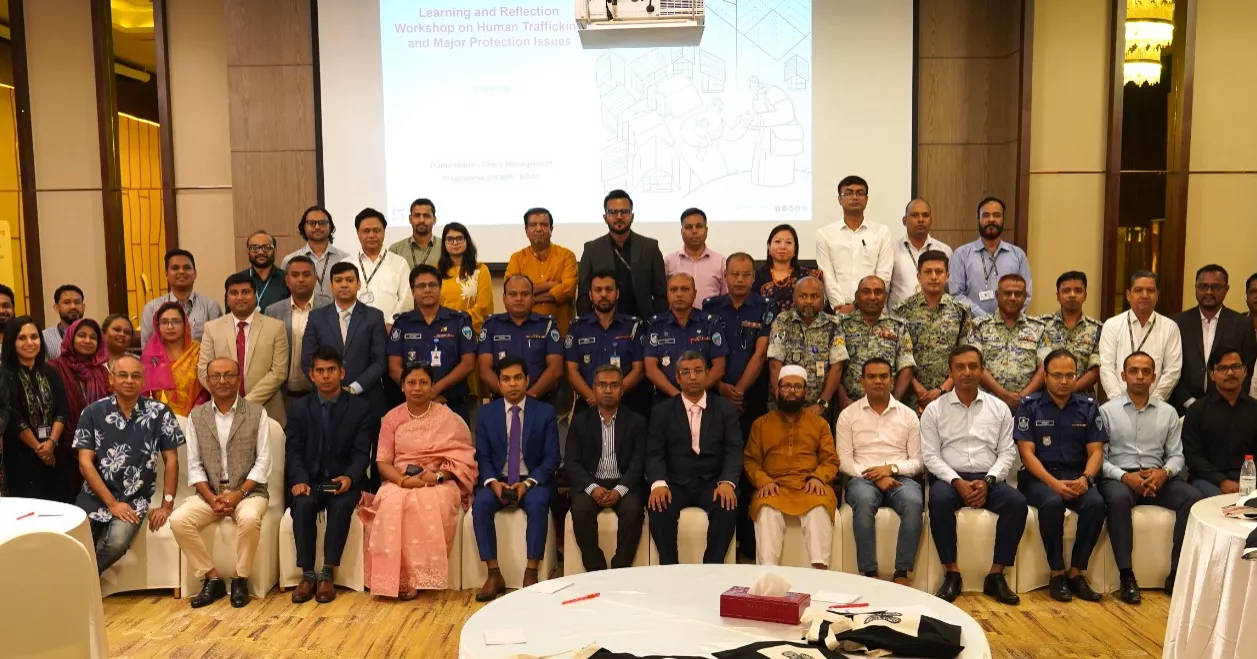
The observations were shared at a workshop titled “Consultation, Learning and Reflection Workshop on Human Trafficking and Major Protection Issues,” organised by BRAC’s Humanitarian Crisis Management Programme (HCMP) at a hotel in Cox’s Bazar.
The workshop aimed to strengthen coordination among the judiciary, law enforcement agencies, and camp authorities, and to generate actionable recommendations.
Rezaul Karim, Associate Director and Office In Charge (OIC) of HCMP, delivered the welcome remarks.
According to the 2025 report by the Anti-Trafficking Working Group (ATWG), 33% of trafficking victims are women and girls, while 25% are under 18. The number of victims rose by 28.8% in 2025 compared to the previous year.
BRAC reported that its HCMP Protection Sector has provided legal support to 784 trafficking survivors in host and Rohingya camps between 2017 and March 2026. Additionally, under the Humanitarian Development Coexistence (HDC) project, 400 Rohingya teachers, volunteers, and community leaders have received training through 18 skill development sessions to help prevent trafficking.
A key presentation was delivered by Md. Tanvir Islam of BRAC’s HCMP Protection Sector on the trafficking context and legal framework. Fakhrul Hasan, Assistant Superintendent of Police (ASP, Forcibly Displaced Myanmar Nationals) of the Armed Police Battalion (APBn), also highlighted operational challenges faced by law enforcement.
Among those present were Tapti Chakma, Camp-in-Charge (Camp 17), Saleem Badsha from IOM, and representatives from UNHCR. Mohammed Saifur Rahman Siddique, Senior District Judge of the Women and Children Repression Prevention Tribunal-3, also spoke on the legal frameworks and judicial processes related to trafficking.
The sessions were moderated by Mohaiminul Islam, Manager of Knowledge Management in the Protection Sector of HCMP, BRAC, and Naziyat Islam, Manager of Legal Protection at HCMP, BRAC.
Over 60 participants, including representatives from international organisations and NGOs, attended the workshop.