
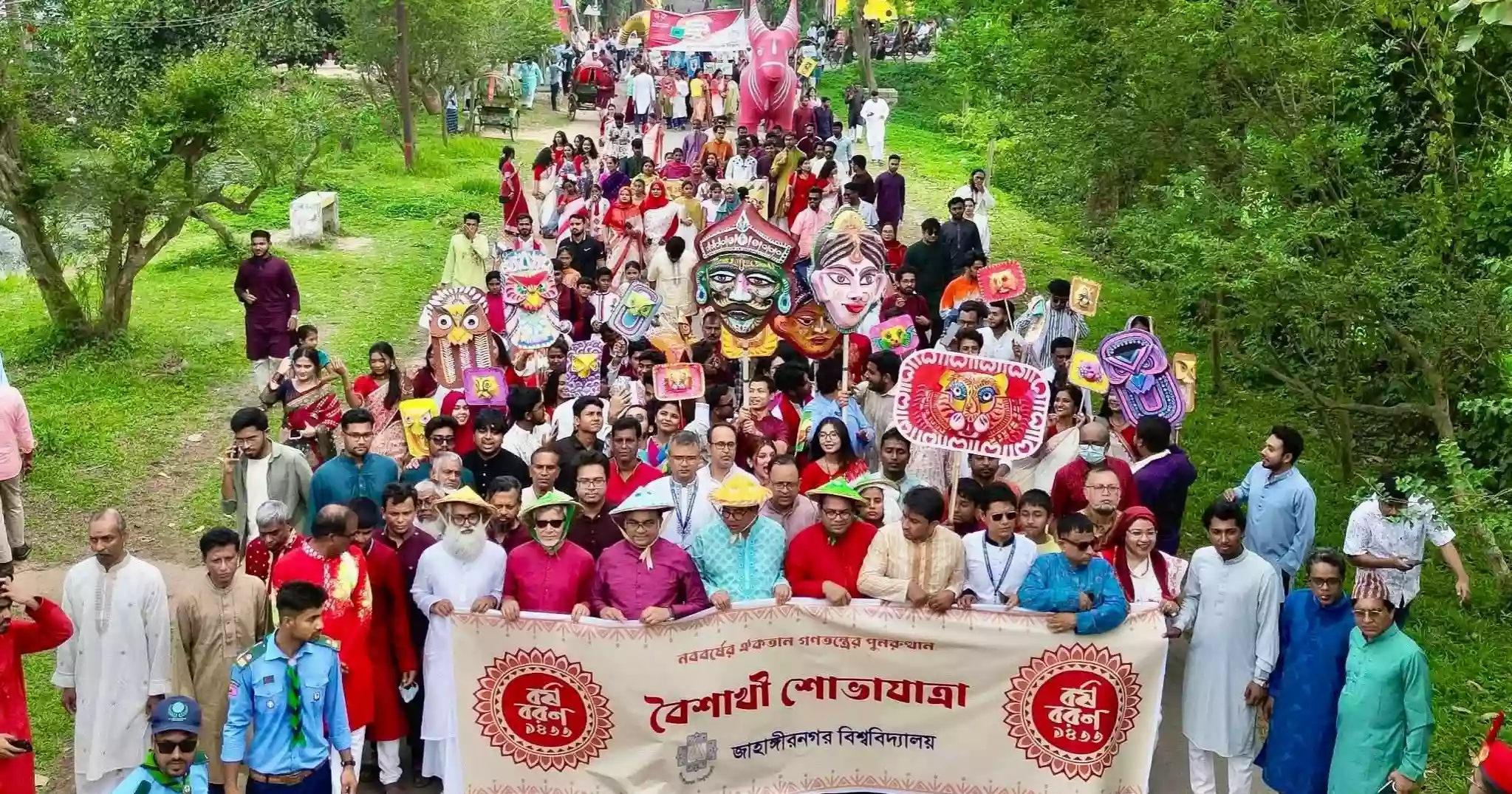
Jahangirnagar University (JU) celebrated the Bangla New Year 1433 with various programmes, including a Baishakhi rally and cultural events, on Tuesday.
JU Vice Chancellor Prof Dr Mohammad Kamrul Ahsan inaugurated the celebrations by exchanging New Year greetings with teachers, students, officers and staff at his residence around 8:15am.
Organisers played traditional Bangla New Year songs, including ‘Esho hey Baishakh Esho Esho,’ while they served guests with traditional items such as jilapi, sandesh, kadma, watermelon, mango juice, batasha, muri and khoi.
Later, around 9:45am, the VC formally inaugurated the Baishakhi celebration programme on the premises of the old Arts and Humanities Faculty. A colourful Baishakhi procession then started from the venue and paraded through the campus before concluding at the Selim Al-Deen Muktamancha.
Speaking on the occasion, the VC said JU has long been recognised as a centre of cultural excellence, adding that this year’s arrangement stands out for its diversity.
"Our goal is not to only prepare students for professional life but also to develop them as morally upright and enlightened individuals," he added.
The VC also urged all to move forward by embracing positivity, leaving behind the sorrows of the past and to contribute to building a humane society with respect for differing opinions.
Pro-VC (Academic) Prof Dr Mohammad Mahfuzur Rahman, Pro-VC (Administration) Prof Dr Sohel Ahmed, deans of different faculties, leaders of JU Central Students’ Union (JUCSU) and a large number of teachers and students joined the procession.
After the rally, the VC inaugurated a Baishakhi fair on the TSC premises. He later attended separate celebration programmes organised by the Bangla, Philosophy, English, Government and Politics, and Geography and Environment departments, exchanging greetings with participants.
In the afternoon, the Teacher-Student Centre (TSC), in coordination with the Student Welfare and Counselling Centre and JUCSU, arranged a cultural programme at the Selim Al-Deen Muktamancha, concluding the day’s festivities.