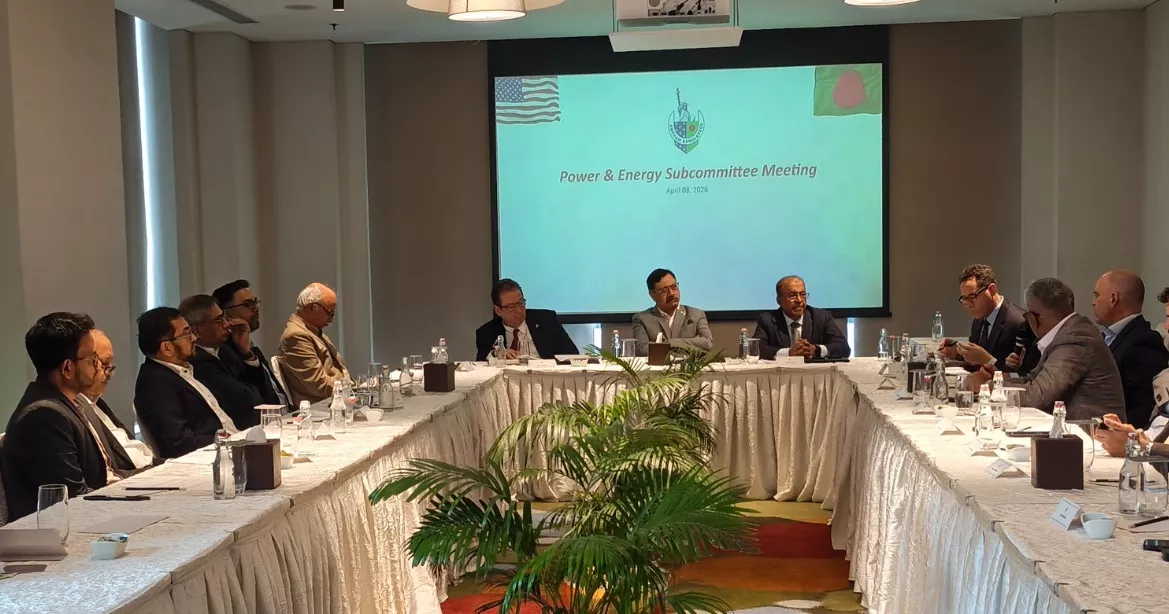
The American Chamber of Commerce in Bangladesh (AmCham) has called for a coordinated national energy strategy, emphasizing the urgent need for renewed domestic exploration and a diversified energy mix to meet the country's soaring future energy demand.
The call came during a ‘Focused Group Discussion’ organized by the AmCham Energy & Power Subcommittee at a hotel in the capital's Banani area on Wednesday. The event brought together industry leaders, policymakers, and energy experts to address challenges in the evolving energy landscape.
AmCham President Syed Ershad Ahmed stressed the importance of a consultative approach in policy formulation. He announced that AmCham would soon submit a comprehensive set of short, medium-, and long-term recommendations to relevant ministries based on stakeholder feedback.
Eric Walker, Vice President of AmCham and President of Chevron Bangladesh, warned that national energy demand could potentially double or triple within the next 15 to 20 years.
"Bangladesh must prepare for this surge through renewed drilling and government support for exploration," Walker said. He advocated for a multi-pronged strategy including expanded onshore and offshore exploration, additional LNG terminals, and increased investment in solar power.
Echoing the need for domestic self-reliance, Professor M. Tamim, Vice Chancellor of IUB and former Special Assistant to the Chief Advisor, noted that while gas field development takes time, the "BAPEX-only" approach has limitations. He recommended engaging international reservoir management firms to optimize output and urged a clear policy decision on domestic coal.
Prof. Tamim highlighted renewable energy as the fastest solution, suggesting Bangladesh could add 5,000 MW of solar capacity—including 2,000 MW from rooftop systems—by 2030 to reduce reliance on costly oil-based plants.
Dr. Sebastian Groh, Managing Director of SOL share, pointed out policy inconsistencies hindering green growth.
He noted that specialized energy service companies face duties exceeding 30 percent on solar equipment, while garment factories pay only 1%, creating an "uneven playing field."
He also recommended formalizing electric three-wheelers through licensing to unlock their potential as distributed energy storage.
On the demand side, experts suggested innovative measures such as staggered zonal school timings, seasonal office hours, and incentives for energy-efficient domestic appliances to manage the grid more effectively.
Habib Bhuyian, Country Manager at Excelerate Energy, warned that prolonged reliance on high-priced spot-market LNG could have severe economic consequences, urging a consolidated industry voice to guide policymakers.
The discussion was attended by representatives from leading firms, including Chevron, Energypac, Excelerate Energy, GE Vernova, and Omera Petroleum, as well as officials from the U.S. Embassy in Dhaka.