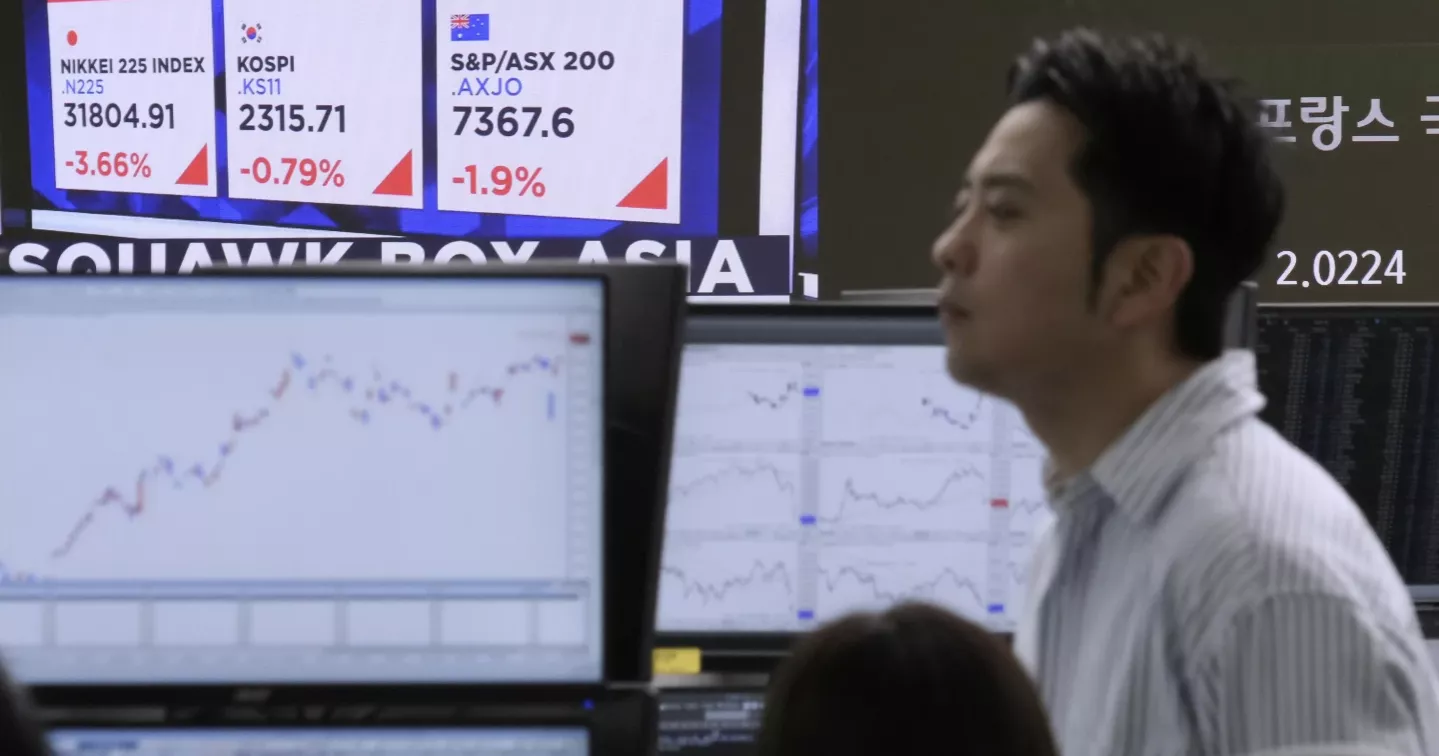
Asian stock markets tumbled on Wednesday after a sweeping new round of U.S. tariffs, including a staggering 104% duty on Chinese imports, officially came into force at midnight Eastern Time. The move has intensified global trade tensions and triggered widespread uncertainty among investors, economists, and policymakers.
Japan’s benchmark Nikkei 225 took a significant hit, at one point plunging more than 5%, while other key regional indices followed suit. By mid-afternoon in Tokyo, the Nikkei was down 4.7% at 32,475.57. Hong Kong’s Hang Seng dropped 1.8% to 19,769.24, South Korea’s Kospi shed 1.9% to 2,290.87, and Australia’s S&P/ASX 200 declined 1.8% to 7,374.80. Shanghai’s Composite Index edged slightly lower by 4 points to 3,141.46, and New Zealand markets also registered losses.
The market turmoil followed a volatile Tuesday on Wall Street. The S&P 500 erased a 4.1% gain to close 1.6% lower, falling nearly 19% below its February high. The Dow Jones Industrial Average dipped 0.8%, while the tech-heavy Nasdaq fell 2.1%.
China criticises US tariffs, warns of trade war losses
The latest tariffs, which build on previous rounds, include a baseline 10% duty on nearly all of America’s trading partners. Additional levies range from 20% to 50% on specific countries, with China facing the steepest hike. A 34% tariff was recently added to existing 70% duties on Chinese goods, bringing the combined rate to 104%. Other nations facing sharp increases include Vietnam (46%), Madagascar (47%), Taiwan (32%), South Korea (25%), Japan (24%), and the European Union (20%).
Economists warn the prolonged trade conflict could raise consumer prices in the U.S., dampen global economic growth, and potentially trigger a recession if the tariffs remain in place long-term. Some analysts believe the worst could still be averted if President Trump scales back the duties through negotiations.
Bangladesh Garment Sector at Risk
In Bangladesh, the world's second-largest apparel exporter after China, manufacturers are growing increasingly concerned about losing ground in the U.S. market. The country’s garments sector exported $7.34 billion worth of apparel to the U.S. in 2024, out of a nearly $39 billion industry.
However, with the U.S. now imposing a new 37% tariff on Bangladeshi apparel, manufacturers say American buyers are already pausing orders. Industry leaders warn this could allow competitors like India and Pakistan to gain market share.
To mitigate the impact, the Bangladeshi government has requested a three-month delay in implementing the new tariffs. Asif Ashraf, managing director of Urmi Group, cautioned that the measures could “change the global equilibrium.” The garments industry employs around 4 million people in Bangladesh, mostly women, and accounts for nearly 80% of the country’s exports.
South Korea Announces $2 Billion Auto Sector Support
Meanwhile, South Korea has rolled out an emergency support package worth 3 trillion won (approximately $2 billion) to shield its automobile industry from the fallout of the new tariffs. The initiative includes expanded low-interest financing from state-run banks, a joint support program with Hyundai and Kia, and increased subsidies for electric vehicle purchases.
China reiterates warning of retaliation over US tariffs
The auto sector is a key pillar of South Korea’s economy. Last year, the country exported $34.7 billion in vehicles and $8.2 billion in auto parts to the U.S. The South Korean government fears the newly imposed 25% U.S. tariff on cars and components will deal a “severe blow” to the sector.
As global markets reel from the escalation, all eyes remain on Washington to see whether further retaliatory moves or a return to negotiations will follow.
Source: With input from agency