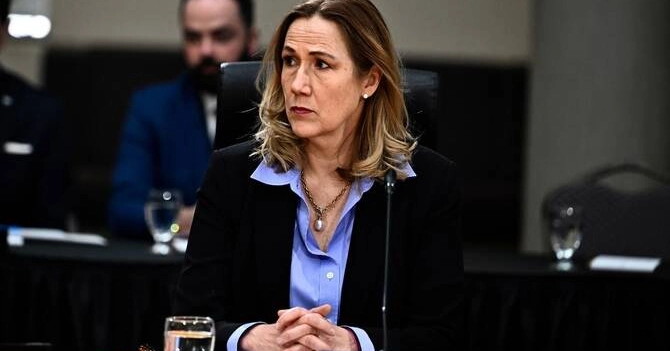
Canada’s top diplomat in Washington, Kirsten Hillman, announced Tuesday that she will step down next year, just as Canada and the United States prepare to reassess their free trade agreement.
In a letter, Hillman said the timing is appropriate for appointing a successor who will manage negotiations on the United States-Mexico-Canada Agreement, which is scheduled for review in 2026.
Prime Minister Mark Carney praised Hillman for laying the groundwork for Canada ahead of the upcoming assessment, noting she is one of the country’s longest-serving envoys to the U.S. Hillman, appointed in 2017 by then-Prime Minister Justin Trudeau, was also the first woman to hold the post.
She played a key role in negotiating trade terms during former U.S. President Donald Trump’s first term and worked with U.S. and Chinese authorities to secure the release of two Canadians imprisoned in China.
Hillman and Canada-U.S. trade minister Dominic LeBlanc have been leading discussions with U.S. Commerce Secretary Howard Lutnick and U.S. Trade Representative Jamieson Greer.
China’s exports rise 5.9% in November despite U.S. shipments falling sharply
U.S. Ambassador to Canada Pete Hoekstra praised Hillman on social media, calling her a respected figure in bilateral relations and wishing her well in her next chapter.
Trade tensions flared in October when Trump halted negotiations after Ontario aired an anti-tariff ad in the U.S., angering the president. This followed earlier friction over Trump’s suggestion that Canada should join the U.S. as its 51st state. Asked this week about resuming talks, Trump replied, “we’ll see.”
Canada remains one of the world’s most trade-reliant nations, with over 75% of its exports headed to the United States under the USMCA, which is due for review. Carney has set a goal to double Canada’s non-U.S. trade within 10 years.
Canada supplies about 60% of U.S. crude oil imports and 85% of its electricity imports. It is also America’s largest foreign source of steel, aluminum and uranium, and holds 34 critical minerals vital to U.S. national security.
Source: AP