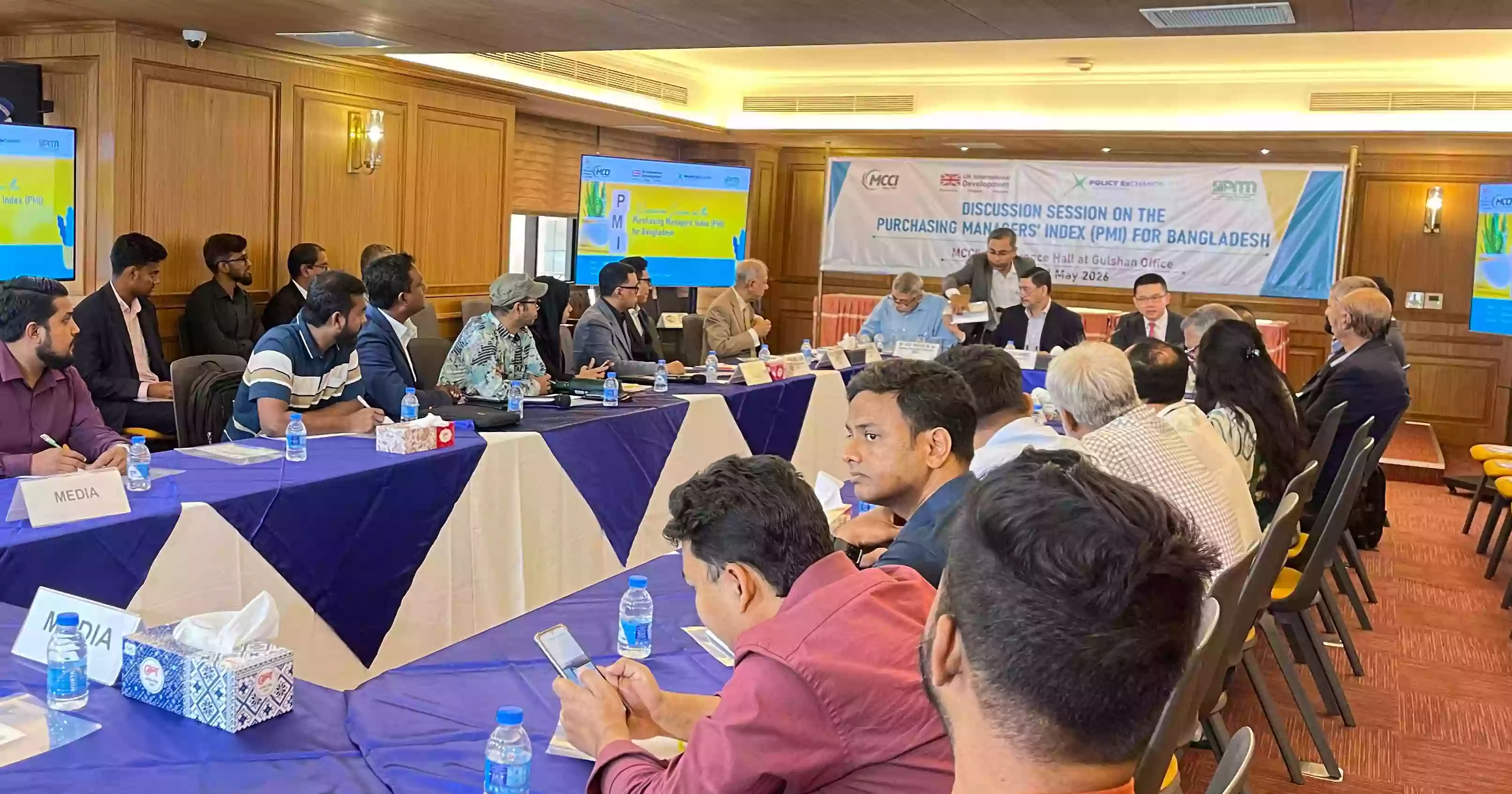
While Bangladesh’s agriculture and manufacturing sectors showed signs of expansion in April, other key segments of the economy, particularly construction, continued to contract, leaving businesses in sectors like steel struggling to stay afloat, experts and economist said at a discussion on the country's Purchasing Managers' Index (PMI) data on Wednesday.
The event, jointly organised by UK International Development, Policy Exchange Bangladesh and the Metropolitan Chamber of Commerce and Industry (MCCI), was held at the MCCI's Gulshan office.
Hasnat Alam, Senior Manager at Policy Exchange Bangladesh, presented findings from the latest PMI survey at the programme.
Responding to questions from journalists, he explained that the PMI is calculated by surveying senior executives or owners of firms across various sectors, asking seven to eight structured questions on trends in employment, imports, exports, output and new orders.
Aggregating the responses across firms and sectors, Hasnat said, yields a composite picture of the economy's overall direction – expanding, contracting or stagnating.
The PMI findings were broadly consistent with official data presented in a concurrent MCCI quarterly economic review. The review showed that the industry sector registered a sharp growth deceleration, falling to 1.27 percent in Q2 of FY26 from 6.82 percent in the previous quarter, while the manufacturing sub-sector slowed even more steeply, to 1.13 percent from 6.09 percent.
Construction growth collapsed from 9.35 percent in Q1 to just 1.56 percent in Q2, with the sector's difficulties creating knock-on effects for building materials industries.
Agriculture, by contrast, outperformed expectations. The sector grew 3.68 percent in Q2 of FY26, up from 2.11 percent in Q1, buoyed by favourable weather and timely government support for inputs and financing.
The sector accounts for approximately 44 percent of the country's labour force.
Domestic food grain production targets of 45.39 million metric tons were set for FY26, with Boro rice, accounting for about 52 percent of total rice output, expected to meet its target.
The services sector also registered a modest slowdown, growing 4.45 percent in Q2 compared to 4.51 percent in the previous quarter, with its share of GDP declining 1.47 percentage points to 50.57 percent.
Meanwhile, overseas employment recorded solid growth, with manpower exports rising 15.25 percent to 7,64,149 persons during July-February period of FY26 compared to 6,63,021 persons a year earlier.
The government is currently pursuing diplomatic efforts to reopen labour markets in Malaysia, Oman, the United Arab Emirates and Bahrain, while separately working towards placing 1,00,000 Bangladeshi workers in Japan over the next five years under a bilateral agreement.
The MCCI cautioned that the overall recovery, while showing some gradual improvement, remains exposed to both domestic risks, including political uncertainty and weak private investment, and external headwinds from the Middle East conflict and global trade disruptions.