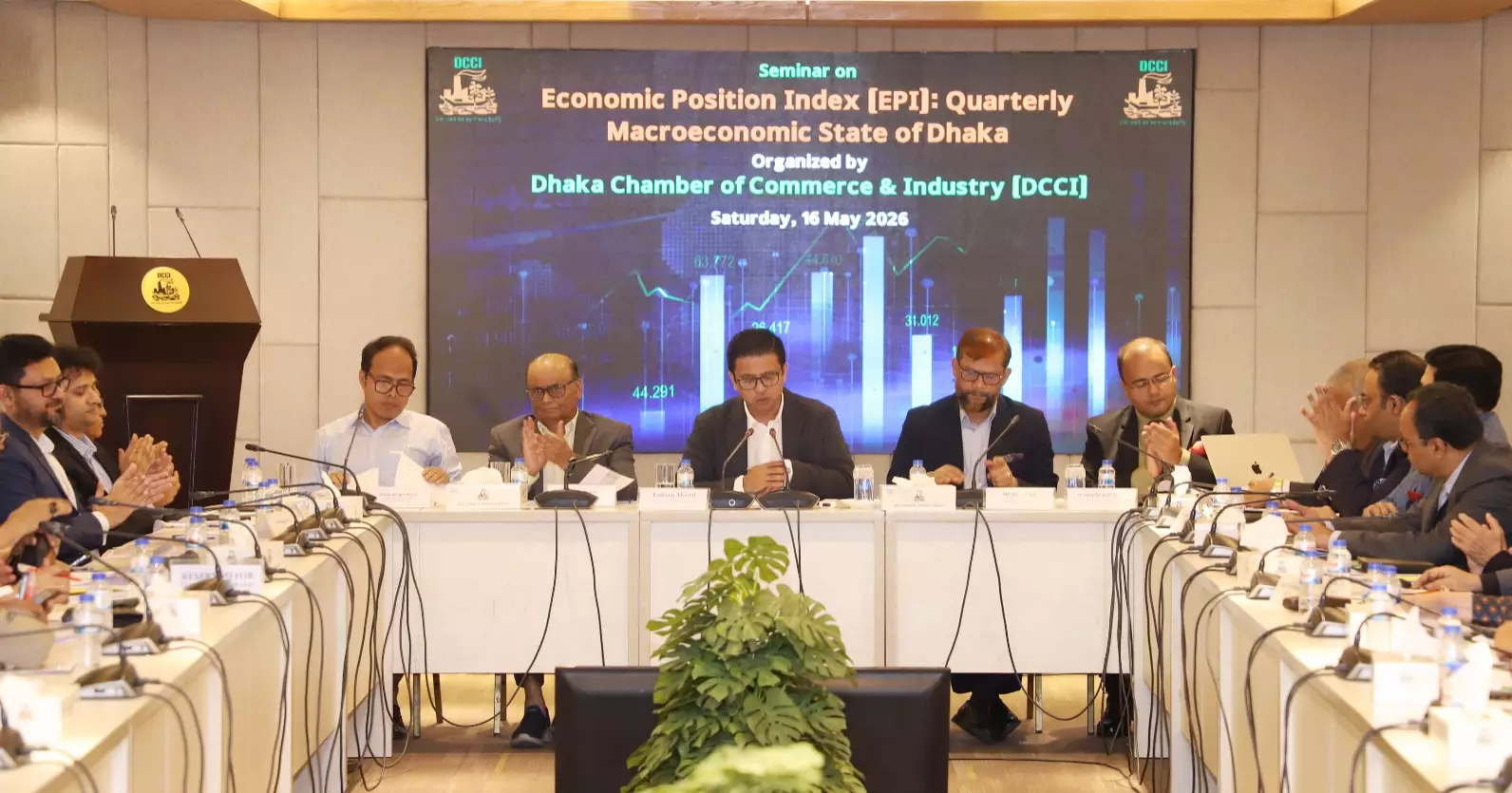
Economists, trade experts and government officials on Saturday called for expanding the Dhaka Chamber of Commerce and Industry's newly launched Economic Position Index (EPI) beyond Dhaka to make it a nationally effective policy tool, while stressing the urgency of addressing high inflation, sluggish investment and LDC graduation risks facing Bangladesh's economy.
Speaking as discussants at a seminar titled “Economic Position Index (EPI): Quarterly Macroeconomic State of Dhaka” held at the DCCI Auditorium in the capital chamber President Taskeen Ahmed said Bangladesh's economy is currently navigating a challenging period marked by high inflation, pressure on foreign exchange reserves, sluggish investment, energy uncertainty, rising manufacturing costs and declining employment opportunities.
He noted that conventional macroeconomic indicators are failing to capture real-time conditions and short-term changes, limiting effective policy response.
Policy Research Institute of Bangladesh (PRI) Chairman Dr Zaidi Sattar said while the research was conducted focusing on Dhaka, its acceptability and effectiveness would increase significantly if expanded nationwide.
Such an index would help entrepreneurs assess the prevailing business climate and take appropriate decisions accordingly, he added.
Nesar Ahmed, International Trade Expert (Former Additional Secretary), Support to Sustainable Graduation Project (SSGP), warned that Bangladesh exports its highest volume of goods to European markets under duty-free facilities but risks losing these preferential arrangements following its graduation from the least developed country category.
He said the CMSME sector faces particular exposure and stressed there is no alternative to reducing the cost of doing business and ensuring supportive business policies to overcome the challenge.
Additional Secretary Shibir Bicitro Barua of the Ministry of Commerce's IIT Wing identified high inflation, negative investment trends and fragility in the banking and financial sectors as the country's major economic challenges at present.
He informed the seminar that the Ministry of Commerce has initiated necessary reforms to the Import Policy Order, expected to be finalised within the next few months.
Dhaka University Professor Dr Mizanur Rahman observed that expenditures in both the public and private sectors have in recent years outpaced income levels, while sluggish investment growth has slowed overall economic activity.
He emphasised the necessity of institutional reforms, particularly strengthening the capacity of financial sector institutions.
Ministry of Foreign Affairs Director General for International Trade, Investment and Technology Dr Syed Muntasir Mamun said Bangladesh should rely more on its capital market for long-term financing rather than depending heavily on the banking sector.
He said the capital market remains weak and that there is also an absence of the necessary mindset to increase reliance on it.
Bangladesh Investment Development Authority (BIDA) former Director General Md Ariful Hoque said sector-specific information plays an effective role in policymaking, institutional reform and the provision of incentives.
Bangladesh Bank Chief Economist Professor Dr Akhand Mohammad Akhtar Hossain said there is no alternative to foreign direct investment for accelerating economic growth, an area where Bangladesh continues to lag behind.
Senior Private Sector Specialist at the International Finance Corporation (IFC) of the World Bank Group, Miah Rahmat Ali, urged the government to step forward with necessary policy and financial support for entrepreneurs to tackle global economic instability caused by wars and climate change.
Former DCCI Senior Vice President Alhaj Abdus Salam and former Director M Bashirullah Bhuiyan also spoke during the open floor discussion. DCCI Senior Vice President Razeev H Chowdhury, Vice President Md Salem Sulaiman, members of the Board of Directors and representatives from the public and private sectors were present on the occasion.