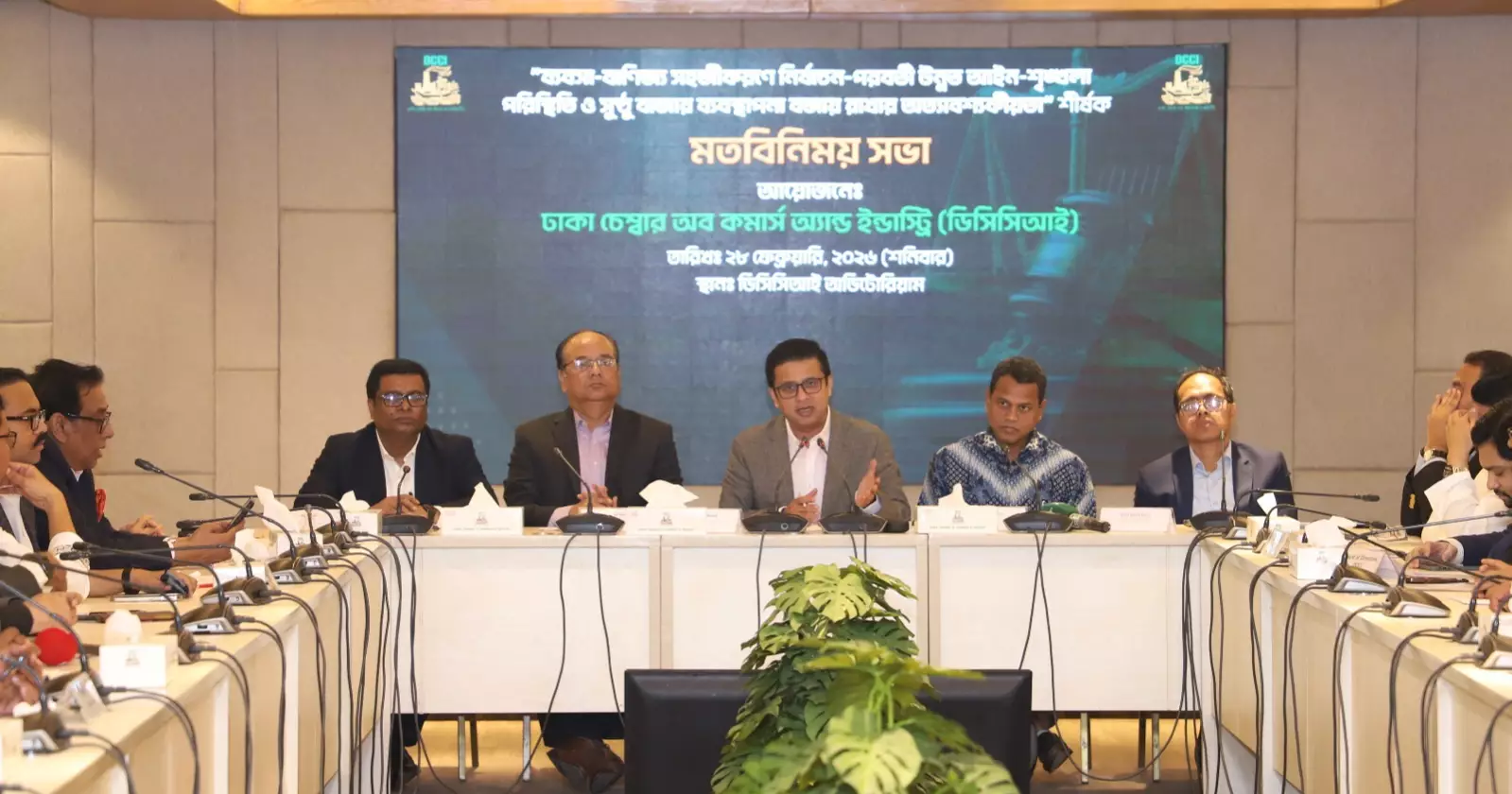
Business leaders on Saturday underscored that strengthening law and order, alongside coordinated market management, is essential for boosting trade, attracting investment and lowering the cost of doing business in the country.
The call came at a views-exchange meeting titled ‘Necessity of Maintaining an Improved Law & Order Situation to Facilitate the Ease of Doing Business’, organised by the Dhaka Chamber of Commerce & Industry (DCCI) at its auditorium in the city.
In his welcome address, DCCI President Taskeen Ahmed said the private sector has failed to achieve the desired progress in recent years due to contractionary monetary policy, deterioration in law and order, illegal extortion, corruption, administrative complexities and bureaucratic red-tapism.
He said there is no alternative to ensuring a safe and predictable environment for boosting trade and investment alongside macroeconomic stability.
Taskeen expressed hope that the newly elected government would prioritise trade and investment facilitation by improving law and order and strengthening coordination among the private sector, law enforcement agencies, policymakers and economic ministries.
Chairman of the Bangladesh Competition Commission AHM Ahsan said effective initiatives by both the government and private sector have brought visible stability to the market, particularly for essential commodities, during the current Ramadan.
He emphasised that proper coordination between supply and demand and ensuring accurate data on the use and distribution of essential goods are indispensable for sound market management.
Creating a business-friendly environment reduces institutional costs for entrepreneurs, which ultimately helps keep product prices stable, he added, urging closer cooperation with law enforcement agencies to maintain order.
FBCCI Administrator Md Abdur Rahim Khan said improving law and order and strengthening market management are prerequisites for smooth business operations.
He observed that sustained economic growth would contribute to strengthening the political system and law enforcement, thereby reducing activities outside the legal framework.
Abdur Rahim, however, stressed that prompt reform measures are needed to bring visible changes and restore public confidence.
Additional Secretary of the Ministry of Commerce Shibir Bicitro Barua said instability in law and order creates a crisis of confidence among businesses and discourages both local and foreign investment.
He pointed out that the ministry has taken initiatives to introduce the IPO Policy 2025–28 to further facilitate business and investment activities.
Abdul Jalil, Director of the Directorate of National Consumer Rights Protection, highlighted quality concerns in agricultural production, saying excessive use of fertilisers and pesticides in potatoes is hampering export prospects as products often fail to meet international standards.
He called for coordinated efforts among farmers, entrepreneurs and government agencies to address the issue.
Deputy Commissioner of Dhaka Metropolitan Police Mohammad Harun-or-Rashid said around 500,000 battery-operated auto-rickshaws have been added to Dhaka since the election, significantly worsening traffic congestion.
Rashid said police have undertaken several initiatives and expressed hope that visible improvements would be seen after Eid, and stressed the need for regulating import policies for related equipment and bring charging garages under proper monitoring.
He urged the public not to occupy footpaths and roads for setting up shops and assured that police would take the highest level of initiative to control extortion.
During the open discussion, business leaders identified traffic congestion and deterioration in law and order as two major concerns affecting trade and investment.
They called for a tolerable VAT and tax policy, stricter measures to curb extortion during product transportation, and improved traffic management to reduce operational costs.
Some participants also criticised limited import permissions for essential commodities, saying it creates syndicates and drives up prices. They suggested allowing more genuine business entities to import such goods.
DCCI Senior Vice President Razeev H Chowdhury, Vice President Md Salem Sulaiman and members of the board of directors were also present.