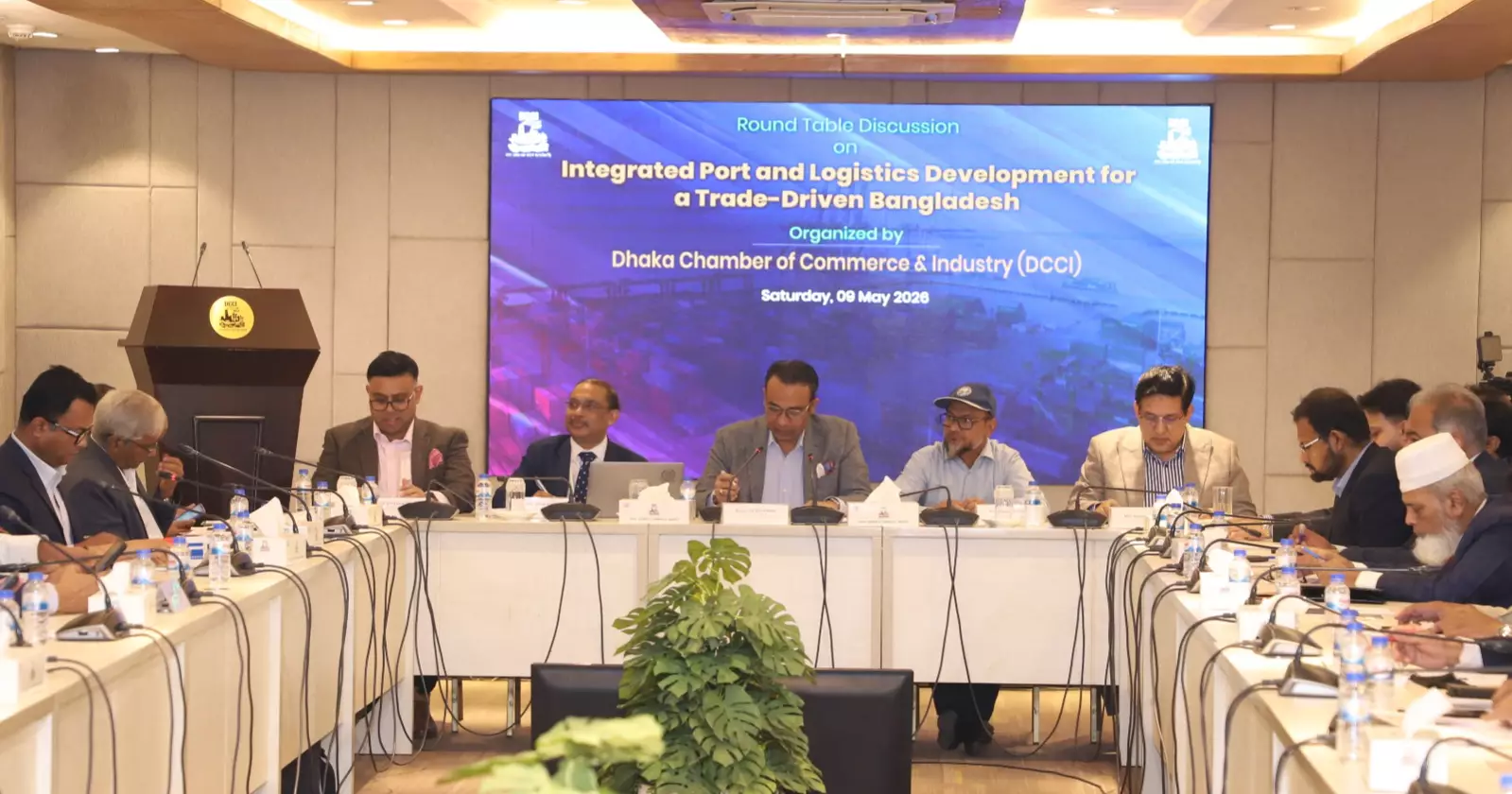
Bangladesh must urgently modernise its port infrastructure, overhaul trade facilitation systems and activate its dormant National Logistics Policy to remain competitive in global markets, a leading policy economist said on Saturday.
M. Masrur Reaz, Chairman and CEO of Policy Exchange Bangladesh, made the observations while presenting a keynote paper titled ‘Integrated Port and Logistics Development for a Trade-Driven Bangladesh’ at a roundtable organised by the Dhaka Chamber of Commerce and Industry (DCCI) at its Chamber Auditorium in Motijheel.
DCCI pushes for lower taxes, digitalisation in FY27 budget recommendations
Drawing on comparative data, Dr. Reaz warned that Bangladesh's overdependence on the readymade garments sector, which still accounts for 81.49 percent of total exports in FY2024-25, combined with a deteriorating logistics ecosystem, poses serious risks to the country's long-term economic resilience, particularly as it approaches LDC graduation.
“RMG exports have already declined 5.51 percent in July-March of FY2025-26,” he said, underscoring vulnerability in the country's narrow export base.
On the logistics front, Reaz presented a stark picture.
Bangladesh ranks 88th on the World Bank's Logistics Performance Index, far behind India at 38th and Vietnam at 43rd, while Chattogram Port sits at 356th on the Container Port Performance Index, compared to Haiphong at 30th. Container dwell times at Chattogram remain critically high, with vessel turnaround averaging 3.23 days against just 0.86 days at Colombo.
He said Chattogram Port handles 92 percent of the country's seaborne trade and 98 percent of container trade, yet operates under an outdated “tool port” model, relies heavily on manual processes, and has a draft depth of only 9.5 metres, insufficient for large vessels and forcing costly transshipment via third countries. Port tariffs have not been revised since 2008.
Citing World Bank research, Reaz said a 25 percent reduction in logistics costs could boost exports by 20 percent, while cutting container dwell time by just one day at Chattogram would increase exports by 7.4 percent.
He called for a comprehensive reform agenda built around eight priorities: activating and implementing the National Logistics Policy; transitioning to a landlord port model to attract private operators; fully operationalising the National Single Window for customs; accelerating the Matarbari Deep Sea Port and Bay Container Terminal projects; integrating road-rail-waterway multimodal networks; deploying AI and digital cargo tracking systems; revising the port tariff structure on a performance-linked basis; and strengthening regulatory safeguards for foreign investment in strategic infrastructure.
Reaz also referenced Bangladesh's strategic geographic potential, noting the country is positioned as a natural transit corridor for India, Bhutan, Nepal and China, with the World Bank estimating an additional $11 billion in South Asia trade potential yet to be tapped.
Referring to Korea's two-decade PPP port development experience, which mobilised $6.3 billion across 17 seaport projects and Vietnam's success with the Cai Mep–Thi Vai deep-water port cluster, he said private sector participation, backed by strong legal and regulatory frameworks, was indispensable for Bangladesh's port transformation.
“Successful PPPs require strong legal, institutional, and regulatory frameworks aligned with international best practices,” he said. “Without that foundation, neither the investment nor the operational excellence will follow.”
The proposed reforms align with the new government's manifesto commitments under Chapter 3, which envisages an integrated logistics hub centred on Chattogram and Mongla ports, multimodal transport integration, and strengthened digital customs systems.