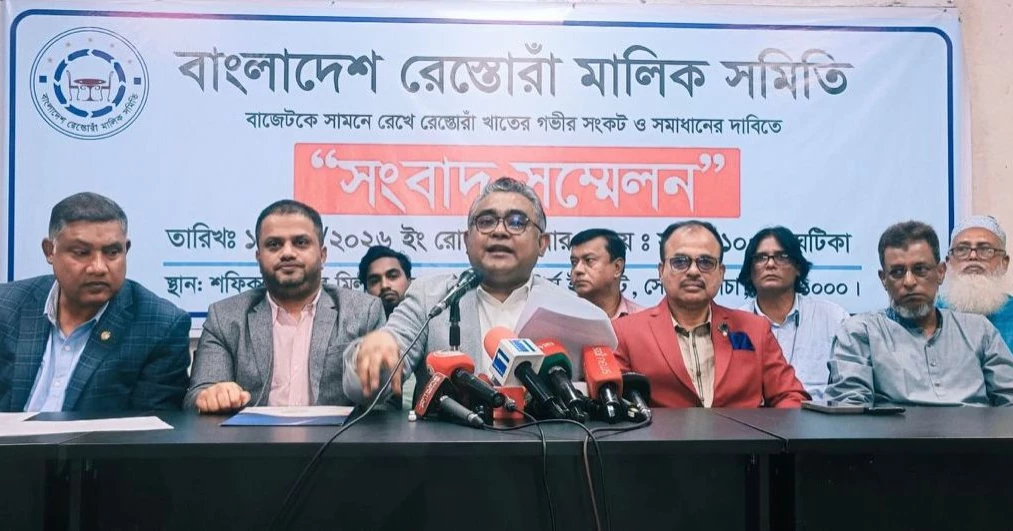
Restaurant owners in Bangladesh have urged the government to reduce Value-Added Tax (VAT), resume new pipeline gas connections and end ‘bureaucratic harassment’ by regulatory agencies to protect the industry from mounting economic instability.
Bangladesh Restaurant Owners Association (BROA) made the demand at a press conference held at Dhaka Reporters Unity (DRU) on Sunday, ahead of the national budget for the fiscal year 2026-27.
The association also placed an 11-point demand including maintaining VAT and tax rates at ‘tolerable levels’ and introducing a one-stop service for licenses and permits.
While the VAT on the sector was previously reduced from 15 percent to 5 percent following discussions with the National Board of Revenue (NBR), leaders claimed they are still struggling under a 10 percent supplementary duty, source taxes, and various other levies.
They called for a flat 5 percent VAT rate for canteens and catering services and the total withdrawal of source taxes.
"High tax rates discourage compliance and lead to evasion," said BROA Secretary General Imran Hasan. "Reducing rates while expanding the tax net would ultimately increase government revenue."
Hasan noted that the industry has yet to fully recover from the Covid-19 pandemic, with global instability and rising fuel costs further inflating operational expenses.
"The uncontrolled rise in commodity prices has pushed essential goods beyond consumers' purchasing power. Its direct and severe impact is now being felt across the restaurant sector," Hasan added.
The association also highlighted the energy crisis, noting that a shortage of Liquefied Petroleum Gas (LPG) has disrupted operations.
They urged the government to increase LPG imports and restart new pipeline gas connections to stabilise food prices.
The association also hit out at regulatory bodies including Rajuk, the Fire Service, and the Department of Environment accusing them of creating ‘bureaucratic complications’ and unnecessary pressure.
According to BROA, opening a restaurant currently requires 10 to 12 different approvals, a process that can take up to six months.
Hasan argued that these hurdles are forcing many into ‘systematic’ non-compliance.
Other key demands include reopening trade license services under the two Dhaka city corporations, permitting beef imports to lower costs, preventing ‘corporate aggression’ within the sector, and launching government-supported training programs for unskilled workers.
The association also revealed that approximately 80 percent of restaurants in the country remain unregistered, often operating without proper hygiene standards or tax contributions.