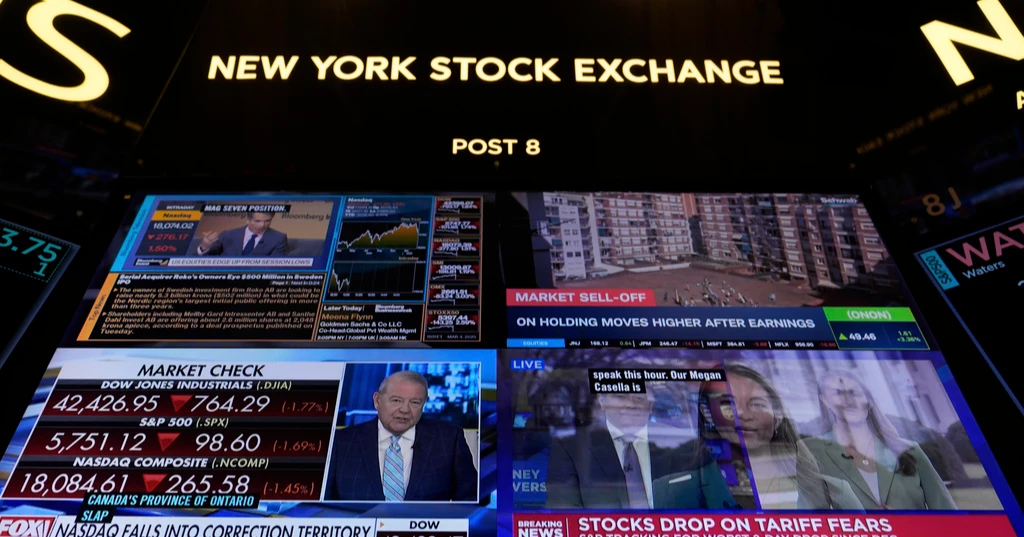
The U.S. stock market's downturn deepened on Monday as Wall Street speculated on how much economic strain President Donald Trump is willing to endure through tariffs and other policies to achieve his objectives.
The S&P 500 fell 2.7%, bringing it nearly 9% below its all-time high set just last month. At one point, it was down 3.6%, heading for its worst day since 2022—when soaring inflation strained budgets and fuelled concerns about a recession that ultimately did not materialise.
Bangladesh Bank halts exchange of new notes for Eid
The Dow Jones Industrial Average dropped 890 points, or 2.1%, after recovering from an earlier loss of over 1,100 points, while the Nasdaq composite tumbled 4%.
This marked the worst day yet in a volatile period where the S&P 500 has fluctuated by more than 1% in seven of the past eight sessions due to Trump's unpredictable tariff policies. The concern is that these sharp swings could either directly harm the economy or create enough uncertainty to push U.S. companies and consumers into economic stagnation.
Signs of economic weakening have already emerged, primarily through surveys reflecting growing pessimism. Additionally, a widely monitored set of real-time indicators compiled by the Federal Reserve Bank of Atlanta suggests the U.S. economy may already be contracting.
Asked over the weekend whether he foresaw a recession in 2025, Trump told Fox News Channel: "I hate to predict things like that. There is a period of transition because what we’re doing is very big. We’re bringing wealth back to America. That’s a big thing." He then added, "It takes a little time. It takes a little time."
Trump aims to bring manufacturing jobs back to the U.S., citing this as one of the reasons for his tariff policies. His Treasury Secretary, Scott Bessent, has also indicated that the economy may undergo a "detox" period as it adjusts to reduced government spending. The White House is seeking to curb federal expenditures, cut the federal workforce, and increase deportations—moves that could impact the labour market.
For now, the U.S. job market remains stable, and the economy ended last year on solid footing. However, economists are lowering their growth projections for this year.
Goldman Sachs' David Mericle, for example, has reduced his estimate for U.S. economic growth in 2025 from 2.2% to 1.7%, largely due to the expectation that tariffs will be more extensive than previously forecasted.
He sees a one-in-five chance of a recession within the next year, raising the probability only slightly because "the White House has the option to pull back policy changes" if economic risks "begin to look more serious."
"Multiple forces are always at play in the market, but right now, almost all of them are secondary to tariffs," said Chris Larkin, managing director for trading and investing at E-Trade from Morgan Stanley.
In response to the market decline, White House spokesman Kush Desai pointed out that numerous companies have responded to Trump's "America First" economic agenda with "trillions in investment commitments that will create thousands of jobs."
On Monday, Trump met with tech industry CEOs, though the meeting was closed to the media.
Remittance inflow surges amid forex reserve crisis
The turbulence on Wall Street has been particularly damaging to some of its biggest players. Big Tech stocks and firms that benefited from the recent artificial intelligence boom have experienced sharp declines.
Nvidia dropped another 5.1% on Monday, bringing its year-to-date loss to over 20%—a stark contrast to its nearly 820% surge over 2023 and 2024.
Elon Musk's Tesla plummeted 15.4%, extending its 2025 decline to 45%. Initially, Tesla saw a post-election boost due to expectations that Musk's close ties with Trump would benefit the company. However, the stock has since slumped amid concerns that Musk’s brand has become too closely linked with the administration. Protests against the U.S. government's workforce reduction efforts and other policies have even targeted Tesla dealerships.
Companies reliant on strong consumer confidence also took significant hits. Cruise operator Carnival fell 7.6%, while United Airlines dropped 6.3%.
The sell-off has not been limited to stocks. Investors have also pulled back from other assets that previously seemed unstoppable, such as bitcoin. The cryptocurrency's value has fallen below $80,000, down from over $106,000 in December.
Instead, investors have sought refuge in U.S. Treasury bonds, which are perceived as more stable during economic uncertainty. This has driven Treasury prices sharply higher, pushing down their yields.
The yield on the 10-year Treasury fell again to 4.22% from 4.32% on Friday. Since January, when it neared 4.80%, yields have steadily declined as economic concerns have mounted—a significant shift for the bond market.
Despite the uncertainty, Wall Street dealmaking has continued. Redfin's stock soared 67.9% after Rocket announced it would acquire the digital real estate brokerage in an all-stock deal valued at $1.75 billion. However, Rocket's stock fell 15.3%.
ServiceNow declined 7.9% after the AI platform company revealed plans to acquire AI-assistant maker Moveworks for $2.85 billion in cash and stock.
Overall, the S&P 500 lost 155.64 points to close at 5,614.56. The Dow Jones Industrial Average dropped 890.01 points to 41,911.71, while the Nasdaq composite fell 727.90 points to 17,468.32.
Global markets also felt the impact, with European indexes largely declining after a mixed session in Asia.
Hong Kong’s index dropped 1.8%, and Shanghai’s edged down 0.2% after China reported a decline in consumer prices for the first time in 13 months. This was the latest sign of weakness in the world’s second-largest economy, where persistently weak demand was compounded by the early timing of the Lunar New Year holiday.