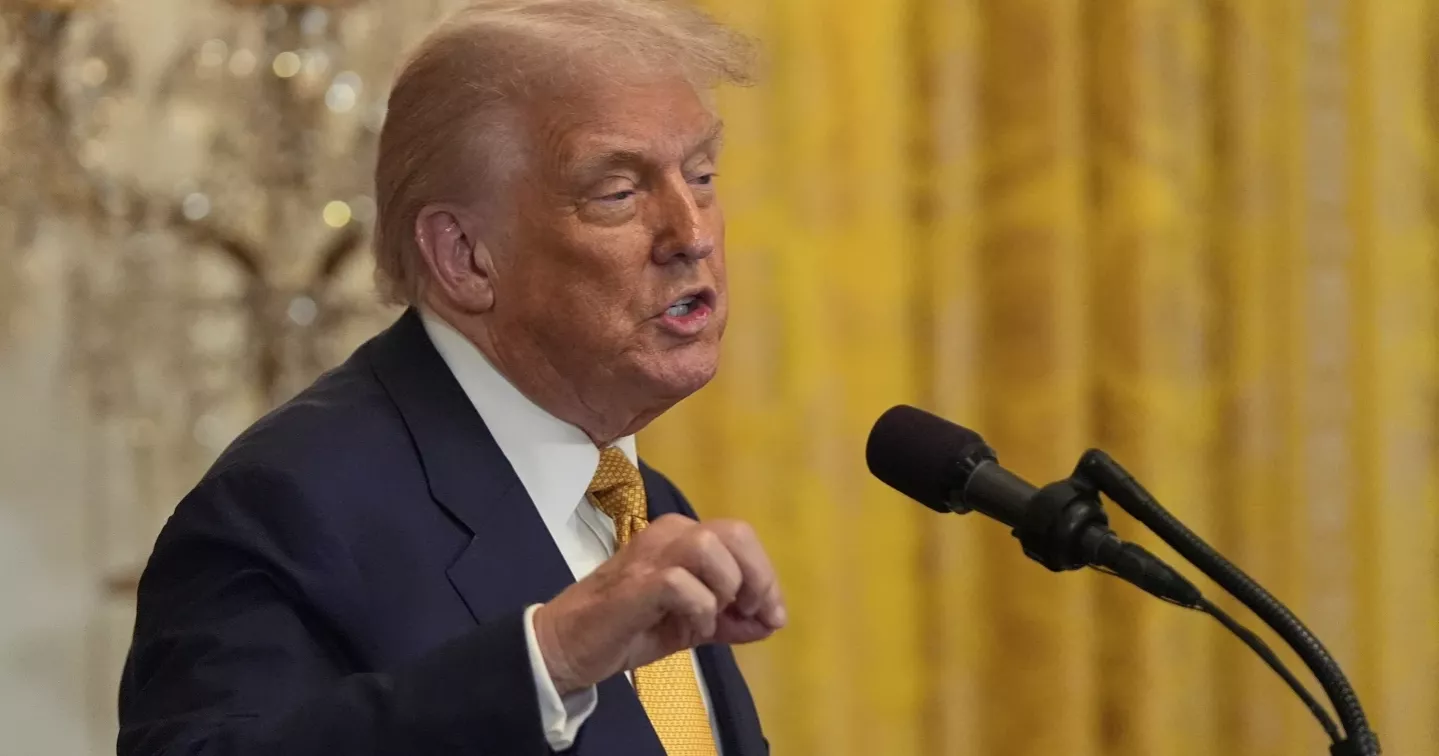
President Donald Trump on Tuesday unveiled a new trade framework with Japan that imposes a 15% tariff on imported Japanese goods, down from the previously threatened 25% rate set to take effect on August 1.
Calling it a landmark agreement, Trump wrote on Truth Social: “This Deal will create Hundreds of Thousands of Jobs — There has never been anything like it.” He also emphasized the strong U.S.-Japan relationship, saying the United States “will continue to always have a great relationship with the Country of Japan.”
Under the deal, Trump said Japan would invest $550 billion into the U.S. “at my direction” and open its market to American automobiles and rice. Japanese Prime Minister Shigeru Ishiba acknowledged the agreement early Wednesday, saying it would benefit both countries and strengthen economic cooperation.
The announcement marks another attempt by Trump to showcase his negotiating skills, especially after earlier tariff threats led to financial market volatility and concerns about slowed economic growth. However, the White House has yet to clarify if Japanese-built cars would still be subject to the steeper 25% tariff imposed on that sector.
Faraday future unveils two world-first products, advanced tech architecture in LA
The administration continues to frame tariffs as a tool to rebalance trade and boost domestic manufacturing. Officials argue that the revenue will reduce the budget deficit and incentivize companies to move factories back to the United States.
But the tariffs have also triggered uncertainty. On Tuesday, General Motors reported a 35% drop in second-quarter net income and warned of further disruptions due to tariffs — news that caused its stock to fall sharply.
Alongside the Japan deal, Trump announced a similar trade framework with the Philippines, which includes a 19% tariff on its exports to the U.S., while American goods would face no import tax. He also reaffirmed a 19% tariff on Indonesian imports.
In 2024, the U.S. reported a $69.4 billion trade imbalance with Japan, $17.9 billion with Indonesia, and $4.9 billion with the Philippines, according to the U.S. Census Bureau.
With the August 1 tariff deadline approaching, Trump also revealed that the European Union would be sending representatives to Washington for trade discussions. He previously warned the 27-member bloc of a 30% tariff on EU goods if no agreement is reached.
Meanwhile, negotiations with China continue, with Treasury Secretary Scott Bessent scheduled to meet Chinese officials in Stockholm early next week. The U.S. currently imposes a 30% baseline tariff on Chinese goods.
Trump administration limits Mexican flights, threatens Delta-Aeromexico alliance amid trade dispute
“President Trump is remaking the U.S. into a manufacturing economy,” Bessent said on Fox Business. “If we can get China to consume more while we manufacture more, it would be a home run for the global economy.”
Source: Agency