Wall Street was poised for losses before Wednesday’s opening bell as investors awaited President Donald Trump’s disclosure of the latest round of U.S. tariffs on trade partners.
Futures for the S&P 500 fell by 0.6%, while Dow Jones Industrial Average futures declined by 0.5%. Nasdaq futures, already in correction territory due to the heavy presence of major technology firms, dropped a further 0.7%.
Trump set to announce 'reciprocal' tariffs in a risky move that could reshape the economy
Every sector in the S&P was in negative territory except for consumer staples. The hardest-hit sectors included autos, transportation, industrials, and technology.
Trump’s new tariffs—set to be unveiled on what he has dubbed “Liberation Day”—aim to revive U.S. manufacturing while penalising countries he accuses of engaging in unfair trade practices for years. However, most economists believe these tariffs could push the economy into a recession and strain longstanding alliances.
The reciprocal tariffs Trump is set to introduce follow previous measures, including 25% duties on auto imports, levies against China, Canada, and Mexico, and expanded tariffs on steel and aluminium. He has also imposed tariffs on countries importing oil from Venezuela and plans to implement separate import taxes on pharmaceutical drugs, lumber, copper, and computer chips.
Markets have been highly volatile in recent weeks, with momentum shifting frequently due to uncertainty surrounding Trump’s tariffs and concerns over their impact on inflation and economic growth.
Gold, traditionally a safe haven in uncertain times, has been trading at record highs, continuing that trend on Wednesday.
Even before Trump’s latest tariff announcement, businesses have already been feeling the effects of his trade policies, and markets have experienced weeks of turbulence.
"With uncertainty around tariff details, risk sentiment remained broadly fragile," Tan Jing Yi of Mizuho Bank commented.
Even if the announced tariffs are less severe than expected, the unpredictable manner in which Trump has introduced his trade policies could still generate enough uncertainty to cause American consumers and businesses to cut back on spending, potentially harming the economy.
Meanwhile, European markets saw declines by midday, with France’s CAC 40 dropping 0.7%, Germany’s DAX falling nearly 1.3%, and Britain’s FTSE 100 sliding 0.6%.
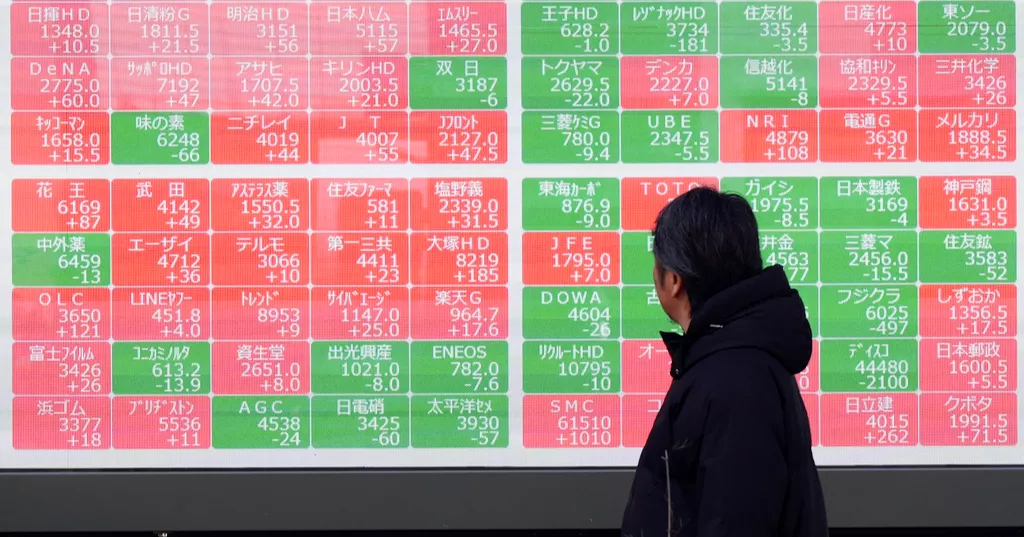
In Asia, Japan’s Nikkei 225 edged up 0.3% to close at 35,725.87.
Asian stocks rebound after Wall Street gains amid tariff concerns
Hong Kong’s Hang Seng remained nearly unchanged at 23,202.53, while the Shanghai Composite rose by less than 0.1% to 3,350.13.
Australia’s S&P/ASX 200 gained 0.1% to reach 7,934.50, while South Korea’s Kospi slipped 0.6% to 2,505.86.