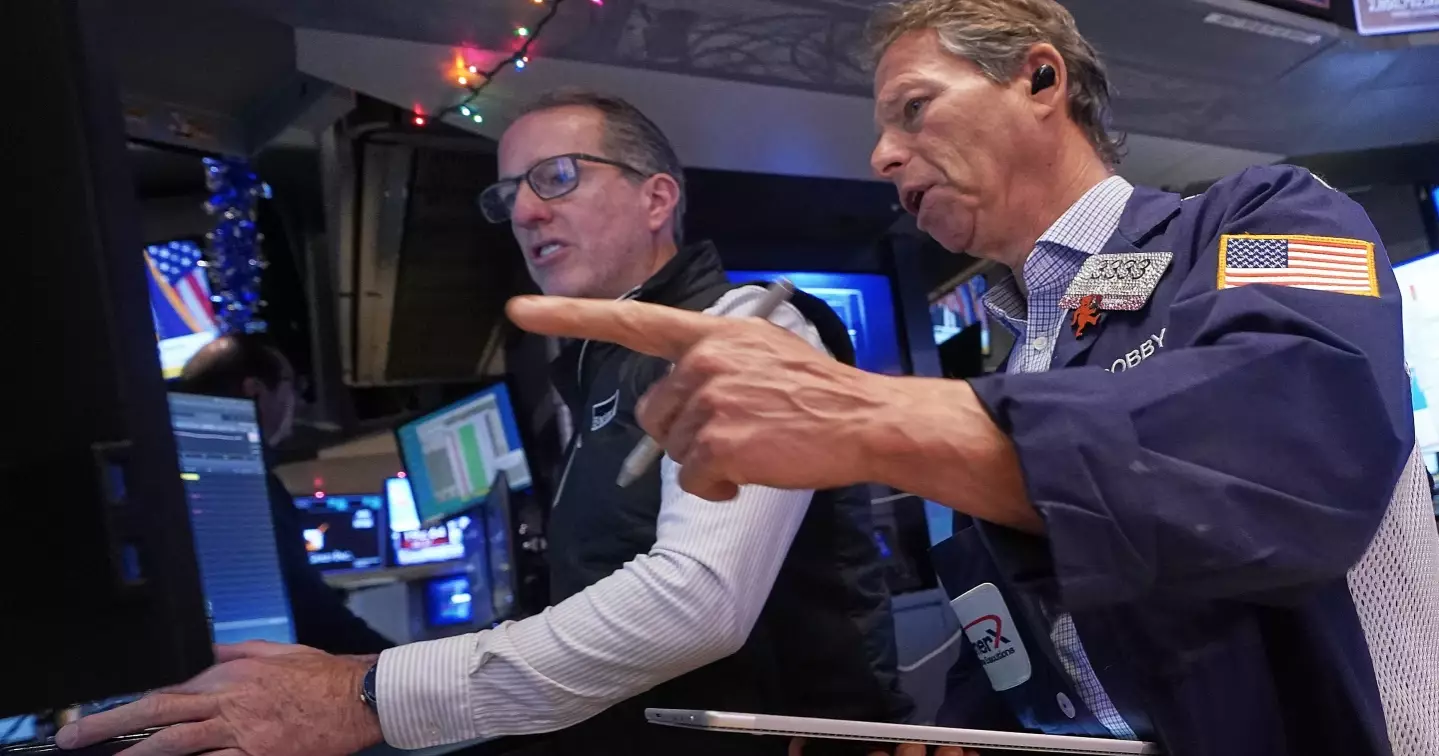
Wall Street drifted lower in light trading early Wednesday as investors prepared for the final opening bell of 2025, heading toward a fourth straight day of losses after a year marked by strong gains alongside lingering uncertainty.
Futures for the S&P 500 and the Dow Jones Industrial Average each eased 0.1 percent, while Nasdaq futures fell 0.2 percent. Trading was expected to remain muted as most institutional investors have already wrapped up their positions for the year. US markets will remain closed on Thursday for New Year’s Day.
Despite the late-year softness, 2025 proved to be a banner year for equities. The S&P 500 is up more than 17 percent for the year, driven largely by enthusiasm around artificial intelligence and its potential to transform multiple sectors of the economy.
That enthusiasm, however, has also fueled concerns. Investors worry that artificial intelligence may not generate enough profits and productivity gains to justify the massive investments poured into the sector. Such doubts have kept pressure on leading AI-related stocks such as Nvidia and Broadcom, which accounted for a large share of this year’s market gains.
Valuation concerns extend beyond AI. Many analysts argue that stocks across the broader market remain expensive, as share prices have risen faster than corporate profits.
Adding to investor caution is the continued impact of a wide-ranging, US-led trade war, which threatens to push inflation higher. Although the Federal Reserve cut its benchmark interest rate three times toward the end of the year, inflation remains well above the central bank’s 2 percent target.
The Fed has said the rate cuts were partly motivated by concerns over a softening labor market. Later Wednesday, the Labor Department is set to release its latest weekly data on jobless claims, a closely watched indicator of layoffs.
Minutes from the Fed’s December meeting showed divisions among policymakers and highlighted uncertainty over economic risks ahead. Markets are widely expecting the central bank to keep interest rates unchanged at its January meeting.
Sung Won Sohn, a professor of finance and economics at Loyola Marymount University, said global markets are facing growing uncertainty due to inflation pressures, labor shortages and questions about the future path of interest rates.
He said central banks need to move cautiously and warned that financial markets are likely to remain volatile as expectations continue to shift.
In commodities trading, precious metals remained volatile. Silver fell sharply, giving up more than 8 percent early Wednesday after posting double-digit gains a day earlier. Despite the swings, silver is still up more than 140 percent this year. Gold slipped 1.5 percent but remains up about 66 percent in 2025.
In global markets, trading was closed in Germany, Japan and South Korea for New Year holidays. Elsewhere, France’s CAC 40 fell 0.5 percent and Britain’s FTSE 100 lost 0.2 percent.
In Asia, Hong Kong’s Hang Seng index dropped 0.9 percent, while China’s Shanghai Composite edged up 0.1 percent. Taiwan’s Taiex gained 0.9 percent and Australia’s S&P/ASX 200 dipped slightly.
In energy markets, US crude oil rose 31 cents to $58.26 a barrel, while Brent crude added 28 cents to $61.61. Even so, oil prices remain sharply lower for the year, with crude down about 19 percent since January. US gasoline prices have also fallen by around 6 to 7 percent nationwide.