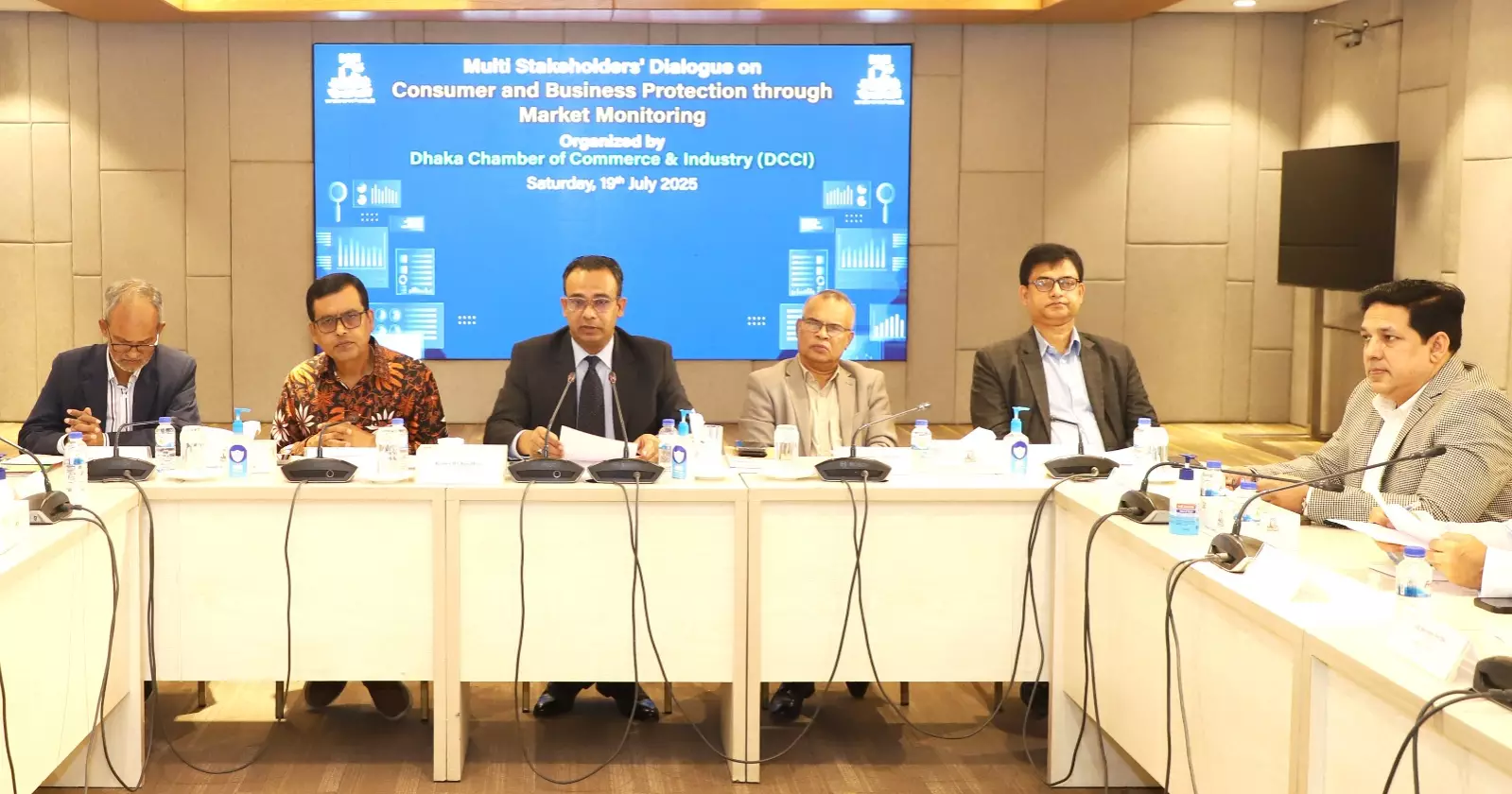
Speakers at a stakeholder dialogue said that unrestrained extortion in the transportation sector and a lack of effective market surveillance are the main reasons behind rising prices of essential commodities in local markets.
They said this while speaking at a dialogue titled "Protecting Consumer and Business Interests Through Effective Market Monitoring," organized by the Dhaka Chamber of Commerce & Industry (DCCI) on Saturday.
Speakers highlighted several key factors of influence in prices, including artificial shortages, substandard products, insecure transportation, complex import procedures, insufficient storage facilities, and a lack of competition in product management.
They further noted that the absence of effective market surveillance, the prevalence of middlemen, extortion, insecurity, and a lack of coordination among regulatory bodies are the primary causes of market instability.
Vegetable prices soar in Khulna’s post-Eid markets
Rajib H. Chowdhury, Acting President of DCCI, said that the soaring prices of daily necessities pose a significant challenge for both consumers and honest businesses.
He identified artificial scarcity, low-quality goods, complex import processes, a lack of competition, and administrative inefficiencies as factors contributing to disarray in the market system.
Rajib called for the establishment of a coordinated, accountable, and effective market monitoring framework.
Mohammad Alim Akter Khan, Director General of the National Consumer Rights Protection Directorate, revealed that due to a severe shortage of personnel, their operations are limited to only 19 of the 64 districts, which is insufficient for effective market oversight.
He underscored the importance of legal coordination, policy transparency, and increased public engagement.
Md. Shahjahan Mia, Administrator of Dhaka South City Corporation, attributed the high prices of essential goods, particularly, to the influence of middlemen in product transportation and market management.
Adviser Farida emphasises national policy for fair milk prices
He lamented that the reputation of the vast private sector is being tarnished by a small number of dishonest traders, urging honest businesspeople at all levels to step forward and curb these illicit activities.
Professor Dr. Mohammad Shoaib, Member (Food Industry & Production) of the Bangladesh Food Safety Authority, stated that while regular operations are conducted to ensure food quality, a more robust market monitoring system, leveraging technology and improved coordination, is crucial.
Dr. Md. Akhtaruzzaman Talukder, Member of the Bangladesh Competition Commission, asserted that a lack of fair competition in the market leads to increased prices and irregularities.
He suggested that research and data-driven planning would be instrumental in addressing these issues.
Industry Voices
The dialogue also featured insights from Mohammad Golam Mawla, General Secretary of Moulvibazar Traders Association; Khandaker Monir Ahmed of the Poultry Industries Association, Abul Hashem of the Sugar and Oil Traders Association, and Md. Zakir Hossain of the Supermarket Owners Association and Mirza Golam Sarwar from the Patents and Trademarks Department.
Fuel prices to remain unchanged in July
They collectively pointed to a shortage of storage facilities, import complexities, excessive profit-taking at the retail level, the closure of government sugar mills, and the absence of fair pricing mechanisms as factors contributing to market instability.