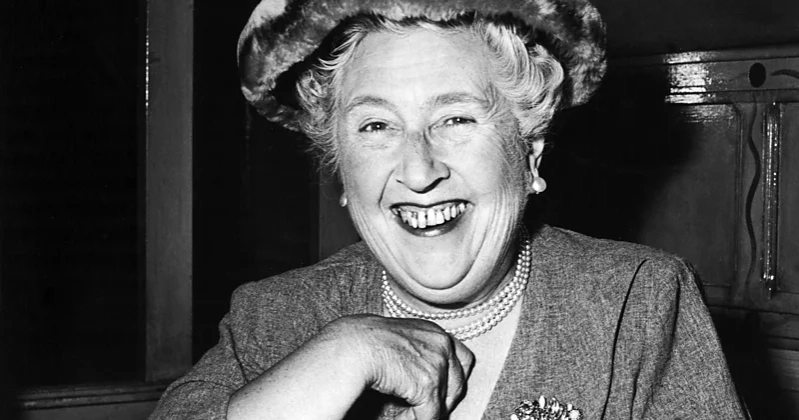
A rare BBC radio interview from 1955 offers fresh insights into the life, career, and creative process of celebrated British crime novelist Agatha Christie, whose works have captivated readers for more than a century.
The interview, recorded more than 50 years ago, captures the reclusive author discussing her unconventional upbringing, inspirations, and distinctive approach to writing.
Born Agatha Miller in 1890 to a prosperous family, Christie was mostly home-schooled and described her childhood as “gloriously idle.” In the interview, she said that periods of boredom sparked her imagination, leading her to write short stories and a lengthy early novel before publishing her first major work, The Mysterious Affair at Styles, in 1920, which introduced her iconic detective Hercule Poirot. Her experience as a volunteer nurse during World War One, including work in a hospital pharmacy, provided her with knowledge of medicines and toxins, which she later used in 41 murders, attempted murders, and suicides across her novels.
Christie explained that while her novels followed a typical formula—a closed circle of suspects, a murder, clues, and a private detective revealing the truth—her plays allowed her more creative freedom. She noted that writing plays was “much more fun than writing books,” as it avoided lengthy descriptions and demanded faster pacing to maintain dialogue flow. Three of her plays were running simultaneously in London’s West End by 1955, including The Mousetrap, which became the world’s longest-running play.
The interview also explored her personal challenges. In 1926, after the death of her mother and her husband Archie Christie’s confession of infidelity, she disappeared for ten days in a widely publicised incident. Found 230 miles from the site of her car crash in Harrogate, North Yorkshire, Christie never fully explained the episode, attributing it vaguely to “illness, sorrow, despair, and heartbreak.”
Christie later married archaeologist Max Mallowan in 1930, whose shared interest in Middle Eastern history influenced novels such as Death on the Nile (1937). She revealed that while thinking through plot development required careful mental planning, the actual writing of a novel could be completed in three months if uninterrupted. Theatre impresario Sir Peter Saunders, who produced her hit play The Mousetrap, described her talent for mentally visualising entire scenes before writing, a view echoed by Penguin Books founder Sir Allan Lane. Actor Richard Attenborough highlighted the contrast between her quiet, dignified persona and her ability to enthrall audiences with suspense and drama on stage and screen.
The BBC interview underscores Christie’s reliance on imagination over rigid technique, her joy in devising intricate plots, and her enduring legacy as one of the world’s most ingenious and enigmatic crime writers.