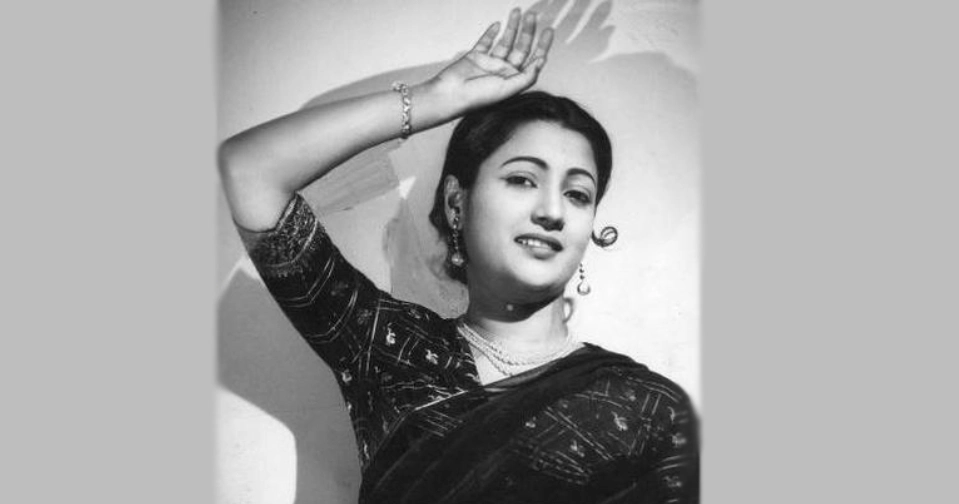
The haunting melody of “Tumi je amar…” from Harano Sur still lingers in the hearts of generations, evoking a time when Bengali cinema was defined by quiet intensity, emotional depth and timeless romance.
At the centre of that golden era stood Suchitra Sen- the legendary actress whose grace, silence and expressive eyes made her one of the most enduring icons of South Asian cinema.
Yet her journey did not begin in the world of glamour. It began in the modest surroundings of Pabna, where she was born as Roma Dasgupta on April 6, 1931, into a middle-class family.
Coke Studio Bangla concludes Season 3 with Runa Laila’s iconic ‘Mast Qalandar’
Her father was a schoolteacher and her mother a homemaker, and her early life was shaped far from the spotlight she would one day command.
A modest beginning, a quiet transformation
After her family moved to Kolkata, her life gradually took a new turn.
Married at a young age, she entered the film industry with little expectation of immediate success. Her early films went largely unnoticed, but she continued to refine her craft with patience and discipline.
Her breakthrough came in the 1950s, when her natural screen presence and emotional restraint began to set her apart.
A legendary pairing that defined an era
Her on-screen partnership with Uttam Kumar created one of the most celebrated pairings in Indian cinema history.
Together, they delivered unforgettable classics such as Harano Sur, Saptapadi and Deep Jwele Jai—films that transcended entertainment to become cultural milestones.
From Sharey Chuattor (1953) to Priyo Bandhabi (1975), their collaboration defined a golden chapter in Bengali cinema.
The power of restraint and silence
What distinguished Suchitra Sen was her extraordinary control over expression.
She rarely relied on dramatic gestures. Instead, her eyes, pauses and subtle emotions conveyed deeper psychological layers.
In Deep Jwele Jai, she delivered one of her most powerful performances as a nurse torn between duty and emotional exhaustion.
In Saptapadi, she portrayed a modern, self-assured woman navigating love and societal barriers—an unusually progressive character for its time.
Her role in Saat Pake Bandha brought her international acclaim, including a Silver Award at the Moscow International Film Festival, establishing her reputation beyond regional cinema.
She also left a lasting mark in Hindi cinema with Aandhi where she played a politically ambitious woman whose personal and public lives collide in complex ways.
The mystery of withdrawal
At the height of her career, Suchitra Sen made a decision that deepened her legend—she withdrew completely from public life. She stopped attending events, avoided the media and retreated into near-total seclusion for decades.
An eternal presence
Though she is no longer alive, Suchitra Sen remains vividly present in cinematic memory. Her films continue to be revisited, her performances studied, and her persona admired for its rare combination of elegance and mystery.
From a quiet town in Pabna to the pinnacle of cinematic greatness, her journey reflects not just fame, but artistic integrity and individuality.
She was not merely a star. She was an era.