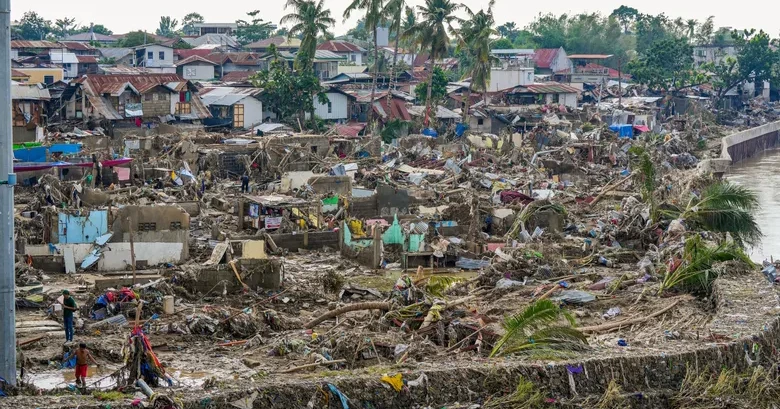
Super Typhoon Fung-wong, the strongest storm to threaten the Philippines this year, began lashing the country’s northeastern coast Sunday, knocking out power and forcing mass evacuations just days after another deadly storm killed more than 200 people.
With a massive 1,600-kilometer-wide band of rain and wind, Fung-wong—locally known as Uwan—is expected to impact nearly two-thirds of the country as it approaches from the Pacific. The typhoon comes as the nation is still reeling from Typhoon Kalmaegi, which left at least 204 people dead earlier in the week before moving on to Vietnam, where five more were killed.
President Ferdinand Marcos Jr. declared a state of emergency due to the devastation caused by Kalmaegi and the looming threat from Fung-wong.
According to the state weather bureau, Fung-wong was packing sustained winds of up to 185 kph (115 mph) and gusts of up to 230 kph (143 mph) Sunday morning. It was located about 125 kilometers (78 miles) northeast of Virac in Catanduanes province and is forecast to make landfall late Sunday or early Monday in Aurora or Isabela province.
Defense Secretary Gilberto Teodoro Jr. warned that the super typhoon could have “catastrophic” effects across a vast area, including Cebu—the region worst hit by Kalmaegi—and Metro Manila, the nation’s capital and financial hub.
Teodoro urged residents in high-risk zones to evacuate before it’s too late. “When it’s already raining or the typhoon has hit and flooding has started, it’s hard to rescue people,” he said in a televised address.
Deadly Typhoon Kalmaegi leaves Philippines reeling, heads toward Vietnam
The government has not yet requested international aid, but Teodoro said both the United States and Japan are ready to assist if needed.
Officials reported power outages in several eastern towns, while more than 50,000 families have been evacuated from vulnerable coastal and low-lying areas in the Bicol region. Schools and most government offices in northern provinces have been ordered closed on Monday.
More than 6,600 commuters and cargo workers were stranded at 86 seaports after the coast guard suspended ferry and cargo services due to dangerous seas. Several domestic flights were also canceled.
The Philippines, located in the Pacific “Ring of Fire,” is struck by about 20 tropical cyclones each year and faces frequent earthquakes and volcanic eruptions, making it one of the world’s most disaster-prone countries.
Source: AP