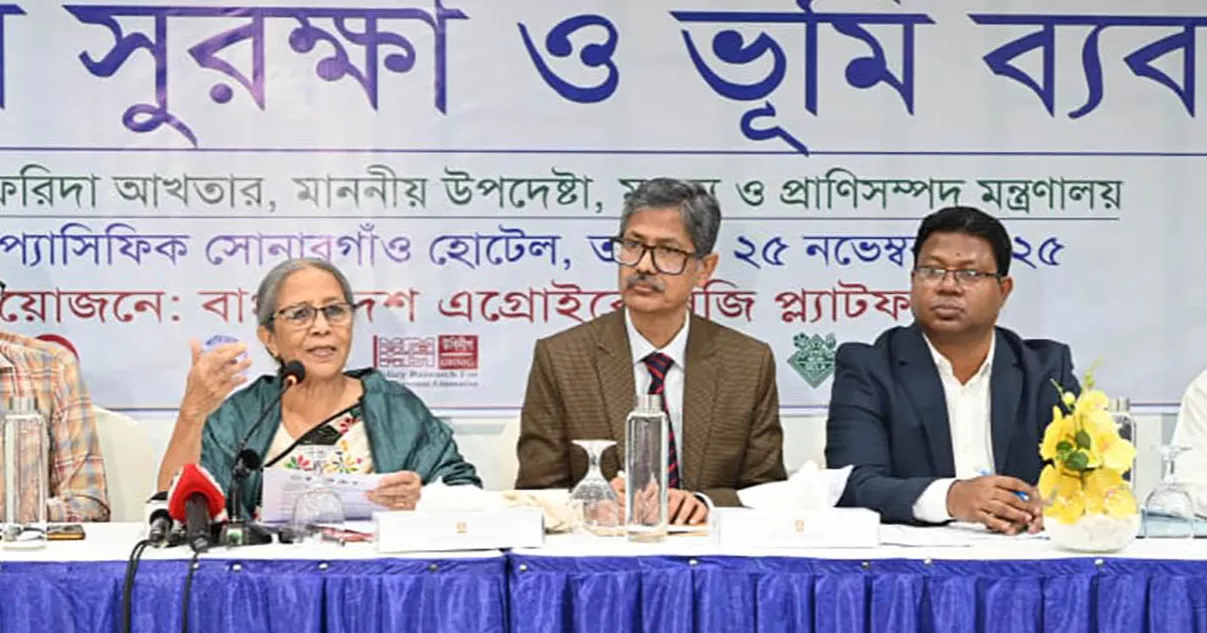
Bangladesh’s farmland is rapidly shrinking as unplanned urban and industrial expansion, coupled with climate-driven pests, diseases and declining soil fertility, continues to erode nearly 80,000 hectares of arable land each year.
Addressing a workshop titled ‘Protection of Agricultural Land and Land Use’ at a city hotel, the adviser said the workshop, organised by the Bangladesh Agroecology Platform, stressed the urgent need for safeguarding farmland from further depletion.
Farida said climate change is introducing new pests and diseases, while chemical-based farming is degrading soil fertility and affecting overall agricultural productivity.
“In the past, one, two, or even three crops could be cultivated on the same land, but modern farming methods and increasing pressures make diverse crop cultivation increasingly difficult,” she said.
Highlighting misuse of herbicides and pesticides, the adviser said domestic fish production has increased through farming, but it cannot remain the sole source.
Previously, 60 percent of Bangladesh’s fish came from open water bodies and 40 percent from aquaculture; today, the situation is reversed, she warned.
Farida said pollution, land reclamation and unregulated tourism in open water bodies are destroying fish breeding and movement areas, threatening long-term biodiversity and fishery resources.
Speakers highlighted that agriculture still contributes 11 percent to the national GDP and remains the primary livelihood for most rural people.
Out of 8.82 million hectares of arable land, nearly 80,000 hectares are being lost each year due to urbanization, industrialization, and unplanned development, they said.
Land grabbing, privatisation, chemical use and climate change are major threats to farmland. Participants emphasized the need for effective implementation of proposed government laws to protect agricultural land.
Jahangir Alam Jony, director of Development Alternative Policy Research Institute (UBINIG), chaired the event while Bangladesh Krishok Federation President Md. Badrul Alam presented the keynote paper.