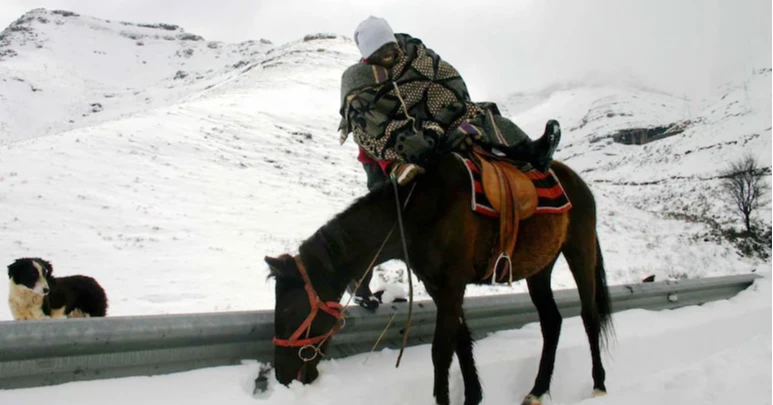
When people think of Africa, images of heat, savannas and wildlife often dominate imagination. But tucked away in southern Africa is a rare exception— Lesotho, a high-altitude, landlocked country entirely surrounded by South Africa.
Often called the “Kingdom in the Sky,” Lesotho stands out as the only country in Africa where all land lies above 1,000 metres, making it the continent’s coldest nation.
Snowfall and freezing temperatures are common between May and August, particularly in the Maluti Mountains, where winter temperatures can drop below minus 10 degrees Celsius. In some high-altitude areas, snow and ice are frequent, allowing for rare winter sports like skiing and snowboarding on the continent.
Historically, the region was inhabited by Khoisan-speaking hunter-gatherers before the Sotho people unified the territory under King Moshoeshoe I in the early 19th century. Lesotho later became a British protectorate and gained independence in 1966.
Since then, the country has faced political instability, economic challenges and persistent poverty, with heavy reliance on neighbouring South Africa for trade and access to global markets.
Despite its challenges, Lesotho has pursued modernisation efforts since the 1990s. Tourism and diamond mining have emerged as key economic sectors, while the capital Maseru has expanded as an urban centre. The country is one of only three in the world, along with Vatican City and San Marino, that is completely surrounded by another nation.
The country experiences a seasonal climate, with most rainfall between October and April. Weather conditions vary sharply with altitude, with summer highs reaching around 32°C in lowlands, while winter temperatures in highland areas can fall below minus 18°C. Frost is widespread, and the Maluti Mountains are often snow-covered in winter.
Its landscape is largely dominated by grasslands and mountains, though overgrazing and soil erosion have damaged natural vegetation in many areas. Conservation efforts, including reforestation, have had limited success so far.
Wildlife populations have also declined significantly over time due to hunting and habitat loss. Large species such as lions, zebras and wildebeests have disappeared, though smaller animals like antelopes, hares and hyraxes still exist. Protected areas such as Sehlabathebe National Park preserve endangered species including the bearded vulture and mountain reedbuck.
Lesotho’s population is predominantly Basotho, a group with strong cultural unity rooted in the legacy of King Moshoeshoe I. Smaller communities include Zulu-origin groups, people of mixed or Asian heritage, and a limited number of expatriates.
The country has also gained global cultural recognition. Its dramatic mountain scenery and cultural elements, including the traditional Basotho blanket, influenced the design of the fictional African kingdom Wakanda in Marvel’s Black Panther. The film’s costume designers drew inspiration from Lesotho’s landscape and clothing traditions to shape its visual identity.
Tourism is further boosted by Afriski Mountain Resort, one of only two ski resorts in sub-Saharan Africa. Located at around 3,050 metres in the Maluti Mountains, it offers skiing and snowboarding between June and August, along with year-round adventure activities such as mountain biking, hiking and trail running.
With its snow-covered peaks, unique geography and rich cultural identity, Lesotho remains one of Africa’s most unusual destinations, challenging common perceptions of the continent while continuing to attract global attention.
#From NDTV